17-year cicadas to emerge in May
AGRICUTLURAL RESEARCH SERVICE
Nodaway County is among the locations in western Missouri expected to witness emergence of 17-year cicadas sometime this month. Periodical cicadas pose no threat to people and a minimal threat to trees, but do set the outdoors abuzz with sound. In order to attract females, male cicadas rapidly flex two drum-like structures in their abdomens known as tymbals. The flexing produces a click, and the clicks come so fast they create a continuous, rasping hum.
For 17 years a brood of “periodical” cicada nymph has been tunneling through the soil, sucking sap from roots and growing from tiny specks into bumblebee-sized nymphs.
Soon, the insects will emerge by the thousand in western Missouri, southern Iowa and other states, transforming into winged adults and leaving their dried, brown exoskeletons behind.
Seventeen-year cicadas pose no threat to people and a minimal threat to trees. But later this month the outdoors is expected to be abuzz with sound wherever they emerge, according to Rob Lawrence, a forest entomologist for the Missouri Department of Conservation.
In order to attract females, male cicadas rapidly flex two drum-like structures on their abdomens called tymbals. The flexing produces a click, and the clicks come so fast they sound like a continuous hum.
“They’re loud,” said David Easterla, emeritus distinguished professor of biology at Northwest Missouri State University. “It can be pretty annoying. Fortunately, they’re diurnal. They quiet down at night.”
The cicadas should begin emerging in early to mid-May, depending on how quickly soil temperatures rise. Current conditions, according to MDC, could prompt the emergence to begin May 10 to May 12 in the Kansas City and St. Joseph areas. However, Easterla said continuing cool, damp weather may set the bugs back a bit.
Though the cicadas will create a fair amount of racket whenever they do surface, no one need be alarmed. The large, winged insects may be a little creepy to look at, but according to the USDA’s Agricultural Research Service, they don’t sting, bite or carry disease.
The cicadamania.com website states that Brood IV — the brood set to emerge in western Missouri — will most likely appear in the following counties: Atchison, Barton, Buchanan, Caldwell, Clay, Clinton, Daviess, Dekalb, Gentry, Grundy, Harrison, Holt, Jackson, Johnson, Lafayette, Livingston, Mercer, Nodaway, Pettis, Ray, Saline, Vernon and Worth.
Local horticulturist Rego Jones said cicadas are among the largest members of the order of Hemiptera, a grouping sometimes referred to as “true bugs” and also comprising aphids, planthoppers, leafhoppers and shield bugs,
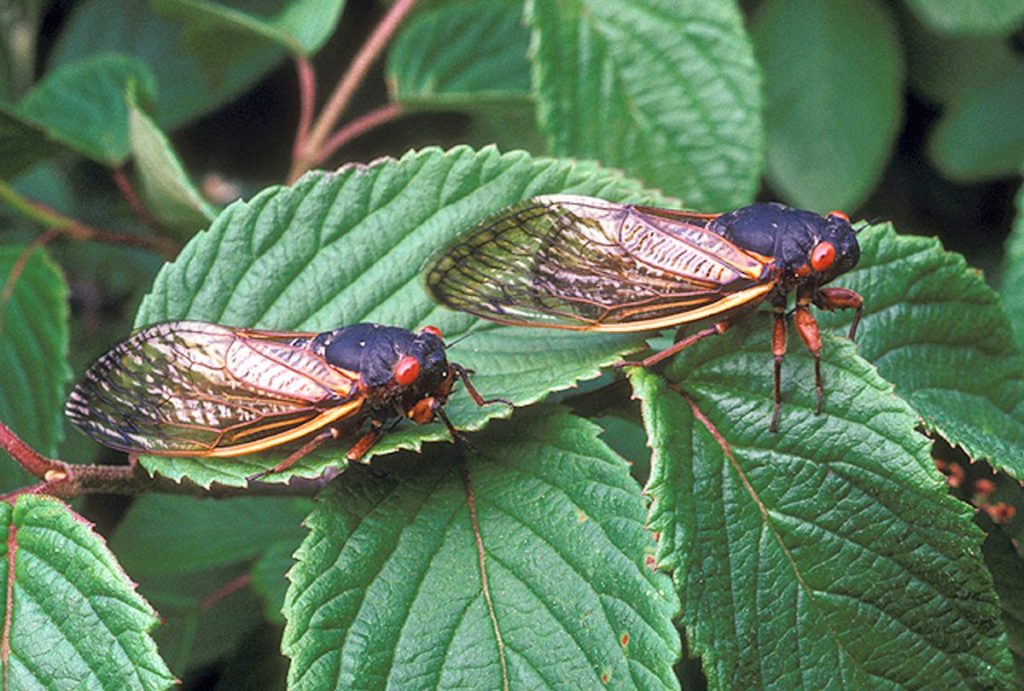
Jones said periodical cicadas are a little smaller than the annual species and also more colorful, with tan and orange markings and bright red eyes.
Cicada nymphs open half-inch holes in the soil as they emerge, and some may build 3- to 5-inch mud chimneys. Nymphs will climb trees and other objects, shed their exoskeletons, and become adults with wings, leaving the paper-like shells attached to trees, porches and posts.
Periodical cicadas are so named because broods emerge in 13-year or 17-year cycles. The expected Brood IV emergence is to occur in an area that extends from Iowa to Texas and eastward into portions of Kansas.
Don’t look for the insects to appear in all locations within the brood emergence area, Lawrence said. A field or yard that did not have trees 17 years ago likely failed to provide a place for females to lay eggs and for the nymphs to hatch and drop to the soil.
However, in areas with favorable conditions periodical cicadas appear by the hundreds or even thousands.
Easterla said the mass emergences are an evolutionary defense that have allowed the species to thrive, since the cicada is a choice treat for many different kinds of predators, including humans.
“People eat cicadas,” Easterla said. “They have a lot of meat and a lot of predators on them, but they beat that by flooding those predators with such a large emergence. Regardless of how many you eat, you can’t eat all of them.”
Some emergences, Easterla said, are so large, that streets can literally become slick with vehicle-squashed bugs. But the winged tide doesn’t last very long, usually just a week or so.
“They will survive above ground anywhere from a week to several weeks,” Easterla said. “Then, after they mate, they literally die of old age. Of course, a lot of it depends on the weather.”
But though an individual adult cicada — after living underground for 17 years — enjoys only a brief flight into the sunshine, the species as a whole is designed for survival over the long haul.
“Their life (above ground) is very short, but it’s their way of surviving over millions of years, and it works for them,” Easterla said.
Cicadas can affect trees. Females cut narrow slits in small branches where they lay eggs. This can cause limb stress. Large, mature trees are generally not greatly affected, but young trees and mature fruit trees can be stressed.
MDC foresters do not recommend using insecticides for cicadas. Small or newly planted trees and shrubs should be covered with mesh and tied at the trunk.