Growers use dry week to make progress in corn fields
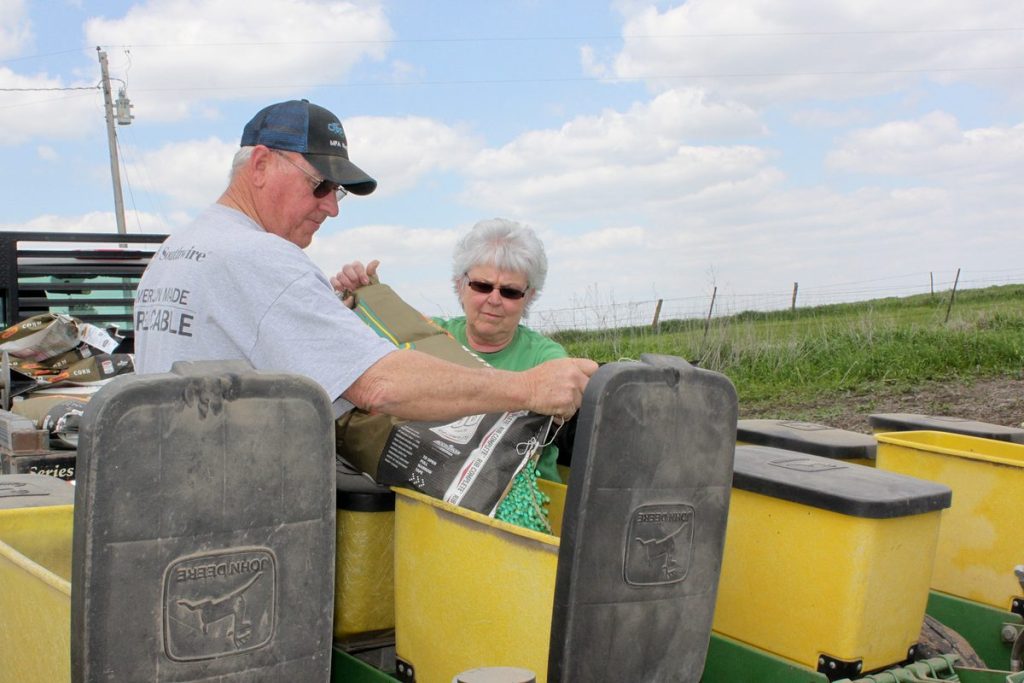
KAITY HOLTMAN/DAILY FORUM
Don and Marilyn Buhman fill planter boxes on Wednesday afternoon in their corn fields west of Ravenwood. A week with no rainfall means many local crop growers are getting into fields that are dry enough before next week’s forecasted rains.
“It’s time.”
Speaking like a veteran farmer, Don Buhman of Ravenwood loaded his planter Wednesday afternoon to get started in his first field of corn for this spring’s planting season.
He picked up his first bags of seed corn at MFA in Conception Junction just after lunch and headed straight for the field.
“It’s really still too wet, but it’s time,” Buhman said. “There’s a chance of rain four or five days next week, so I’m using the dry days I have.”
He pointed to the sky and said with temperatures warming up and little cloud coverage, he’s making the most of the nice weather.
But, if “April showers bring May flowers,” the question becomes what makes this April different than the average.
“The larger April rains came spaced out pretty evenly, and we didn’t have a lot of good drying days with all the cloud cover and some days of drizzly weather,” said Tim Dreier, Nodaway County Farm Service Agency (FSA) director. “That’s the only way I can explain the apparent ‘wet’ conditions.”
Dreier keeps track of daily rainfall at the Maryville FSA office. He measured 2.74 inches of rain in April, which is below the 30-year average of 3.48 inches.
“Actually every month in 2015 so far has been below average in precipitation, compared to its 30 year average,” Dreier said. “The 30-year average for January through April 7.35 inches. We’ve only had 4.97 inches to date this year.”
While this spring is no wetter than a normal year, 2014 boasted 43.85 inches of total rainfall, which is well above the 34.54-inch average since 1918. Excess moisture in 2014 possibly saturated the ground well enough to possibly retain moisture levels to keep fields wetter longer this year.
Weekly statewide crop progress reports from the US Department of Agriculture’s (USDA) National Agricultural Statistics Service (NASS) show currently 81 percent of the topsoil has an adequate moisture supply and 16 percent has a surplus of moisture. Similarly, 88 percent of the subsoil has adequate moisture supply and 6 percent is in surplus.
The progress report also shows that the northwest region of Missouri is behind the rest of the state, and that the state is behind both 2014 and the five-year average.
For the week ending April 26, only 7 percent of corn is planted in northwest Missouri, with the rest of the state ranging from 16 to 43 percent. Statewide, progress is spotty, with the southwest, central, and northeast regions of the state leading the way, respectively.
This same week in 2014, mirroring the five-year average, shows that 44 percent of the state’s corn was planted.
Buhman’s wife Marilyn, who helps Don load the planter for most of their corn acres, said they’ve learned that every year is different.
“We don’t compare year-to-year too much,” she said. “But this is a beautiful day, we’ll take all of them we can get.”