Kansas City Fed chief sees continued growth
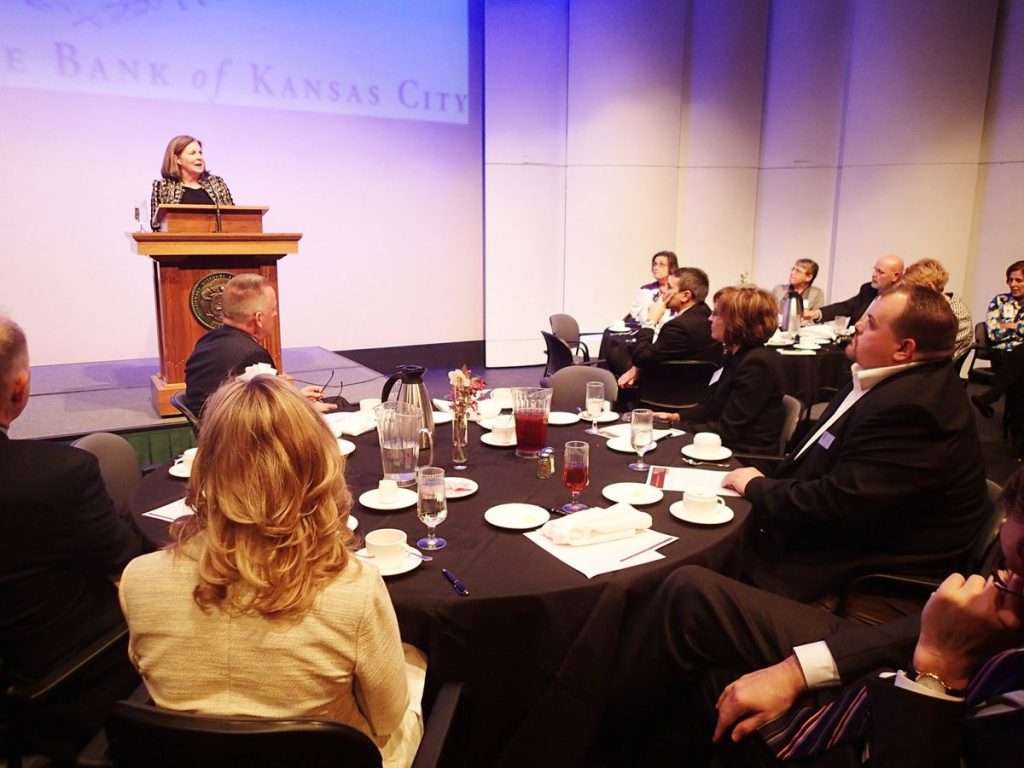
TONY BROWN/DAILY FORUM
Esther L. George, president and chief executive officer of the Federal Reserve Bank of Kansas City, speaks to a gathering of businesspeople and civic leaders from across northwest Missouri Monday afternoon at the Ron Houston Center for the Performing Arts. George said she favors moving interest rates “slowly off of zero,” but does not expect a change in the key federal funds rate following next week’s meeting of the Federal Open Market Committee in Washington D.C.
Esther L. George, president and chief executive officer of the Federal Reserve Bank of Kansas City, addressed a group of bankers, businesspeople, civic leaders and university staff Monday during a noon-hour luncheon at the Ron Houston Center for the Performing Arts on the campus of Northwest Missouri State University.
Billed as an “economic forum,” the luncheon provided an opportunity for George to offer her thoughts about the direction of the U.S. economy before traveling to Washington, D.C., next week for a meeting of the Federal Open Market Committee.
The panel, of which George is a member, is the principal organ of national monetary policy, and sets the federal funds rate, the interest rate commercial banks charge each other for overnight loans.
Since the financial crisis of 2008, the rate has hovered near zero, and George said she believes the time has come to begin gradually moving that number upward.
However, she said, the committee is unlikely to raise the federal funds rate in April, meaning it could take action in June at the earliest.
Even then, the increase will be fractional, George said, perhaps only 25 basis points, or 25 hundredths of a percent.
George said the economy has been in recovery since 2010, but added that growth has been “modest by historical measures,” averaging between 2 and 2.5 percent a year.
Nevertheless, consumer spending and employment, she said, have both demonstrated significant gains, despite the impact of one of the coldest, snowiest winters ever across much of the northeastern United States, home to nearly 20 percent of the nation’s population.
Other recent positive indicators that argue for a higher rate, George said, include auto purchases, improved home values and a rising stock market.
Also helping set the stage for growth are falling gasoline prices, down an average of $1 from a year ago.
Cheaper gas, George said, is saving consumers an average of $700 a year, which she added hasn’t really affected spending yet but has contributed to lower household debt and higher household savings.
But despite her guarded optimism, George said the economy is still creeping forward against several “headwinds,” including high export costs caused by a strong dollar and regulatory questions tied to such issues as health care and the environment.
Weak growth across much of Europe, as well as in Japan and China, is also a concern should the Fed ultimately decide to raise rates, she said.
And while unemployment has shrunk from 10 percent at the height of the Great Recession to a current mark of around 5.5 percent, that figure includes millions of workers who have been jobless for extended periods or who have been forced to accept lower-paying part-time positions.
Still, George said, the nation’s unemployment rate is at its lowest level since 1999.
Other employment indicators, she said, show a “small but steady” rise in wages and an increase in mobility as workers gain the confidence to leave their current jobs for better-paid opportunities elsewhere.
Taking all of that into consideration, George said in her opinion the time has come to nudge rates upward.
“I have reasonable confidence in the forward path of the economy to raise interest rates,” she said. “The economy is strong enough that we can slowly move off of zero.”
On other fronts during a question-and-answer session with the audience, George addressed uncertainty with regard to the nation’s payment system, which is being transformed by technology.
The payment system is simply the way people, businesses and institutions exchange value within the economy.
Online services like PayPal and Google Wallet — and the advent of Bitcoins, a decentralized virtual currency — are rapidly changing the way people pay for stuff, but have also raised questions about access and security.
Bitcoins, for example, have introduced “a lot of innovation” into the payment system, George said. “Unfortunately,” she added “much of that innovation has been nefarious.”
George said it is essential that the payment system catch up with technological developments, so that “the public will be served by technology, and that it will be done in a safe way.”
On another topic, the high cost of agricultural land, George said prime land — “good dirt” — is likely to remain expensive, but that falling commodities prices mean costs per acre will likely flatten over the foreseeable future.