
Nixon praises MHS for student success
TONY BROWN/DAILY FORUM
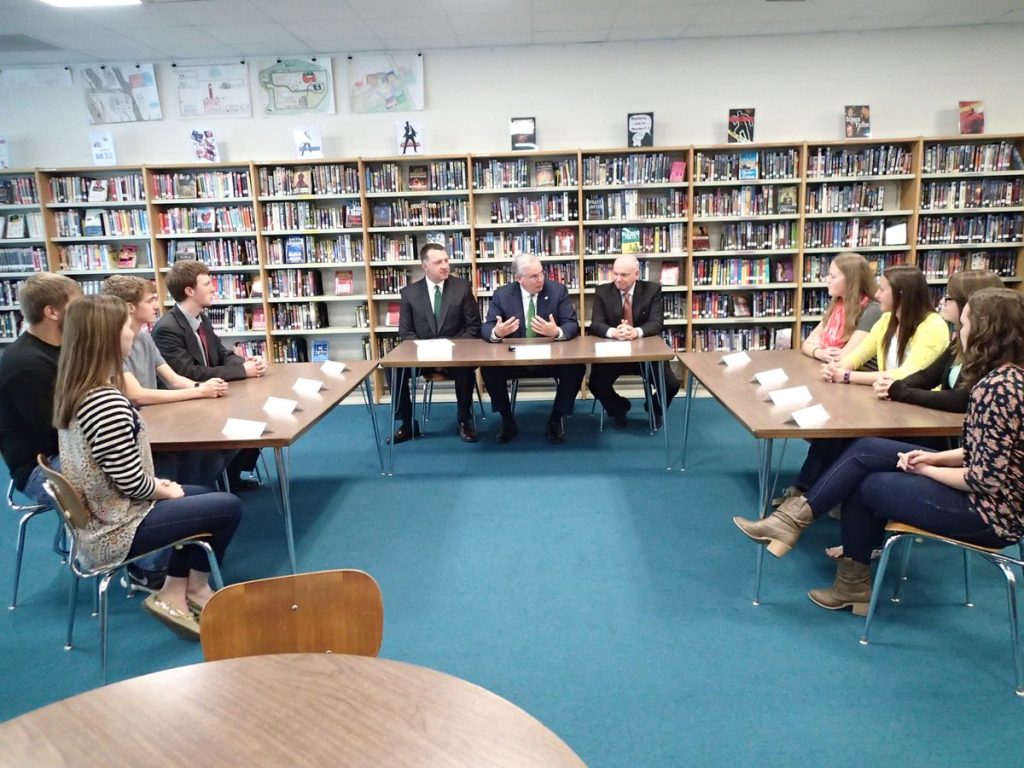
A group of Maryville High School seniors took part in a discussion early Wednesday afternoon with Missouri Gov. Jay Nixon, center. Also in attendance were Maryville R-II Superintendent Larry Linthacum, center left, and former Missouri State University President Mike Nietzel, now a member of Nixon’s staff as an advisor on higher education and workforce readiness. Participating MHS students, clockwise from left to right, were Dakota Hannah Hall, Jacob Cacek, Dominic Mattock, Dakota Shields, Patricia Euler, Dominique Wiedmaier, Riley Elliott and Jessica Knowles.
Missouri Gov. Jay Nixon visited Maryville High School Wednesday afternoon, where he met with local school and community officials, participated in an informal round table with a panel of eight graduating seniors and addressed an all-school assembly.
Nixon was in town to call attention to recent data released by the U.S. Department of Education’s National Center for Education Statistics indicating that Missouri’s high school graduation rate has increased 5 percent since the 2010-2011 school year, the fifth-best improvement in the nation.
“Strong schools create strong communities, and that’s why here in Missouri we’ve worked across the aisle to support and improve public education,” Nixon said. “This new data shows that thanks to outstanding efforts of schools like Maryville High, Missouri is a national leader in making sure more students stay in school and on track to success.”
Nixon said he chose to come to MHS because the school’s accomplishments are in line with his Top 10 by 20 initiative, which has the stated goal of moving Missouri onto the top-ten list nationally of best-performing states in terms of public education.
Maryville’s high school graduation rate has increased 2 points to a little more than 96 percent since 2011, Nixon said, adding that Maryville R-II as a whole scored 95.7 percent on the 2014 Missouri School Improvement Program Annual Performance Report, or APR, up from 92.9 percent in 2013.
Improved APR performance, Nixon, said was achieved despite the implementation of more rigorous standards by the state Department of Elementary and Secondary education.
Similar improvements in all of the state’s public school systems, he said, are essential to Missouri’s economic growth.
“Flunking out of high school is a one-way ticket to a low-wage job,” Nixon told more than 400 MHS students gathered in the school gymnasium. By contrast, he said, a “college degree is the pathway to a lifetime of greater opportunity.”
Nixon added that in a global economy education is more important than ever, and that the young people listening to his speech would be competing for jobs against their peers all over the world, not just in St. Joseph or Kansas City.
The governor praised the Maryville school district for efforts aimed at improving classroom success rates and preparing more students to take the ACT college readiness examination.
He also said the existence of an educated, qualified workforce in this area was a key reason why Kawasaki Motors Mfg. Corp. U.S.A. is making plans for a $25 million expansion of its Maryville plant, and that education is the state’s “best economic development tool.”
“The more education you have, the more financially independent you’ll be,” Nixon said, “and the more jobs our economy will create.”
According to the U.S. Department of Education report, Missouri’s high school graduation rate increased from 81 percent in 2010-’11 to 86 percent in 2012-’13, the most recent year for which data is available. Only Nevada, Alabama, Utah, and New Mexico had larger increases in graduation rates over that time. In 2012-2013, Missouri was tied for the 11th highest graduation rate nationwide.
Nixon further noted that the most recent Missouri High School Graduates Performance Report shows that the state’s public high school graduates entering college in fall 2014 had the lowest rates of enrollment in remedial math and English courses in the past five years.
Before addressing the all-school assembly, Nixon took part in a discussion with Maryville High School seniors Dakota Shields, Dominic Mattock, Jacob Cacek, Hannah Hall, Patricia Euler, Dominique Wiedmaier, Riley Elliott and Jessica Knowles.
Also attending the session was former Missouri State University President Mike Nietzel, now a member of Nixon’s staff as an advisor on higher education and workforce readiness.
Nixon quizzed each of the students about his or her college and career plans, which ranged from medicine (Hall) to sports administration (Cusack) to education (Wiedmaier).
The governor offered special encouragement to students interested in science and technology, saying that graduates in those fields experienced extremely bright job prospects following graduation, though he cautioned those leaning toward the sciences that they faced a tough road ahead.
“In the sciences, there aren’t any shortcuts,” Nixon said. “It’s like climbing Mount Everest. You’ve just got to work your way up, and it’s hard.
Following the governor’s remarks in the gym, R-II Superintendent Larry Linthacum told reporters that rising achievement statistics at MHS and the district’s other schools are the result of students, teachers, staff and community members working together.
He also cited such programs as “Spoofhound Hours,” times during the school day when students can seek out teachers for assistance with subjects or assignments where they need extra help.
Linthacum said the district’s emphasis on co-curricular activities has played a role as well by providing “things kids can get excited about.”
Participation in school activities, Linthacum said, improves attendance, which leads to better test scores.
“We pride ourselves on providing a quality education that prepares students for rewarding careers and fulfilling lives,” Linthacum said. “Our consistently high graduation rate is just one example of our commitment to excellence at all levels.”
After his speech, Nixon met briefly with reporters and said he believes the Legislature will pass the state’s budget on time with a proposed $150 million increase for public schools intact.
He added that he hopes the House and Senate will reconcile their budget differences and ultimately reject a Senate proposal to cut $300 million from programs providing aid to foster children, the elderly and the mentally ill.
In response to another question, the governor said the state needs to address what the Missouri Department of Transportation is calling a severe funding shortfall that could result in significant cutbacks to highway construction and maintenance.
Nixon said he supports a “user fee model” rather than an additional sales tax to fund transportation needs, and that he thinks most Missourians realize additional revenue for highways is a priority.




