City reveals scope of Kawasaki tax deal
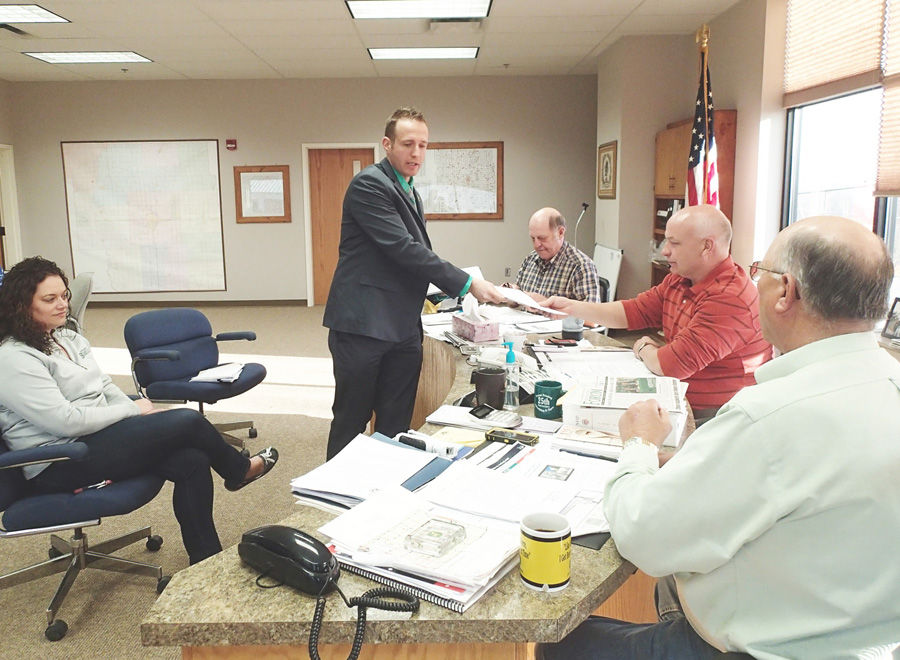
TONY BROWN/DAILY FORUM
Maryville City Manager Greg McDanel hands copies of a tax incentive plan designed to finance a Kawasaki Motors factory expansion to members of the Nodaway County Commission. Pictured at left is Mayor Renee Riedel. Shown seated from left are West District Commissioner Robert Westfall, Presiding Commissioner Bill Walker and South District Commissioner Robert Stiens.
Details regarding a proposed tax abatement deal between the city of Maryville and Kawasaki Motors Manufacturing Corp. with regard to a planned multi-million-dollar plant expansion emerged during a meeting Friday between City Manager Greg McDanel and the Nodaway County Commission.
Also attending the session were Josh McKim, executive director of Nodaway County Economic Development, County Assessor Rex Wallace, Mayor Renee Riedel and County Collector-Treasurer Marilyn, Jenkins.
During extended remarks before the three-member commission, McDanel outlined the specifics of a plan under which the city would act as the fiscal agent for $25.5 million in Industrial Development Revenue Bonds.
Proceeds from the bonds would be used to finance a 100,800 square-foot addition to the Maryville small-motor factory, an initiative Kawasaki officials have said will create around 30 new jobs. The plant currently employs about 800 workers.
The broad outlines of the deal were first announced late last year after Kawasaki agreed to allow its factory and grounds to be annexed into the city limits, a move hailed by McDanel and other civic leaders as a good-faith show of corporate citizenship that would significantly boost municipal property and sales tax revenues.
As the deal was first described, all real and personal property taxes pertaining to the expansion were to be waived over the 10-year life of the bonds, since the project would technically be owned by the city
Following the initial announcement, Maryville R-II Superintendent Larry Linthacum pointed out the annexation would do little for school revenues, since the Kawasaki plant has always been inside the district’s boundaries.
Linthacum said at the time that in 2012 Maryville R-II received $781,702 in real and personal property taxes from Kawasaki, a figure he claimed has fallen each year since except for 2013, when the factory’s school tax bill increased from $574,040 in 2012 to $575,690.
Last year, according to Linthacum, Kawasaki’s property tax contribution to the district totaled $524,837.
As Linthacum’s remarks were made public, McDanel announced that negotiations were under way to ensure that the school district remained fiscally “whole.”
The result of those talks was the topic of Friday’s meeting, during which McDanel said that, pending approval by the City Council, Maryville would technically acquire ownership of the entire Kawasaki plant, and lease it back to the corporation for considerations equal to the principal and interest payments on the bonds.
In return, Kawasaki is pledging to make lump-sum annual payments equivalent to 100 percent of the property taxes on the existing plant and 50 percent of personal property taxes on fixtures, machinery and equipment associated with the expansion. Personal property taxes on existing fixtures, machinery and equipment would remain unaffected.
In-lieu-of-tax payments based on new personal property are subject to depreciation and would decrease from a high of $176,704 in 2016 to $18,026 in 2025. In-lieu-of payments based on real property are to remain constant at $256,269 a year for ten years, of which $164,492 would go to the school district, or a little more than 64 percent.
McDanel said the deal is contingent on Kawasaki maintaining a workforce of at least 750 employees over the span of the agreement. Failure to do so, he said, would mean the city could call in the bonds and enforce tax assessment at the full amount.
The city is has no fiscal liability in the event Kawasaki fails to discharge its bond debt, he said.
County Assessor Rex Wallace said following Friday’s meeting that the real-property payment schedule is based on the 2014 tax year, when Kawasaki’s plant and grounds had an assessed value of $3.2 million and a tax rate of 7.9949 cents per $100 of assessed valuation.
Wallace voiced concerns that the formula uses values estimated before the factory was annexed into the city limits, which raised the assessed real-property valuation for 2015 from $3.2 million to $3.9 million.
Using the earlier tax year will cost local taxing entities around $60,000 annually in real-property revenue, most of which would have gone to the school district.
According to figures supplied by the city of Maryville, the in-lieu-of-tax payments over the life of the bonds will total $3.17 million, not counting taxes on personal property (equipment, fixtures and machinery) attached to the existing part of the plant, which will continue to be assessed at the full rate, including depreciation.
Of that amount, 2.1 million will go to Maryville public schools.
Without the abatement, assuming Kawasaki went forward with the expansion, the project would yield $4.15 million in new taxes, of which about $2.8 million would go to the R-II School District.
On Friday, Linthacum said he was unsure exactly how much of an impact the abatement plan would have on Maryville schools, adding that he is to meet with Wallace next week in order to go over the projections in detail.
Linthacum also said he planned to attend the next regular City Council meeting on March 30, when the city’s governing board is expected to consider approval of the tax abatement package.
“Obviously we’re concerned about the impact,” Linthacum said. “We’re not opposed to jobs and growth for Maryville. We have enjoyed a great partnership with both the city and Kawasaki, and we want to continue that. But we want to determine what the exact impact is that this will have on us, then see what we do from there.”
For his part, McDanel said that tax incentives are simply a fact of life in an era when cities and states must compete fiercely for industrial development.
He added that Kawasaki’s plans to expand the Maryville plant are not binding, and that the corporation still has the option of transferring the project to its large facility in Lincoln, Neb.
In addition, McDanel warned the commissioners and other officials at Friday’s meeting to expect more of the same if Maryville wants to stay competitive in terms of attracting and retaining industry.
“It is going to take an incentive to sell the Energizer facility — it will,” he said, referring to the now-vacant manufacturing complex on the eastern edge of the city.
Nodaway County Economic Development’s McKim also addressed the commission, calling for an intergovernmental effort aimed at creating an overarching community tax incentive plan acceptable to all parties.