Dry weather fuels risk of wildfire
TONY BROWN/DAILY FORUM
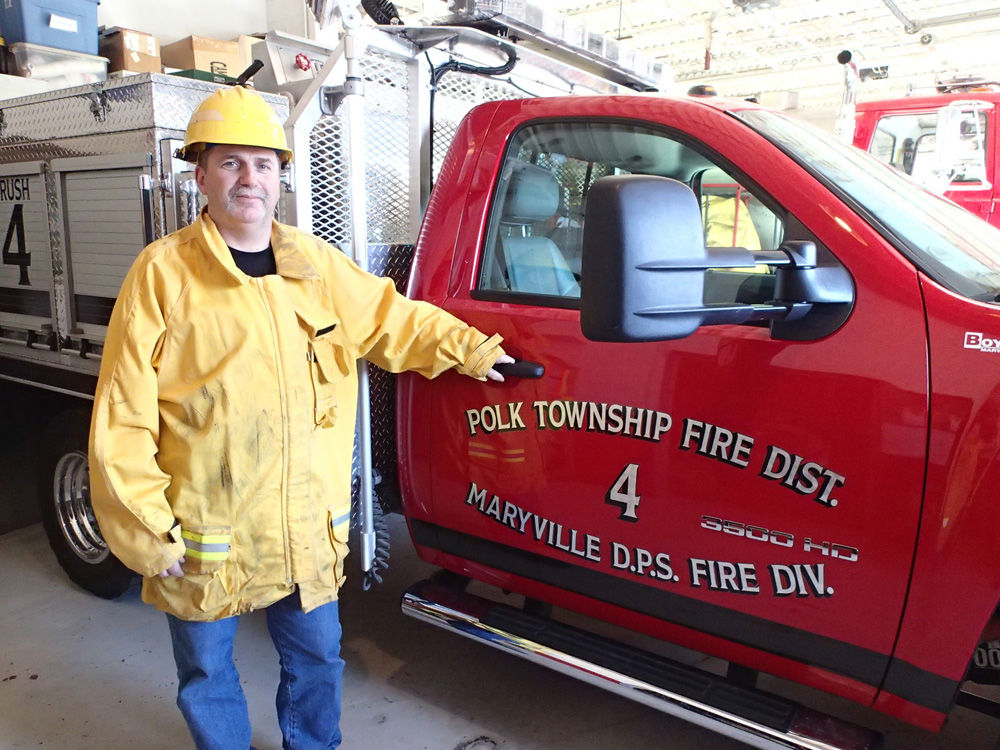
Maryville fire division Capt. Phil Rickabaugh stands beside the Polk Township “brush truck,” which is used to fight wildfires in rural areas. Unseasonably warm, dry rather is causing a spike in the number of brush and grass fires in Nodaway County, and Rickabaugh is advising landowners to use extreme caution when conducting a controlled burn.
Spring may have sprung, but April showers have yet to arrive, which means dry conditions have caused a rash of wildfires across Nodaway County.
Capt. Phil Rickabaugh, supervisor of the Maryville Public Safety fire division, reports that firefighters from MPS/Polk Township and a number of rural departments have responded to nearly a dozen wildfires over the past week.
Most of the fires were in Polk Township, a rectangle extending about five miles in each direction from the Maryville City Limits. However a number of grass and brush fires have been reported in other parts of the county as well.
“The dry conditions are starting to pose a genuine threat,” Rickabaugh said. “Everybody’s been kind of hopping.”
Despite the danger, Rickabaugh said, the National Drought Mitigation Center has yet to list Nodaway as drought zone, which is the trigger that would cause the County Commission to issue a ban on open burning.
Therefore, county residents who want to conduct controlled field burns or dispose of brush piles are free to do so. Rickabaugh, however, is urging landowners who burn to use extreme caution.
“Typically, spring is burning season,” Rickabaugh said. “But humidity levels are low, and the wind is a factor this time of year. So people need to be careful.”
Rickabaugh said factors contributing to the increased danger of wildfire this spring include prescribed burns conducted by landowners enrolled in the federal Conservation Reserve Program. Another “problem” is the early onset of pleasantly warm, clear weather.
“After a long winter people are anxious to start cleaning up debris and brush piles,” Rickabaugh said. “It’s warmed up, so they want to get out and take care of that.”
However, the fire captain is pleading with landowners to plan carefully and take precautions before striking that first match.
“First, check to see if there is a burn ban,” he said. “At this time there is not, but even though the National Drought Mitigation Center says conditions are fine, in reality that’s not true. It’s still very dry.”
Secondly, Rickabaugh urged people about to conduct a controlled burn to do so at least 75 feet away from any structures and to avoid the use of gasoline and other accelerants.
Perhaps the most important precautions, he said, are never leaving a fire unattended and making sure means are at hand to knock down the blaze before it gets out of control.
Rounding up a shovel crew is one approach, Rickabaugh said. Another good idea is making sure whoever is supervising the fire has quick access extinguishers or a water source.
If a fire does get out of control, Rickabaugh said, people shouldn’t wait to call for help while attempting to put out the flames themselves.
“That is key,” he said. “If open burning gets out of hand, don’t delay in calling the fire department. Get on the cell phone and dial 911.”
But the best way to put out a wildfire is to prevent it from happening in the first place.
Rickabaugh said that, given advance notice, most Nodaway County fire departments, including Maryville and Polk Township, are happy to lend a hand to landowners conducting a burn.
“Call the fire department first,” he said, “and see if they may be available to assist.”