Nodaway County numbers reflect record-breaking growing season
KAITY HOLTMAN/DAILY FORUM
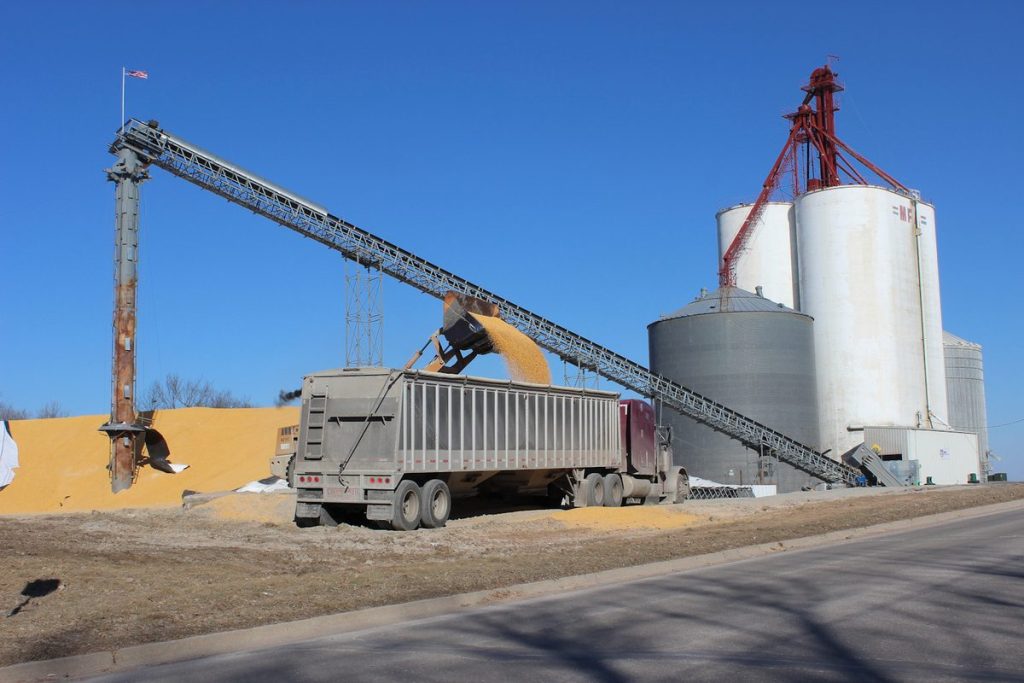
A Maryville MFA Agri Services employee loads a semi-truck with corn from a ground storage facility near the intersection of Seventh and Depot streets. At the height of last year’s record harvest, the temporary facility stored as much as one million bushels of corn.
The ground storage facility at MFA Agri Services in Maryville is one of the last to be emptied in Nodaway County.
While removing piles of corn is not a regular occurrence this time of year, it’s no surprise this year, as Nodaway County echoes the substantial state and national harvest.
The United States Department of Agriculture’s (USDA) National Agricultural Statistics Service (NASS) released Thursday the county estimate breakdown for the 2014 record-breaking harvest. The estimates reflect those growers who respond to the USDA’s survey request.
Nodaway County producers planted 130,500 acres of corn and harvested 128,000 of those acres. The average yield was 194.3 bushels per acre, making total production 24,871,000 bushels.
In comparison, the state averaged 186 bushels per acre and produced a total of 628,680,000 bushels. In 2013 Nodaway County had an average yield of 129.8 bushels per acre and produced 17,170,000 bushels.
County soybean growers planted 151,000 acres of soybeans and harvested 150,500 of those acres. The average yield was 52.9 bushels per acre, totaling a production of 7,963,000 bushels.
“I knew the corn yield would be high, but 194 is unheard of,” said Tim Dreier, Nodaway County FSA director. “In the previous five years the high yield for corn was 148, and 46 bushels per acre or less for soybeans. As for soybeans, 52 is high but not the extreme corn was. In the previous five years, soybeans saw a high of 47.”
The state’s average yield for soybeans was 46.5 bushels per acre, and production totaled 260,400,000 bushels. Statistics from 2013 show a 39.2 bushel-per-acre yield and 5,469,000 total bushels produced.
“For producers, this means more grain to market,” Dreier said. “In a year of diminished prices, compared to the last few, having the extra grain to market helps them meet their bottom line.”
For both crops, Nodaway County ranks among the highest in recorded data. Corn yields recorded rank Nodaway County fifth behind Saline, Holt, New Madrid and Mississippi counties. Nodaway comes in third in total production behind Saline and Holt counties.
In soybean ratings Nodaway County comes in second only to Saline County for yield and in fourth for production, behind New Madrid, Saline and Stoddard counties.
MFA Agri Services General Manager Jeff Meyer said these numbers don’t surprise him.
“We’re in a highly productive part of Missouri,” Meyer said. “A lot of ground has been taken out of grass and (put) into crop, bringing up total production. That just goes to show you that when Mother Nature cooperates, there is a lot of potential.”
As piles of corn continue to disappear across the state, the Missouri Corn Growers Association and Merchandising Council report that 46 percent of the corn crop was exported outside the state. This is an increase over the normal 30 percent from previous years.
Of the remaining grain, 19 percent has gone to livestock feed, 14 percent to the six farmer-owned ethanol cooperatives in Missouri, 7 percent to on- and off-farm storage and 4 percent to distillers grain.
Meyer said they hope to have the temporary grain storage cleared out by early March, which means a full month of moving grain from just that one ‘bin’ that at its peak held one million bushels of corn.
“That’s our main focus right now,” Meyer said. “Some is going to Barttlet in Atchison and St. Joe, some is going to Springdale, Arkansas for chicken feed, and some is going to our MFA-owned feed mill in St. Joe.”
Meyer said he feels like they’ll continue to use the new storage facility year after year.
“With a pipeline full of corn and looking at the five-year average corn crop, I think we’ll definitely have to use it.”