PETA team makes 3-D plea for animal rights
TONY BROWN/DAILY FORUM
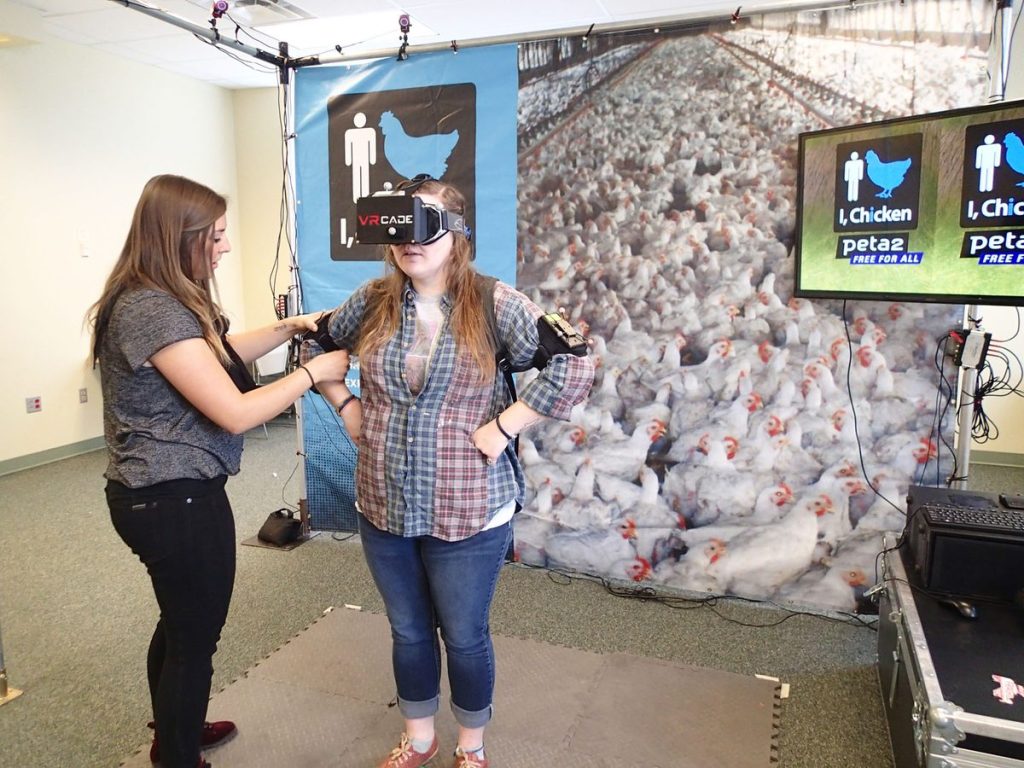
Lauren Boushey, left, a member of the “I, Chicken” tour sponsored by Peta2, the youth division of People for the Ethical Treatment of Animals, attaches virtual reality equipment to Northwest Missouri State University junior Kasea Price. The gear placed college students in the midst of a two and a half minute three-dimensional animation of chickens moving across an open field before being penned up and slaughtered.
“Ain’t nobody here but us chickens,” bandleader Louis Jordan and his Tympany Five sang on a popular recording back in 1946.
Well, that wasn’t quite the case Monday and Tuesday in meeting room “D” of the J.W. Jones Student Union at Northwest Missouri State University, but a traveling group of animal rights activists from Peta2, the youth division of People for the Ethical Treatment of Animals, wanted it to seem that way during the Maryville leg of their “I, Chicken” tour.
Tour Administrator Bridget Dillon and her team spent two days in the union this week handing out pamphlets and talking to students about the benefits of a vegetarian or vegan diet — a vegan being someone who refrains from eating not only meat but all animal-derived products, including eggs, milk, cheese and seafood.
But mostly on their current nine-month tour, which when completed this spring will have traveled to 150 college campuses nationwide, Dillon and her team are concerned with chickens — and especially the conditions under which millions of chickens live and die each year on their way to the nation’s restaurants and family dinner tables.
The centerpiece of the peta2 exhibit at Northwest was a virtual reality rig consisting of goggles, earphones and sensors that allowed people to spend about three minutes seeing the world from a three-dimensional chicken’s-eye view.
Once the goggles and other gear were turned on, the user was treated to the sights and sounds a real chicken would supposedly encounter in an open field — grass, trees, ponds, rocks, blue sky and sunshine.
After a minute or so, however, the images turned darker, and the virtual chicken discovered itself in a huge cage filled with dozens of other birds. Human voices could be heard in the background discussing the upcoming “slaughter.”
The final scene allowed the chicken — that is the person wearing the goggles — to stare out between metal bars at an ominous conveyor belt bearing cartons filled with shrink-wrapped carcasses presumably on their way to the supermarket.
None of the images was especially gruesome, and the conveyor belt scene looked more like an animated prison-escape movie than anything one would find in an actual poultry plant. But the point was clear. Anyone who eats meat is supporting an industry that cages animals and kills them for profit.
Of course, in a place like Nodaway County where production agriculture is king, a lot of people don’t see much wrong with that.
But Dillon said she hoped the virtual reality experience would at least challenge Northwest students to view large-scale meat production practices “from a different perspective.”
“The response has been overwhelmingly positive,” she said. “People are shocked to find out what is being done to chickens.”
Dillon added that, in her view, “Chickens are among the most mistreated animals on the planet.”
“Every hour in the United States, one million chickens are slaughtered,” she said. “They’re crammed into tiny cages, hung up by their legs, and many are scalded while they’re still alive.”
Dillon further maintained that chickens are social animals “with unique personalities like cats and dogs — and they have a desire to live. They are sentient beings.”
Animal ethics aside, Dillon and her colleagues told students who stopped by the exhibit this week that there are other reasons not to eat meat, especially with regard to improved human health the environmental impact of raising livestock for food.
“Humans are omnivores,” she said. “But we thrive on a plant-based diet. There is a huge misconception that you can’t get enough protein and other nutrients from a plant-based diet, but that’s not true.”
With regard to sustainability, Dillon claimed it takes 13 pounds of grain to produce one pound of beef, whereas using that grain to feed human beings “would have a huge, huge impact on world hunger.”
She said she also sees the vast amount of water required to support the U.S. livestock industry as problematic.
Though obviously true-believers themselves, Dillon and her team made less than a convincing case to at least one of the students who trickled through the exhibit late Tuesday morning.
Kasea Price, a 20-year-old marine biology major from Belton, said she agreed with some of PETA’s points about confined animal feeding operations and other large-scale livestock practices but still doesn’t plan on cutting beef and chicken out of her diet anytime soon.
“I eat a lot of chicken,” said Price, who has both worked for a veterinarian and served as a summer intern at the Kansas City Zoo, where she helped take care of trumpeter swans, polar bears and other animals.
“I share a lot of the same values as PETA, except that I eat meat,” Price said. “But this is a good way to get the point across about how chickens are treated. I think treating any animal like that is just awful.”
At the grocery store, Price said, she generally tries to purchase “free-range” poultry raised on the ground rather than in cages or vast feeding structures. Also, given a choice, she prefers buying food labeled as organically produced.
Dillon counters that such phrases as “free range” are tied to loosely written regulations that allow producers to adopt the label as a marketing ploy while continuing what she considers inhumane practices.
“You can still cram thousands of chickens into a barn, but as long as there is no cage it’s still free range,” she said.