Pastor follows call to prison ministry
TONY BROWN/DAILY FORUM
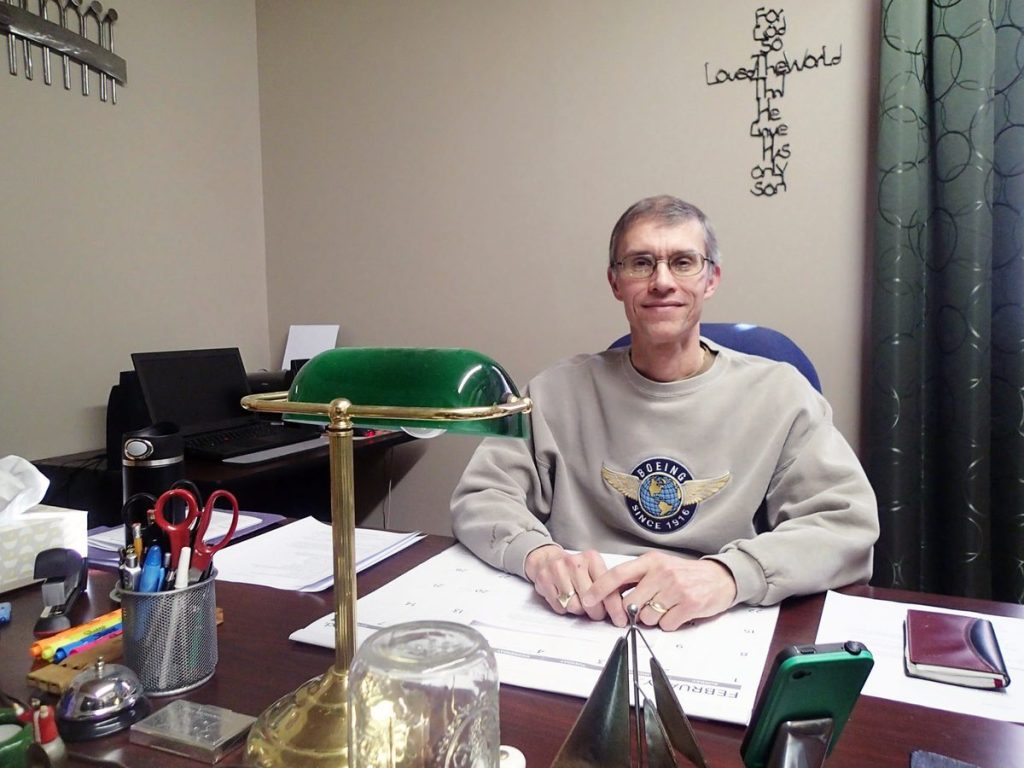
The Rev. David Oddi, pastor of Hope Evangelical Church in Maryville, spends two afternoons a week working as the volunteer auxiliary chaplain at the Maryville Treatment Center, a state Department of Corrections facility just east of town. “As a chaplain, I’m there to assist the offenders in the free exercise of their religious beliefs,” Oddi said. “But my goal as a Missouri Synod Lutheran is really to point them to Christ — that’s my primary role and concern, to preach Christ.”
The Rev. David Oddi is mostly known as the pastor of Hope Evangelical Lutheran Church on South Main Street, where he has served for nearly five years after graduating in 2007 from Concordia Seminary in St. Louis then working as an associate pastor in the southeast Missouri city of Farmington.
But aside from his flock at Hope Lutheran, Oddi also ministers to a very different kind of congregation on the eastern outskirts of town — inmates serving time at the Maryville Treatment Center.
Oddi is the volunteer auxiliary chaplain at MTC, a state Department of Corrections facility housing more than 500 offenders, most of whom are undergoing substance abuse and behavior modification treatment during the final months of their sentences.
There is no full-time chaplain at the prison. The Rev. Richard Iske of the Greater Hope Community Church in Clarinda, Iowa, serves as the facility’s main chaplain and is resident at the facility 20 hours a week from Tuesday through Thursday. Oddi fills in on Mondays and Fridays, mostly during the afternoon.
Prison ministry is nothing new to Oddi, who filled a similar role at the Farmington Correctional Center in St. Francois County, a minimum/medium security facility that, with more than 2,500 inmates, is one of the largest correctional institutions in the state.
Oddi said that though the two prisons, and the offenders they house, are different in character, his job as a chaplain remains essentially the same. It’s a calling, he said, that has a couple of different facets — one objective and the other very much rooted in his Lutheran Church-Missouri Synod faith tradition.
“As a chaplain, I’m there to assist the offenders in the free exercise of their religious beliefs,” he said. “But my goal as a Missouri Synod Lutheran is really to point them to Christ — that’s my primary role and concern, to preach Christ.”
Since MTC offenders profess allegiance to all manner of faiths, everything from Islam to Native American spiritualism, Oddi said a mainstream Christian chaplain’s role requires a certain amount of balance, plus the ability to show respect for the beliefs of others.
“You don’t hide who you are,” Oddi said. “I do not agree with the other (non-Christian) religions out there, and I don’t make any bones about that. But I am always respectful.”
One of Oddi’s jobs at MTC is to conduct chapel orientations, during which small groups of inmates are introduced to the various opportunities for worship, scripture study and pastoral care available to them.
Offenders professing themselves Protestants, of whatever denomination, are classed as “Christian general” and are allowed to attend Sunday services in the MTC chapel conducted by ministers and laypeople who are part of the VIC program, short for Volunteers In Corrections.
A priest offers Mass for Roman Catholic prisoners on Wednesday evenings.
As for other kinds of believers, groups must include at least five people and receive permission from Iske in order to hold their own gatherings or services.
Oddi typically spends six to eight hours at the prison each week, a big slice of time for a busy pastor leading his own church. And he doesn’t have to do it, or wouldn’t if he didn’t believe his God has important work for him to do behind those tall fences topped with razor wire.
“I felt a calling to it,” he said. “I see a need there. And part of my calling here (at Hope Lutheran) is to be a representative of this congregation in the community.”
Also, Oddi is well aware of Bible verses like those contained in Matthew 25 that would seem to place prison ministry squarely within Christianity’s earliest traditions: “… I was a stranger and you took me in; I was naked and you clothed me; I was sick and you visited me; I was in prison and you came to me.”
“That’s a big part of it,” he said. “There is that spiritual need, and the need to proclaim Jesus Christ and him crucified for our sins.”
As auxiliary chaplain, Oddi does not regularly conduct worship services or preach sermons at MTC, but he is a person offenders can go to when they have questions about faith or pass through trials, such as the death of a family member.
Only rarely, Oddi said, do such discussions revolve around the crimes that resulted in the prisoner being incarcerated.
“As far as their offenses go, I’m not interested in that,” Oddi said, “unless someone says, ‘This is what I’ve done, and I really need to be forgiven.’ Then I am happy to extend that promise of Christ’s forgiveness to them.”
Of course, many inmates don’t feel the need for salvation from a God they may or may not believe in. Indeed, Oddi said, the number of “nones” at MTC — offenders who profess no affiliation with a faith tradition — seems to be increasing.
But just as in the New Testament Parable of the Lost Sheep, Oddi’s magic number is one, not 99.
“Even if there is just one person who wants to come and talk — who is having a struggle or who has a question or a need — and I can help them, it’s worth it,” he said.