Wet harvest forces farmers to make 2015 crop decisions
KAITY HOLTMAN/DAILY FORUM
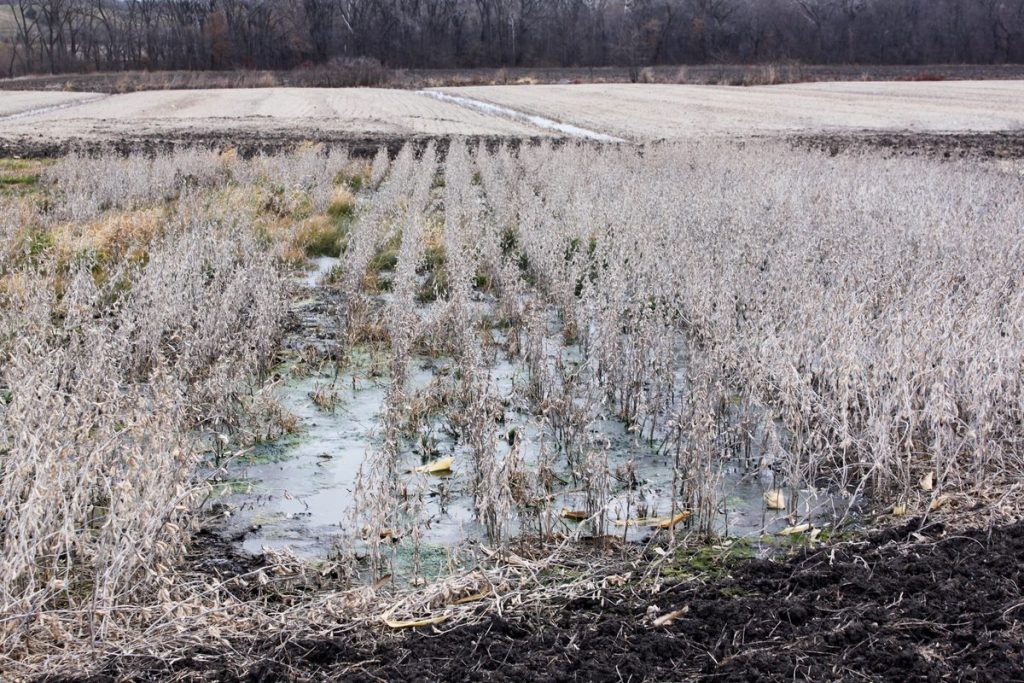
Though the 2014 harvest is abundant, a wet harvest season can impact soil compaction, ruts in wet areas, and crop waiting to be harvested until after the soil has frozen. This river-bottom ground has seen a water table replenished for the first time in four years, which results in unharvested soybeans.
Bin buster. Record breaker. High yielder. All of these are labels put on the 2014 crop harvest. But a couple titles that may not have been discussed yet are soil compactor and field rutter.
With this year’s high rainfall totals, soil has not dried out the way it typically does in the fall. Wet soil has made driving heavy combines, semi-trucks and tractors on some fields difficult. When the equipment has made it into the fields, some damage has likely occurred in those that have retained moisture.
This fall’s wet harvest will likely put farmers behind on work next spring, according to Holt County Extension specialist Wayne Flanary.
“When we have a dry season, harvest is handled quickly, and then we started working on everything for next year’s crop,” Flanary said. “Given that harvest been so big, time has been limited. We’ve been focusing on getting crop out so we haven’t even turned our attention to next year yet. Next year could be a mad rush to get fieldwork done in a timely manner before getting crops in.”
Water tables have resurfaced and have posed some challenges in getting crops out.
“We had several dry years, but ground water and surface water is now being recharged,” Flanary said. “Growers may have wet areas in fields that we’ve forgotten about until this year that are harder to get through. There are several fields that have been pulled out of this fall and are waiting for them to dry or even freeze.”
Soil has likely been packed down where trucks and tractors made many trips across the field.
“Wet soil conditions with all that weight on it has certain implications on soil compaction,” said Erin Dinsdale, local agronomist and Milne-Dinsdale Seed owner. “One of the main things is to try to minimize areas with potential compaction. Farmers have had to think about minimizing the percentage of acres with soil compaction.”
And soil compaction can mean breaking down soil structure, which in turn means putting in touch-up work for next year. Dinsdale said running anhydrous has now become the topic of conversation with her customers.
“It hasn’t been cold enough yet and the soil is still moist,” Dinsdale said. “If they run now, will they be able to get it in the soil, and will it stay?”
When temperatures are this warm, a large percentage of anhydrous can be lost due to high soil temperature. If temperatures are warmer than 50 degrees, there is still activity in the soil, and anhydrous can be broken down.
Flanary said looking at ways to become efficient is especially important this year.
“Everyone should focus on changes in grain prices and look at doing things very efficiently,” Flanary said. “This may mean reducing number of trips across the field in spring trips. There are opportunities to have custom work done to help with that.”
The question now and in the spring they need to be asking is whether they are helping or hurting the soil.
“Those ruts need to be smoothed, but it’s hard to relieve compaction when the soil is wet,” he said. “If the soil can freeze deep, that would help relieve compaction if they do tillage.”
In response to warm temperatures later in the fall, Dinsdale said she imagines she’ll see the use of soil additive products to see anaerobic and microbiological activity.
“I’ve been joking all fall that next spring my producers will be asking ‘why are my plants yellow and stunted,’” Dinsdale said. “The roots will likely have a hard time getting going in some spots from the soil being compacted and the structure being broken down.”
With commodity prices being so low, Dinsdale worries growers will put less fertilization into their fields.
Continuing the trend with a wet winter and spring are also possible concerns.
“Cold weather is good, we need that,” she said. “But a lot of snow would serve as an insulator and would keep the ground from getting too cold.”
Dinsdale said one of the best steps farmers can take is to collect soil samples so they can assess what they need to do for next year’s soil fertility and find any issues they need to correct in time for planting season.