Horse owners warned of toxic beetles
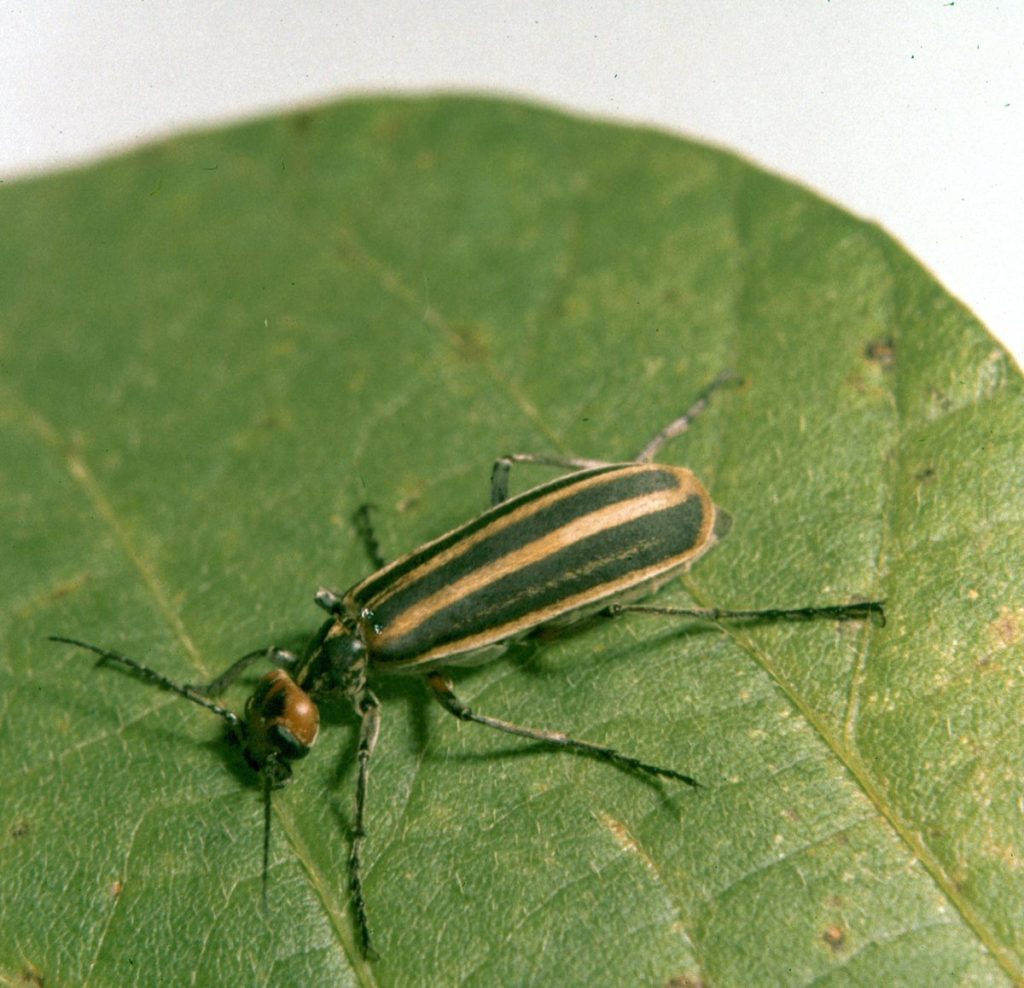
MISSOURI EXTENSION PHOTO
Parts of Missouri are seeing large populations of striped blister beetles. The insects produce a compound called cantharidin, which can poison horses and remains toxic in alfalfa hay for at least four to five years after harvesting.
COLUMBIA, Mo. – Striped blister beetles, which can be toxic to horses, are being seen in high numbers in alfalfa in some areas of the state, according to University of Missouri Extension entomologist Wayne Bailey.
The beetles produce a compound called cantharidin, which remains toxic in alfalfa hay for at least four to five years after harvesting. Adult beetles generally do not appear in the first cutting of alfalfa. Risk exists mostly in second and third cuttings.
Beetles appear in alfalfa, soybean and weed patches in July and August after emerging from the soil. They range in length from a half-inch to an inch and are easily recognized by their characteristic stripes and prominent “neck.”
Bailey said striped blister beetle problems appear following years with large numbers of grasshoppers. This happens because at an immature stage the beetles feed on grasshopper egg pods in the soil.
They move quickly in packs to protect themselves and to mate and drop to the ground as a protective behavior when threatened.
Striped blister beetles move quickly between fields of soybean and alfalfa, so farmers and horse owners are urged to scout alfalfa frequently to determine pest numbers, Bailey said. Damage to alfalfa is minimal, but risk to horses increases when large numbers of beetles are found in small areas of a field.
The insects have earned their name because they can cause blisters on the skin of humans and in the mouths of animals.
The oily, caustic cantharidin in striped blister beetles can cause animals to become sick or die, and Bailey said studies indicate that consumption of as few as 25 beetles in a 24-hour period can be lethal, depending on the size of the horse.
Signs of poisoning vary, said Tim Evans, a veterinary toxicologist with the MU College of Veterinary Medicine. Signs include sores on the mouth and tongue and abnormal breathing with jerking of the diaphragm.
Horses may try to relieve the burning sensation by putting their muzzle and lips in water and blowing bubbles in the water. They also may paw and stretch to reduce abdominal discomfort.
In addition, urine may be blood-tinged and diarrhea may contain blood, mucus or sloughed intestinal lining.
Horse owners who see signs of poisoning should consult a veterinarian and quit feeding the hay immediately, Evans said. A veterinarian can correct electrolyte abnormalities, provide supportive care and help reduce pain.
Crushed beetles are unevenly distributed through contaminated hay, and two animals can eat from the same bale with one becoming poisoned and the other unaffected, Evans said.
Control beetle populations with foliar application of insecticides, Bailey said. Application guidelines are available at http://ipm.missouri.edu.
MU Extension forage specialists Rob Kallenbach and Craig Roberts recommend the following management options:
• Feed horses with first-cutting alfalfa, which is usually free of striped blister bugs. Pure alfalfa stands that are flowering attract beetles most.
• Cut late-season alfalfa when 10 percent or less of alfalfa is in bloom. Keep alfalfa free of weeds.
Avoid use of crimpers and conditioners, which crush hay and promote drying. Avoid running tires on windrows.
• Scout frequently. Not all fields, even on the same farm, will have beetles. Quietly walk through the field the day before harvesting and apply insecticide if needed. Noise causes the beetles to drop to the ground to hide.
• Horse owners should purchase only first-cutting hay. Inspect hay before buying and check alfalfa for the presence of blister beetle at time of feeding.