Belgians large and in charge at Pickering Horse Show
TONY BROWN/DAILY FORUM
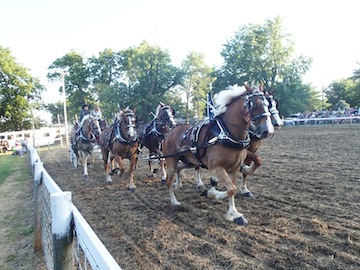
The six-horse Loomis Farms Belgian Hitch takes a turn around the show ring Friday evening during the 77th annual Pickering Horse Show. Gary Loomis represents the third generation of his family to train Belgians, which weigh up to 1 ton and can stand up to 19 hands high at the withers.
When it comes to showing draft horses, teamwork is the most important thing — and Gary Loomis and Heidi Carlson are very good at it.
The Loomis Farms Belgian Hitch, a team of six draft horses, quickly won the hearts of the folks in the stands at the 77th annual Pickering Horse Show on Friday.
The Belgians, light chestnut in color with flaxen manes and tails, opened the show by pulling a fire engine red wagon with a honed precision that delighted a crowd of several hundred equestrian fans.
“The six-horse hitch was the semi of 100 years ago,” Loomis said. “They were the freight wagons of their day. It’s ironic that they used to pull our wagons, and now we use a semitrailer to pull the horses when we take them to a show.”
A big man with an easy smile, Loomis seems comfortable working with the giant 1-ton horses. And in fact, raising and training Belgians has been a way of life for the Loomis family for three generations.
“Driving Belgians is an adrenaline rush. It gets into your blood,” Loomis said. It gets in your billfold, too, since the patent leather harnesses alone costs nearly $6,000 per horse.
“There’s a saying in the hitch world,” said Loomis’ partner Carlson, “lots of people start out as multi-millionaires, but now they’re just millionaires.”
“I’ve taken a vow of poverty,” quipped Loomis when asked about the expense of his six-horse hobby.
Loomis started the Loomis Farms Belgian Hitch in 1993 at his home near Afton, Iowa. The team of geldings competes at state and county fairs across the four-state area.
In addition to the six-horse hitch, Loomis’ Belgians also compete in the one-horse cart division; two-horse hitch; unicorn hitch, a team of three horses with one in front and two following in tandem; and four-horse hitch.
The horses have two gaits, walking and trotting, and react to voice commands from Loomis who tells them when to turn, stop, back up and execute a figure eight.
The wagon the team pulled on Saturday was built in the 1970’s and sports a “fifth wheel hitch” that enables the horses to execute breathtakingly sharp turns.
Just like human athletes, horses need a healthy diet, and Loomis’ Belgians each consume about a gallon and a half of feed and a third of a bale of hay twice a day. They’re watered three times a day and drink between 5 and 10 gallons of water at a time. The horses are also watered before and after being driven.
To perform at a peak level, draft horses need constant practice, and the Loomis hitch works out three times a week.
“Horses are herd animals,” Carlson said. “The more time they spend together, the more they learn to work together.”
Carlson is an expert on draft horses in her own right and has more than 20 years of experience working with Percherons, a breed that her family specialized in.
She said one of the keys is to have a good lead team, and that the Loomis hitch leaders, 3-year-old Cosmo and 5-year-old Joey, are sometimes worked separately from the other pairs.
“The lead team needs to look pretty,” said Carlson. “They need to have a good range of motion and step high with their heads in the air and their ears pointed forward. They’re the first thing the judges see, and that’s key when you’re showing.”
The second pair of horses, Rebel and Trevor, are called the “swing team.” They’re somewhat taller than the lead team, and while they still “have a lot of lift in their knee,” they don’t step quite as high.
The powerhouse of the hitch is the wheel team closest to the wagon. Wheelers Ace and Jake each stand a towering nineteen hands tall (a hand is about 4 inches) at the withers. The two horses pulls about eighty percent of the load and also act as the hitch’s brakes.
“Jake is the feisty one and Ace is the clown,” said Morgan Weaver, a member of Loomis’ crew who said she grew up with “regular” horses but has learned to love the “gentle giants.”
Belgians are known for their docile natures and willingness to spend time in harness.
“When they’re hitched they love to go,” said Jeremy Giles, another Loomis crewmember who said it takes a lot of work by both people and horses to put on a show.
“It takes one to two hours to unload the horses and another four hours to set up,” said Giles, who added that it takes another hour or so to get the animals “dressed up.”
Manes are braided and festooned with ribbons. Tails are tied in knots and decorated with tail bows. As a final touch, the Belgians’ hooves are covered with black shoe polish that contrasts with their white fetlocks.
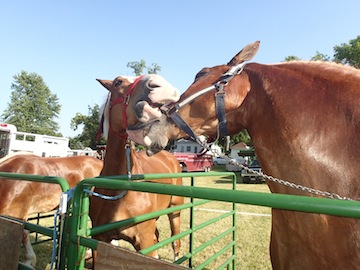
These two geldings from the Loomis Farms Belgian Hitch were feeling a little playful Friday afternoon prior to strutting their stuff in front of a wagon during the Pickering Horse Show.
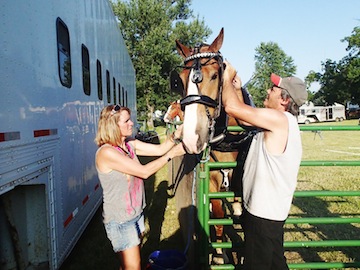
Heidi Carlson and Gary Loomis adjust the bridle on one of Loomis’ Belgian draft horses while preparing a six-horse team for an exhibition performance at the Pickering Horse Show. Grooming the horses and getting them in harness in front of a fire engine red wagon requires several hours of work prior to an arena appearance that might last for 15 or 20 minutes.
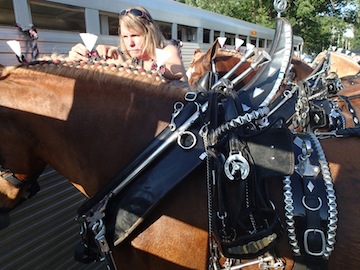
Heidi Carlson adds plastic “flowers” to the braided main of one of the horses comprising the Loomis Farms Belgian Hitch, a six-horse draft team that competes at county and state fairs throughout Iowa, Missouri, Kansas and Nebraska.
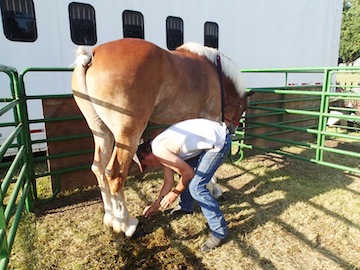
Gary Loomis applies black shoe polish to the hooves of one of his Belgian draft horses while getting ready for a Friday evening exhibition at the Pickering Horse Show. The polish creates a dramatic contrast with the animals’ white fetlocks.
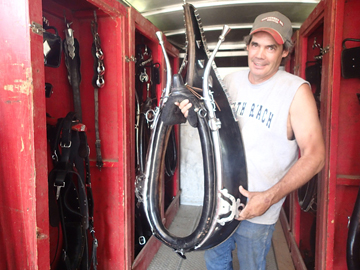
Belgian horse owner and trainer Gary Loomis displays one of the patent leather collars used by his six-horse hitch. The tack required to harness the hitch costs nearly $6,000 per animal. “There’s a saying in the hitch world,” said Loomis’ partner Carlson, “lots of people start out as multi-millionaires, but now they’re just millionaires.”