‘Day Tripper’ Pony Express Museum in St. Joe delivers fun for the whole family
STEVE HARTMAN/DAILY FORUM
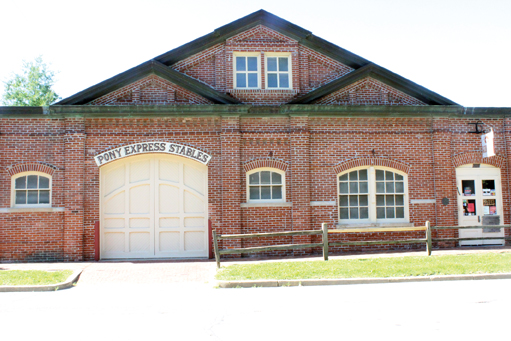
History stabled here The Pony Express National Museum, located at 914 Penn Street in St. Joseph is housed in what served as the stables during the life of the Pony Express during 1860-61. The first rider, Johnny Fry, left the stables at 7:15 p.m. on April 3, 1860. Fry arrived in Sacramento, Calif. on April 14, 1860 with the westbound mail.
Editors’s note: This is the second installment of a regular series the Daily Forum is publishing this summer about close-to-home tourist destinations. Today’s “Day Tripper” highlights The National Pony Express Museum in St. Joseph, Missouri.
Looking for a day trip that will entertain and educate everyone in your travel party? Jump in the car and take a quick 45-minute trip to St. Joseph and pay a visit to the National Pony Express Museum, located at 914 Penn Street.
The museum, which is actually located in the building that served as the stables for the Pony Express, is open from 9 a.m. to 5 p.m. Monday through Saturday and from 11 a.m to 4 p.m. on Sundays. Admission is $6 for adults, $5 for seniors, $3 for students, and travelers under six are free.
During the 1950s, the Goetz Pony Express Foundation and M. Karl Goetz, along with the aid and support form the Chamber of Commerce and the St. Joseph Museum, saved a portion of the neglected Pikes Peak Stables from total extinction. The protected part soon became Missouri’s Pony Express Museum.
In 1993, a further attempt was made to restore the remaining portion of the stables to its original size. Modern, interactive and educational exhibits were created during that time. Today, the central exhibition contains materials that illustrate the need, creation, operation and termination of the famous mail service, which lasted from April 1860 to October 1861. At this time, the museum was renamed the Pony Express National Mueseum.
“The community really got behind the 1993 restoration project,” museum executive director Cindy Daffron said. “We received so many one-of-a-kind pieces that really help to tell the story of the Pony Express as well as the history of St. Joseph.”
The actual Pony Express lasted only 19 months, but served as a vital step in connecting California with the rest of the country.
A total of 184 stations were set up between St. Joseph and Sacramento, giving each rider a fresh horse after he rode at a full gallop between stations. The riders were selected for their lightweight -— under 125 pounds. Due to this size limitation, many of the riders were quite young, with some as young as 11 years of age. Because of the dangers of riding alone through hostile territory, the company preferred to hire orphans. But the young men were paid well for their risky work: $25 a week, compared to $1 a week for unskilled laborers in 1860.
Up to 20 pounds of mail was carried in a mochila, a pouch thrown over the saddle and secured by the weight of the rider. Another 20 pounds of gear included a water bag, a Bible, two weapons (a pistol and rifle, or two pistols) and a horn for alerting the station operator to prepare a fresh horse.
“It took settlers traveling in wagons over three months to cover the distance between St. Joseph and Sacramento,” Daffron said. “The riders would cover the distance in 10 days.”
Rider Johnny Fry was the first rider to leave St. Joseph carrying westbound mail. He departed the stables area at 7:15 p.m. April 3, 1860. That same day at noon, rider Harry Roff left Sacramento with eastbound mail. Both arrived at their final destinations on April 14, proving the mail could be delivered in 10 days.
During 19 months of operation, only one Pony Express rider was killed, (traveling at night, his horse stumbled over an ox lying in the road, throwing the rider and then landing on him), and one bag of mail was lost in the Platte River in Nebraska.
The Pony Express continued until October 24, 1861 when both the east and west coast were finally linked up by the transcontinental telegraph line. The same day, the Pony Express was discontinued. Many Californians preferred the Pony Express as opposed to the faster, but less reliable, telegraph. Unfortunately, the government contract stipulated the service be discontinued after the Overland Telegraph Company completed its construction of the telegraph line. Many claimed the new service was unreliable when breaks occurred in the line.
Wild west icon William “Buffalo Bill” Cody claimed to have been a Pony Express rider, and contributed greatly to the legend of the Pony Express by including it in his wild west show. Cody brought the show to St. Joseph, and it was performed in the park across the street to the north of the current museum when Cody returned to the area to dedicate a monument depicting the origin of the Pony Express.
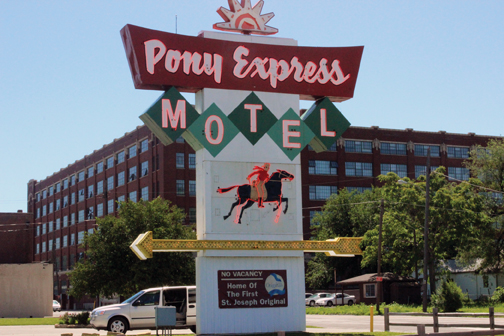
In addition to the telling the story of the Pony Express, the museum features a Whimsical Horses display, several interesting exhibits and artifacts tracing the history of St. Joseph, the Pony School, a fully-restored country school building and the iconic neon Pony Express Motel sign, which blazes in full neon glory most evenings.
For more information, contact the National Pony Express Museum at (816) 279-5059 or toll free at (800) 530-5059, or visit www.ponyexpress.org.
Within easy walking distance of the museum is the Patee House Museum at 1202 Penn Street. Built as a hotel and completed in 1858, the Patee House also served as the headquarters for the Pony Express. Also on the grounds of the Patee House is the house where famous outlaw Jesse James was killed in 1882. For more information on the Patee House Museum, call (816) 232-8206 or visit www.ponyexpressjessejames.com/patee.
STEVE HARTMAN/DAILY FORUM
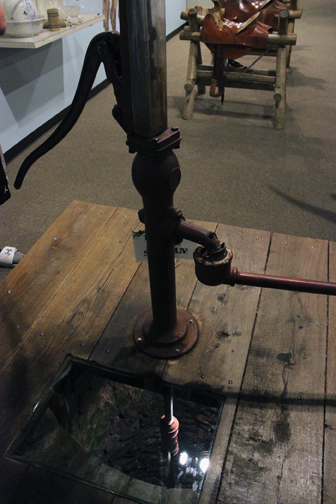
Original pump This is the original well for the stables, and the pump has been restored to working condition. This area of the museum makes for a popular photo opportunity for visitors as they pump water. The water level in the well is directly influenced by the water levels in the nearby Missouri River, and on a few occasions, the water level in the well has been so high as to nearly flood the museum.
STEVE HARTMAN/DAILY FORUM
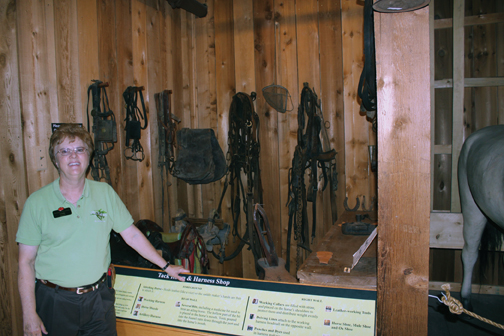
History on display Pony Express National Museum Executive Director Cindy Daffron stands beside an exhibit of saddles and bridles used by Pony Express riders. The museum is full of interesting exhibits for all ages.
STEVE HARTMAN/DAILY FORUM
A neon landmark The iconic sign for the Pony Express Motel, which was located on the Belt Highway, has been relocated to the grounds of the National Pony Express Museum. Thanks to the continuing efforts of Clarence Miller, who did the original neon design for the sign and continues to assist in maintenance of the sign, it still functions and can be seen lighted in its original neon glory most evenings.
STEVE HARTMAN/DAILY FORUM
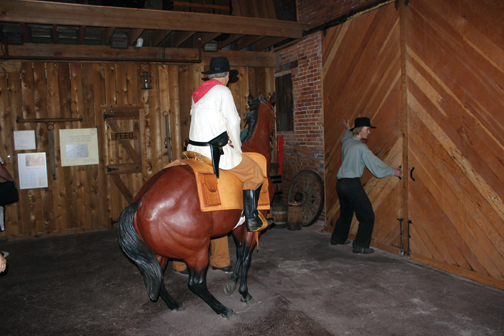
Where it all began This display, featuring rider Johnny Fry preparing to leave the stable with the first westbound bag of mail, is positioned at the actual location where the event took place at 7:15 p.m. April 3, 1860. Once out the door, Fry rode the short distance to the Missouri River, where a ferry delivered him to the Kansas side of the river. From there, Fry rode 90 miles at breakneck speeds before changing horses.