New rules require permit for food stands
FILE PHOTO
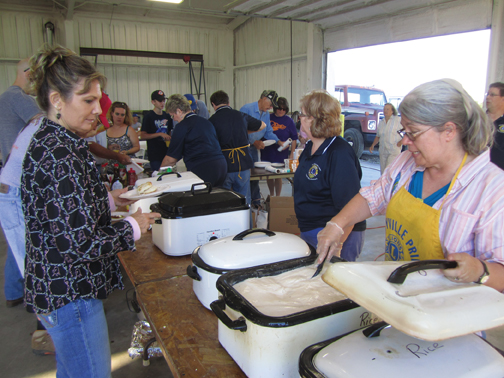
Kathy Rice, right, of the Maryville Pride Lions Club, wears plastic gloves while serving up biscuits and gravy during last year’s Heart of America Tractor Club Cruise. Under a county ordinance passed last October, service clubs, youth groups and charitable organizations must now acquire a permit and have at least one trained food-handler on site when operating concession stands at events like fairs, parades and town festivals. Both the permit and hour-long training are free.
Summer is fair and carnival time, and wherever there are fairs and carnivals there’s going to be lots of food — hot dogs, corn dogs, hamburgers, funnel cakes, brats, nachos, you name it.
A lot of that food will be served up by volunteers running concession stands in order to raise money for service clubs, churches, charitable organizations and youth groups. But there’s a new wrinkle this year.
For the first time, such organizations will be required to have at least one trained food handler on site and must also acquire an operating permit issued by the Nodaway County Health Center.
The new rules are set forth in an ordinance passed last fall by the Nodaway County commission, which is intended to make sure temporary concession operations conform to the Missouri Food Code with regard to sanitation and safety.
Center Administrator Della Rhoades said a fairly long list of organizations — saddle clubs, fraternal orders, churches and youth groups — have already had at least some of their members complete the training.
Tom Patterson, an environmental public health specialist with the health center, said the Food Code has always governed “temporary food service” operations, but that the state lacks the resources to conduct inspections and enforce regulations at thousands of concession stands that pop up during special events in virtually every Missouri community.
So county health departments like Nodaway’s, which operate on local taxes and contract their services to the state, are taking up the slack. About half of Missouri’s 114 counties, Patterson said, now have temporary food service ordinances on the books.
Though the requirements for permits and trained staff are new, Patterson said they are not intended to be burdensome. He added that his job is to serve as an educator with regard to safe food handling, and not a heavy-handed enforcer.
In other words, Patterson is not going to start shutting down 4-H hot dog stands and FFA feeds over minor infractions. He is going to hand whoever is running such operations a brochure titled “Guidelines for Temporary Food Events” and ask that members get trained and fill out a simple one-page application that, when signed, doubles as a permit.
Both the training, which lasts between an hour and 90 minutes, and the permit are free for non-profit groups. Commercial enterprises, say a shade-tree entrepreneur with a barbecue wagon, pay $10.
What’s more, Patterson is happy to meet with members of clubs and organizations at any time and place that’s convenient and provide training to whoever shows up.
Though only one trained person has to be present while a food stand is operating, Patterson recommends that groups get as many of their members trained as possible, so that they don’t have to depend on just one or two people.
Those who complete the training receive a three-year certificate, which is good regardless of who operates the food stand. That means a certified Lions Club food handler can also cook hot dogs at a concession run by the Boy Scouts.
Food-handler training is also offered at the health center, located at 2332 South Main in Maryville, at 1:30 p.m. on the first Thursday of each month, though Patterson requests that those interested call him first at (660) 562-2755 so he can make sure to be in the office.
The training is also offered via the Internet at statefoodsafety.com, though there is a $10 fee for taking the class online.
While the requirements for the permit and training are new, the regulations that govern preparing and serving food to the public at special events are not. Administered by the state Department of Health & Senior Services, the rules are set forth in state statutes that have been in force for years, and they say about what one might expect.
Food workers must wash their hands thoroughly and often. When plastic gloves are worn, they should be used for only one task, such as working with ready-to-eat food, and then discarded. Workers should also wear hats, hairnets, beard restraints and clothing that cover head, face and body hair.
Other topics covered in the training include proper temperature controls, storage safety and techniques for avoiding “cross-contamination,” such as keeping bread and uncooked meat in separate containers.
Patterson said that most service clubs and charitable organizations operating at fairs and other events need only the temporary food vendor permit, which is good for up to 14 days. Some groups, however, serve public meals or regular concessions from a single venue and may require regular inspections and an annual permit, which is good Oct. 1-Sept. 30.
The temporary permit requires vendors to supply the name of their organization, the applicant’s name, a street address, phone number, email, name and location of the event, person in charge, type of food served and dates of operation.
Patterson emphasized that the center is interested solely in protecting the public’s health, and has tried to keep the permitting and training process as simple and hassle-free as possible.
“We’re not looking to close down events,” Patterson said. “That is not the intent. The intent is educational.”