Crop health all over the board
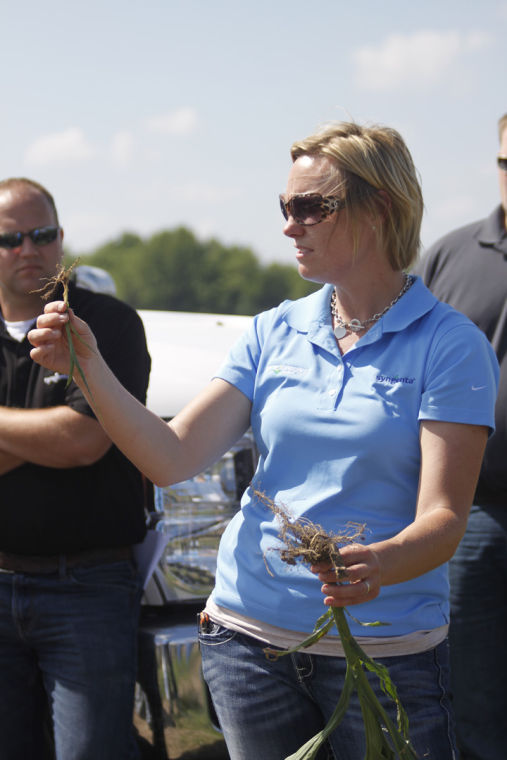
KAITY HOLTMAN/DAILY FORUM
Erin Dinsdale, agronomist and part-owner of Milne-Dindsale Seed, LLC, shows a group of growers some of the corn plants she’s checked so far this growing season. The smaller stalk in her right hand is the result of soil compaction.
It’s no secret that this planting season has seen a wide range of weather conditions. Corn is beginning to show considerable growth, but it’s also showing a wide range of injury.
Erin Dinsdale, local agronomist and part owner of Milne Dinsdale Seed, LLC just west of Maryville, said she’s seen corn in what seems to be every possible condition since it’s emerged.
“This is the widest range of crop health I’ve seen in my 16 years as an agronomist,” Dinsdale said. “There is definitely and unusual amount of crop injury.”
Dinsdale’s list includes shallow planting, anhydrous burn, chemical carryover, first-pass issues, and others.
“We’ve definitely has an unusual growing environment,” she said.
Crops went in to cool soil, which took a long time to warm up, just to cool back down to frost levels. Rainfall eventually came, but it was too little or too much in every place.
Tim Dreier, executive director of the Nodaway County Farm Service Agency (FSA), said that we are below the 30-year average for rainfall.
“Our rain gauge here at the office has recorded 8.02 inches from January 1 through May 31, 2014,” Dreier said. “The 30-year average is 12.01 inches.”
What Dinsdale has noticed was that anywhere growers were disturbing the soil has paid off. This includes applying anhydrous and other treatments.
“Weed management is key in the next couple weeks,” Dinsdale said late last week to small group of growers. “Or at least until the corn is shoulder height.”
Now that crops are in and most replanting is done, it’s about farmers asking themselves “What can I control?” While many factors are out of their hands, mostly weather, they’ve got to think about what they can do to baby their crop along until the plants are more mature.
“Rule things out, think about what it’s not,” she said. “And start assessing how you might do things differently next year.”
Shallow planting, soil compaction continue her list of reasons she’s seen the range of crop stages.
“Dig up the dirt and check planting depths, look for too much fluff above the ground,” she said. “Did the new guy go too fast? Did the old guy go to fast? Do we need more down pressure and less depth? Or the reverse? All of those are questions you should be asking yourselves at this point.”
In the next couple weeks, as the crop continues to grow, most of the injury and poor stand will likely not show anymore.