
New wake boat ordinance takes effect at Mozingo
GEOFFREY WOEHLK/THE FORUM
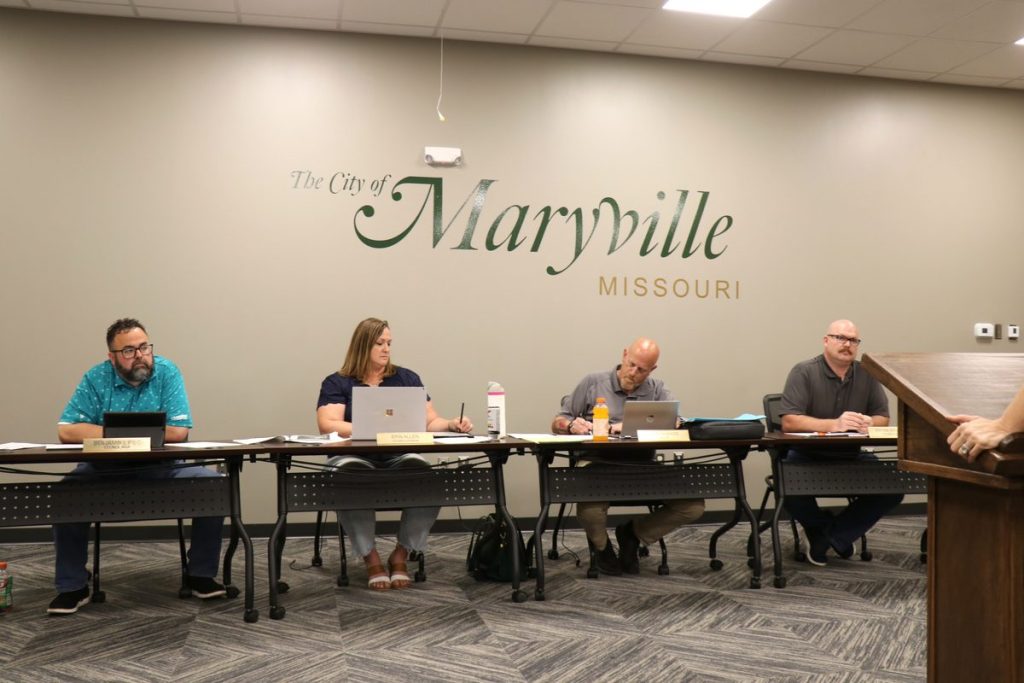
The Maryville City Council on Monday approved an ordinance that addresses wake boat safety at Mozingo Lake and changes a boat parking policy following a concern from a resident.
MARYVILLE, Mo. — The Maryville City Council on Monday approved a new ordinance that prohibits “wake enhancements” on Mozingo Lake like full ballast tanks on wake boats and wake-shaping devices.
Wake boats are not prohibited by the ordinance, but ballast tanks and ballast bags must be empty when operating on the lake. The ordinance also bans active wake shapers, fins or other wake enhancement devices, and prohibits artificially bow-high operation of boats.
The change was made following recommendations from the Mozingo Advisory Board, which was looking to address increased usage of wake boats on the lake. Wake boats typically feature a ballast or bag that, when filled, leave a large wake behind the boat.
“So even though you’re not going fast, it’s creating these large waves for people to be able to ski and tube and do all of these fun things off of. Which is great, in theory,” said Jordyn Greenhaw, Mozingo park director, during Monday’s regular City Council meeting. “However, with our thousand-acre lake, when you get about two of those crossing each other, it does create a big safety hazard if someone were to fall off of the skis, off of the tubes.”
Greenhaw said it could also create safety concerns for swimmers on the beach as well.
But the issue was brought to Mozingo officials by the Missouri Department of Conservation, Greenhaw said, because the wake enhancement devices can also cause environmental damage, including destroying the shoreline and stirring up the bottom of the lake where runoff and sediment has settled.
Greenhaw said the goal was not to ban wake boats entirely, which is why the ordinance only prohibits wake boats from filling their ballasts or bags and other wake enhancement techniques.
As part of the process of drafting the ordinance, Greenhaw consulted with MDC and with the Maryville Police Department, which operates the Lake Patrol.
“And Lake Patrol, speaking with them, they’d still be able to easily tell if those ballasts are filled or not,” she said. “If those ballasts aren’t filled, it’s just like a regular boat going normal speed and people are still out and able to enjoy the weather and the water.”
The ordinance went into effect immediately.
Boat slip policy
In addition to the wake boat change, the ordinance approved Monday also changed Mozingo regulations related to who may park boats overnight at boat slips.
Previously, only guests staying at the park overnight were allowed. During the June 8 council meeting, Steve Reed, who lives near Maryville and has a disability, asked the council to change the policy so he could park his boat at the lake because it is difficult for him to move the boat very often.
At the recommendation of the Mozingo Advisory Board, the regulation change approved Monday now allows anyone authorized by Mozingo officials to park their boats. Council member Erin Allen acknowledged that may put an undue burden on Mozingo staff, and asked Greenhaw to come back after several months of the new system to report on how it’s working.
Evergy fire agreement
Also during Monday’s meeting, the council approved a mutual aid agreement with Evergy’s Mullin Creek Generation Station, a 440-megawatt natural gas power plant that is under construction south of Maryville near Evergy’s existing substation.
Fire Chief Jace Pine said the plant will store hazardous materials including various oils, hydrogen, backup batteries and, most notably, approximately two million gallons of diesel fuel that would be stored for backup use in the event natural gas supply is lost.
Officials from Evergy, the Maryville Fire Department and the Barnard Fire Protection District met last year after the project was announced to discuss emergency response considerations. As a result of those discussions, the agreement approved Monday provides a trailer that can be used to control particularly hazardous fires like the ones that could come from the materials at the power plant. The trailer, purchased by Evergy, carries 500 gallons of F500 encapsulator agent, which Pine said is a substitute for foam substances that are being phased out because of concerns over their cancer-causing properties. The city first used the F500 agent to put out a stubborn fire at the former Maryville Transfer Station in 2024 and have since used it several times, Pine said.
Although the power plant will be in the Barnard Fire Protection District, there isn’t room to store the trailer at that facility. Instead, it will be stored in Maryville and the Maryville Fire Department will be responsible for maintaining it. But the agreement allows the fire department to use the trailer for any incident, not just at the power plant, and Evergy will continue to pay for the expensive F500 agent. Pine estimated that the 500-gallon trailer carries about $20,000 worth of the agent.
“It is an awesome asset to have in our area just to help protect the community,” said council member Bryan Williams, a firefighter who was the first to use the F500 agent in Maryville. “Just thinking about all the ethanol trucks that move through our area going from Iowa down south, we do have a lot of fuel loads and hazards in the area that (this) will apply to great. Very useful. I’m pretty excited to have that up here.”
Water treatment membranes
Public Works Director Matt Smith told the council during Monday’s meeting that aging water filtration membranes at the Maryville Water Treatment Plant are struggling to keep up with demand and the city may need to purchase new ones to use until the new water treatment plant is completed.
Smith said the membranes have especially struggled after recent heavy rains that stirred up Mozingo Lake, the city’s drinking water source. Stirring up the sediment adds more hard-to-filter substances, slowing the process.
The plant uses three sets of membranes called “trains.” One train was replaced last fall. The other two trains, though, are having trouble keeping up, Smith said.
He acknowledged that the timing is unfortunate. When the city announced the plan for a new water treatment plant in 2024, it also announced an ambitious timeline to have the facility in operation by 2027. Getting the plant online as quickly as possible might have allowed the city to avoid the cost of having to replace the filtration membranes, which won’t be compatible with the new facility. The membranes typically last about seven years, and the oldest membranes were purchased in 2020.
However, severe winters and other environmental factors have fouled the membranes at an accelerated rate, officials have said, sapping their effectiveness faster than anticipated. Smith said it is likely that the city will need to budget for replacing the membranes during the city’s next fiscal year which begins in October.
Final completion of the new water treatment plant is now expected in December 2028, City Manager Ryan Heiland said during Monday’s meeting.
Other City Council notes
- Following concerns raised by residents about e-bike and e-scooter safety, the city has partnered with the Northwest Missouri Regional Council of Governments on an e-bike and e-scooter safety awareness campaign, Heiland said. The campaign will include events at the Nodaway County Fair, the aquatic center, the Thomson Splash ‘N’ Play, the back-to-school fair and the downtown farmers market.
- Heiland said dirt hauling at the site of the new water treatment plant has begun and will continue for about 30 more days. “They’re running about 250 trucks a day to the site out there,” he said. “Pretty amazing operation to watch.” Dirt will fill 10 to 14 feet over the existing berm, and that will sit until the dirt has compacted enough. Then the dirt will be scraped to the west and full construction activities will begin, Heiland said.

FORUM FILE PHOTO
Water filtration membranes like this one, shown during a tour of the Maryville Water Treatment Plant in 2020, were installed that year and have an operating lifespan of about 7-12 years, according to HDR.
GEOFFREY WOEHLK/THE FORUM
Mozingo Sign




