Residents ask PWSD No. 1 to refuse water for data center

GEOFFREY WOEHLK/THE FORUM
Brock Pfost, president of White Cloud Engineering and Construction and a longtime consultant for water projects throughout northwest Missouri, answered several questions from the public during Monday’s PWSD No. 1 board meeting. Pfost oversaw a feasibility study that will analyze water resources available to the proposed White Cloud Acres data center project.
MARYVILLE, Mo. — The Nodaway County Public Water Supply District No. 1 Board of Directors on Monday told a packed meeting room that a feasibility study analyzing potential water sources for the White Cloud Acres data center project will soon be released.
Residents opposed to the data center project filled the conference room at the Nodaway County Administration Center, where the board’s regular meeting was moved to accommodate the large crowd.
One of the chief concerns residents have expressed is over the effects on local water resources.
“I would hope that you guys would not be supportive of this but actually … stand up for us and our way of life and say, ‘No, you cannot have our water,’” Jennifer Gillespie, a property owner in the proposed project area, told the board members during an open comment period.
Scale Microgrids, the project developer, has said it plans to use approximately 1.5 million gallons of wastewater to cool the facility’s thousands of processors and related equipment via a closed-loop cooling system. In that scenario, the wastewater would be sourced from the city of Maryville and piped to the data center, about 8 miles south of Maryville.
The feasibility study was conducted by a third-party civil engineering and surveying firm, Lamp Rynearson. Brock Pfost, president of White Cloud Engineering and Construction and a longtime consultant for water projects throughout northwest Missouri, oversaw the study. Pfost said during Monday’s meeting that because he has lived here for more than 60 years, he brought in Lamp Rynearson to conduct the study to avoid any potential conflicts of interest. The study was paid for by Scale Microgrids, he said, but produced for PWSD No. 1.
According to a white paper written by Pfost and distributed by Scale Microgrids, the study looks at potential water sources for the data center, including:
- Expanding existing infrastructure to bring water from the city of Maryville
- Partnering with Evergy to “piggyback” water from the utility’s natural gas power plant set to be built across the highway
- Using wastewater from the city of Maryville
- Allowing the data center to draw water directly from the One Hundred and Two River
Scale Microgrids has made clear that its first choice is to use wastewater from Maryville, which would reduce the data center project’s total need for potable water to just under 100,000 gallons per day, the company has said. Most of that amount, around 70,000 gallons per day, would be used for cooling equipment at the 600-megawatt natural gas power plant the company plans to build at the data center site. Pfost said the 100,000 gallons per day would make the data center PWSD No. 1’s largest water customer.
Mike Wilson, clerk of the city of Bolckow, was one of several residents who were especially concerned about the potential use of water from the One Hundred and Two. Although Scale Microgrids has said its preference is to use wastewater to supply the 1.5 million gallons needed to cool the data center, the feasibility study is looking at the possibility of drawing from the river as a backup plan. Wilson said he is worried that the study will only measure whether the river will adequately supply the data center without giving consideration to what water would be left over for communities like Bolckow, which sits about 10 miles downstream.
Missouri, Wilson said, is a “riparian” state.
“Now if you don’t know what that term means, it means that people downstream have as much right to the water as people upstream,” Wilson said. “You can’t use all the water you want.”
He was one of more than a dozen residents who implored the board to refuse to supply water to the data center project.
“We have a right to thrive and survive and produce and drink,” Mary Mizera, a resident opposed to the data center, told the board during the public comment period. “And you guys can’t just come in and make a decision for all of us. You’re replaceable, quite frankly. You’re replaceable.”
Pfost told the board members that he has sent them a nearly finalized draft version of the feasibility study. After the board members look over the study, they will discuss how best for PWSD No. 1 to move forward. Pfost said the study would likely be posted to the PWSD No. 1 website. The white paper written by Pfost said the board is expected to make a decision by the third quarter of 2026, which begins July 1.
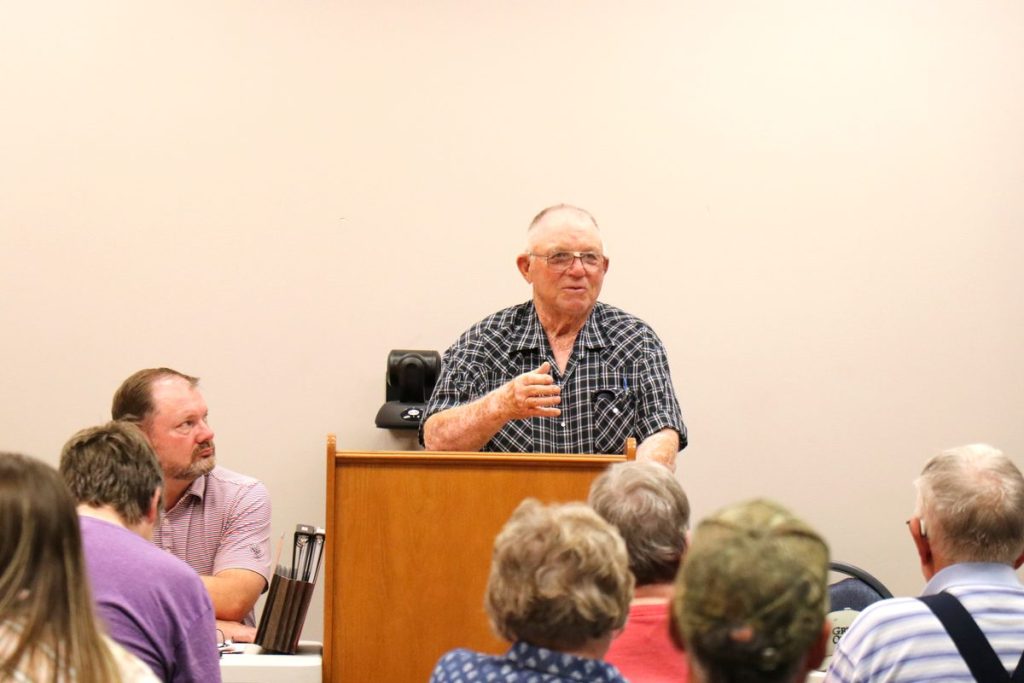
GEOFFREY WOEHLK/THE FORUM
Dean Adwell, PWSD No. 1 board president, speaks during Monday’s regular meeting at the Nodaway County Administration Center. Adwell said the board set aside an hour for public comment during the meeting to learn more about residents’ concerns. He said he wasn’t for or against the data center yet.
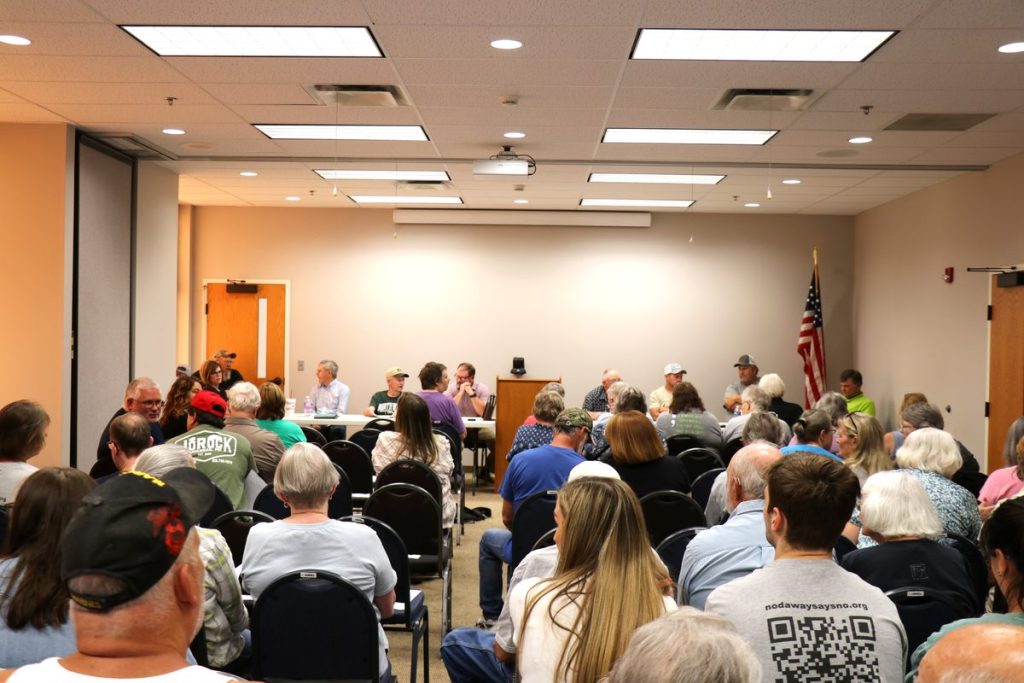
GEOFFREY WOEHLK/THE FORUM
Residents opposed to the White Cloud Acres data center project packed a meeting of the Nodaway County Public Water Supply District No. 1 Board of Directors on Monday at the Nodaway County Administration Center to ask the board to refuse to provide water to the project.