The expansion and contraction of rural schools in Missouri
NCHS MUSEUM
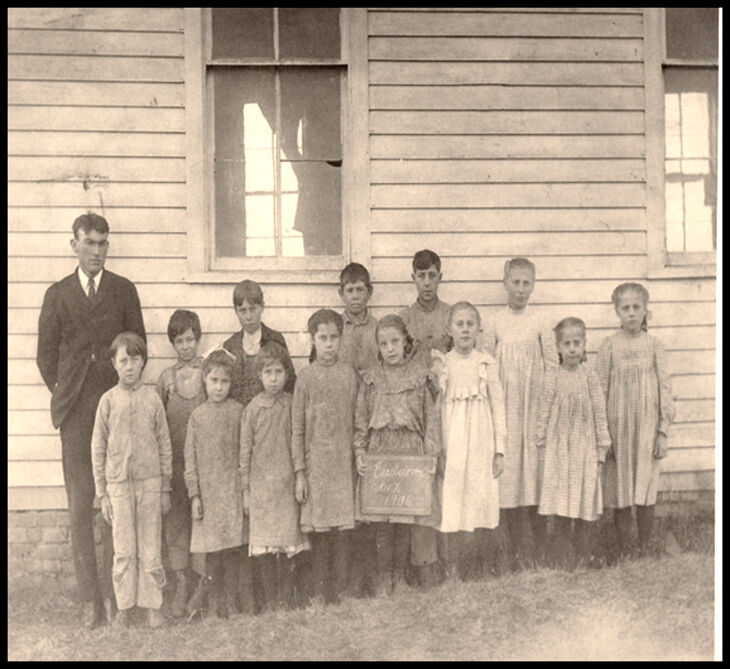
A teacher and students are pictured outside the Excelsior School in 1906.
In the 1785 Land Ordinance Act, the U.S. Congress laid the foundation for the organization of schools and land: each township (6-by-6 miles) should grant the 16th section (1 square mile) to the state for the use of a school for the inhabitants.
The Missouri Constitution of 1820 specified that one school or more should be established in each township of the state, and the township became the unit for school organization. Later laws in 1835, 1839 and 1853 made the school district the unit of organization, but from 1866 to 1874 the township was again used. Finally in 1874 the main features of the rural school system were established, with a local school district set up to be administered by a board of three directors.
In 1874, Missouri mandated that schools needed to be established within a one-hour walking distance or two miles from the students in the area. This can also be referred to as the “child-walking distance per hour” measure, and it resulted in around 10,000 school districts in Missouri, most of them rural. This change also resulted in collecting taxes from the township to finance schools, compared to the private school system that was in use before.
For Nodaway County, this meant that by 1911 there were 181 school districts in the county, but over time many of these districts were consolidated. By 1931, the number of districts had been reduced to 132. Of these, 113 were rural schools, while the remaining 19 were either city or consolidated districts.
Many children went from going to a smaller district school, to then have it consolidated, and ended up at a larger school in the county, such as students who started out at Union School in 1899 and then graduated from Elmo High School in 1908.
Students in Nodaway County schools had varied experiences due to the large number of districts, but there was some overlap. The small, rural schools usually had a limited slate of extracurricular activities, such as music, athletics and theater.
Most of the early rural schools only went up to eighth grade, and students then took a test to graduate from school. If the student passed, they could go to high school or begin working with their family. If they failed, they repeated the eighth grade until they passed.
The agricultural emphasis of the region also impacted the schools. Often, school years would be shortened with breaks for the harvesting season. If a school did not do this, many boys simply would not attend during that time. This caused some boys to fall behind in their education, and sometimes they had to repeat a grade so many times they would be older than the teacher.
Teachers were expected to be model examples in the communities where they taught. The following is a list of rules commonly applied to northwest Missouri teachers in the 19th and early 20th centuries:
- “The teacher will visit every home during the school year.”
- “The teacher is expected to attend church and perform other duties as requested.”
- “The teacher will not marry during the term of your contract.”
- “The teacher must be home between the hours of 8 p.m. and 6 a.m. unless attending a school or church function.”
- “The teacher may not loiter downtown in ice cream stores.”
- “The teachers may not ride in a carriage or automobile with any man unless he is a father or brother.”
- “The teacher may not dress in bright colors.”
- “The teacher may not smoke cigarettes or use any other tobacco.”
- “The joining of any feminist movement is cause for immediate dismissal.”
- “The teacher who performs her duties regularly and faithfully, without fault for five years, will be given an increase of 25 cents a week in pay providing the Board of Education approves.”
- “Every teacher should lay aside a goodly sum for her benefit during her declining years, so that she will not be a burden to society.”
In 1969, the Missouri General Assembly passed a bill, signed by the governor, that would eliminate the three-director school district by July 1, 1973. Within one year from the signing date (Aug. 25, 1969), all non-operating school districts merged with a six-director district, and within three years from that date, all operating three-director districts merged with an operating six-director district. After the closing of many one-teacher schools and consolidation, a reorganization of the school system occurred in Nodaway County in the 1950s. By 1958-1959, there were only nine one-teacher schools and two two-teacher schools remaining in the county. When the last one-teacher school in Nodaway County closed its doors in 1960, the rural school district disappeared, along with the one-room schoolhouse, eliminating a system in use for over a hundred years.
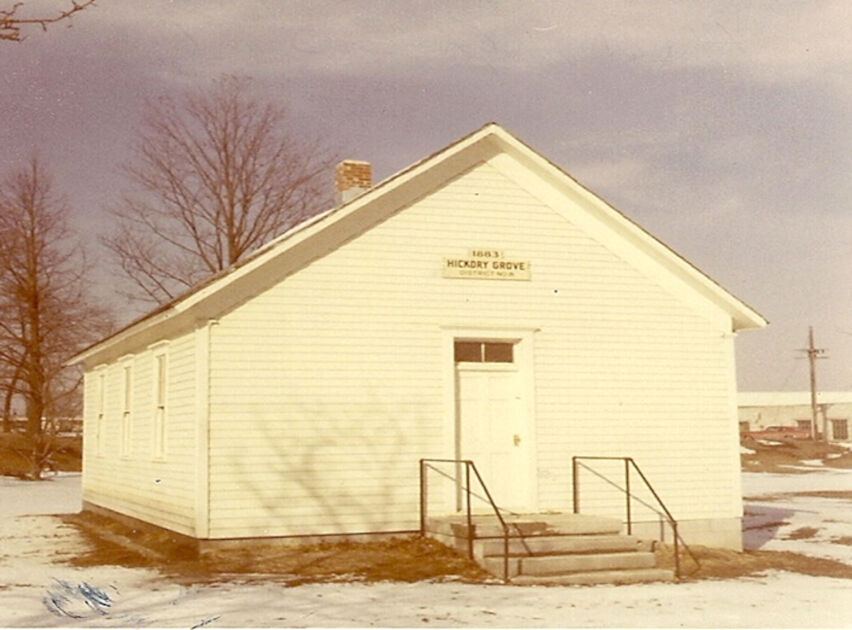
Visit the NCHS Museum at 110 N. Walnut St. to learn more about the history of education in Nodaway County, including a visit to the historic Hickory Grove Schoolhouse, a one-room schoolhouse that you can explore at the museum.
The museum is open March to December on Tuesdays to Fridays from 1-4 p.m. and on the second Saturday of each month from 9-11 a.m. We also host monthly programs and are free to the public.
Upcoming events include a program about genealogy with local expert Tina Brown on Saturday, June 13, at 11 a.m. and our annual meeting on Monday, June 22, at 5:30 p.m. Learn more about the museum’s work on our website, nodawaycountymuseum.com. You can contact us at [email protected] or 660-582-8176.
NCHS MUSEUM
The historic Hickory Grove Schoolhouse is now located at the Nodaway County Historical Society Museum for visitors to explore.