Mosaic Wound Care study earns international recognition for innovative bandage results
SUBMITTED BY MMC-M
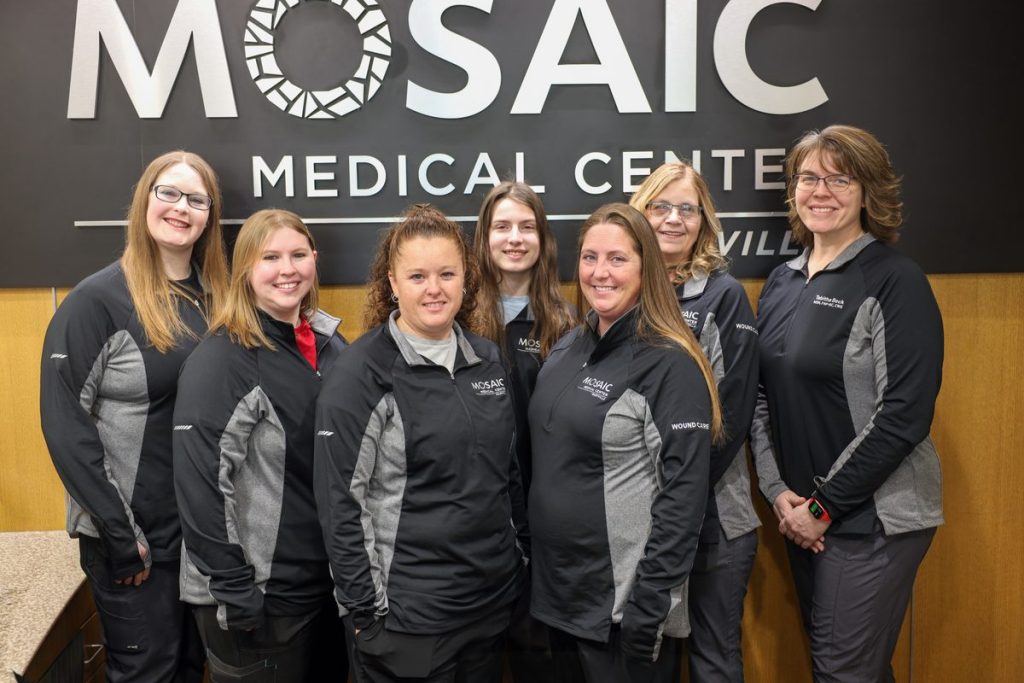
A clinical case study written by Mosaic Medical Center – Maryville wound care team members Carrie Dannar, Tyra Price, Mary Jo Riley, Alissa Bender, Nikki Atkison, Janet Morton and Tabitha Beck has been selected among top care research projects with regard to wound care.
MARYVILLE, Mo. — What may appear downright disgusting to some has a way of making Tabitha Beck light up with excitement. For the traveling wound care provider currently working at Mosaic Medical Center – Maryville, wound care is singularly important, and the outcome of her first study involving new long-lasting Coloplast bandages is making her grin even brighter.
“We’re doing great things at this clinic,” she said. “The impact of this study for other people around the globe … is really big. It’s a big deal.”
Beck, on behalf of the MMC-M Wound Care team, recently presented the findings of its study — one of only 50 selected worldwide — at the Northern Lights Wound Workshop in Reykjavik, Iceland. The study also was featured at the Aurora Awards, an international forum honoring outstanding clinical innovation in wound care.
The study examined the usefulness of a new Coloplast foam bandage for advanced wound care of venous leg ulcers. The team designed and conducted the study over a three-week period and saw what Beck described as “incredible” improvement in skin growth and condition.
She said many bandages that feature foam around an absorbent pad wick draining liquids away from a wound and onto the pad, where it spreads out. That still allows contact with the wound, though, which causes skin maceration — softening, whitening and breakdown that is caused by being too moist for too long. Skin maceration, in turn, can cause the wound to get even bigger in some cases.
“How long does it take when you’re doing dishes to get wrinkled skin like that — I mean, maybe 20, 30 minutes?” Beck asked. “OK, so think about that if you’re doing that for three days.”
The new bandage not only wicked away fluids, but moved them up and locked them away from the wound, leaving it drier and less likely to weaken the surrounding skin.
“I was able to prove that I didn’t get that moisture-associated maceration,” Beck said.
As part of the study, Beck and the team, along with members of the Mosaic Home Health team, worked with the patient to track progress, taking photos every time the bandages were removed and weighing the bandages before and after use.
The weight of the bandages went from 1.9 ounces before application to 4.8 ounces, which converts to about a third of a cup.
“A third of a cup. I mean a third of a cup! That’s an insane amount of drainage, No. 1, but just to hold that away (from the wound),” she said, comparing it to a baby diaper that, if left on for longer than an hour after urination, can start dermatitis breakdown. “This is seven days holding that moisture away from the skin. I just thought that was incredible.”
Beck said after the study was written, she spoke to a company representative who told her there also is a small amount of bio-evaporation that occurs at the top of the bandage, helping the process.
Tracked throughout the three-week study in both descriptions and photography, the photos tell the story of significant healing.
“We were all just kind of blown away,” Beck said. “I think we were all just surprised at how effective this particular product is.”
Time is one of the most exciting aspects of the study for the team. Typically, this type of bandage is removed every three days for care and usually requires a zinc oxide or silicone-type barrier cream.
The Coloplast bandage doesn’t require an additional cream and can stay on the wound for up to seven days, Beck said.
“If you’re in a clinic that is looking at cost, you know everything that you do for a patient takes money,” she said. “… If you’re looking at those nickels and dimes, if you can get the same result out of one border foam or one product versus having to combine a lot of different things, that really speaks well for the product itself.”
For people struggling to afford bandages, she said the product’s length of use would be “really big,” adding that the potential to help in underdeveloped countries is huge.
Advanced wound care
“When we put on our card, ‘Advanced Wound Care,’ I want to be advanced,” Beck said. “I want to have all of the products. I want to know what is the latest and the greatest, and I want to have that option for patients. … I want to bring that to these clinics because everybody deserves standard of care. Everybody deserves quality care.”
Working in wound care, Beck said, is just as exciting for patients looking for results as it is for providers who get to see them heal.
“If I had a motto for my person it would be ‘Hope Through Healing,’” she said, explaining that chronic wounds can alter lives in unexpected ways — from avoiding church because of odor or device noise to skipping restaurants out of embarrassment.
“So when you’re able to give patients their lives back — you can wear dresses again or you can wear sandals again or you can wear shorts or whatever the case may be — and people don’t look at you like you’re some kind of leper, then it really does something amazing for the social connection, the mental health,” Beck said. “And that’s why I say hope through healing. By the time a patient comes to see me in a wound center, I feel like they’ve exhausted a lot of their other resources and I think they feel like ‘I’m always just going to have this.’
“So I always say you’re not destined to have a wound. You didn’t just draw this card in life. There’s always a reason why you don’t heal, so we have to figure out what the reason is.”
As for the patient in the study, Beck said he is happy with his progress and she expected him to be healed later in the week.
“I feel like this is just serendipitous, like it’s almost divine, truly, because as a traveler, I could have been anywhere,” she said. “I could have gone to any clinic, and I’ve been to some where the passion isn’t as evident as I experience here with Janet (Morton) and Carrie (Dannar) and Tyra (Price). When we have our little huddles, I know that they care.”
Beck and other teammates told The Forum earlier in the month that Mosaic Home Health staff played a major role in the study, caring for the patient’s wounds at home and tracking progress.
“They were instrumental in helping us as well, just keeping up on him,” Dannar said.
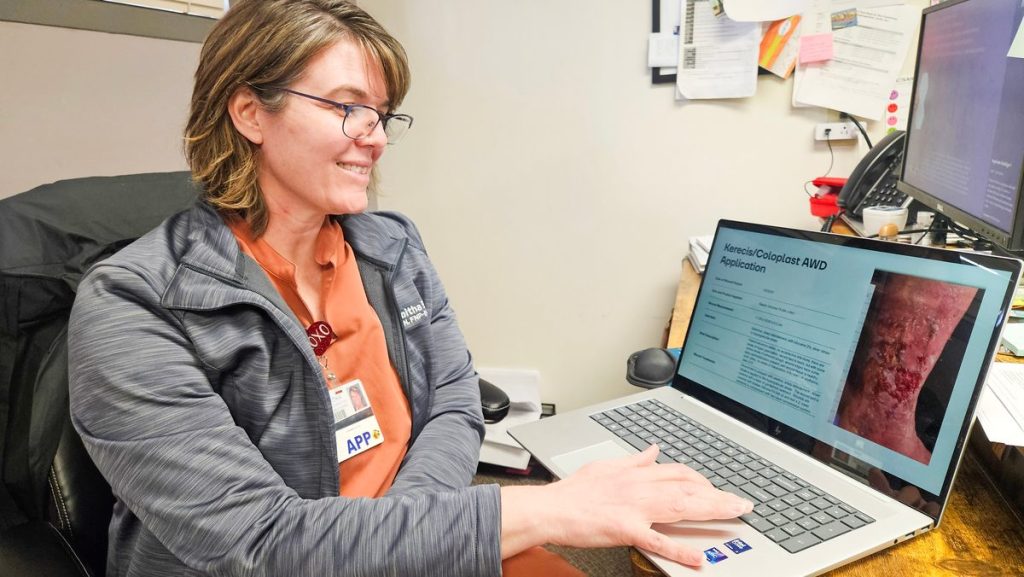
SKYE POURNAZARI/THE FORUM
Tabitha Beck, traveling wound care provider, looks at her slideshow from a presentation she gave in Reykjavik, Iceland, regarding a wound care study that the Mosaic Medical Center – Maryville Wound Care Team conducted about an innovative bandage.