IAMO, township spar over road rock reimbursement
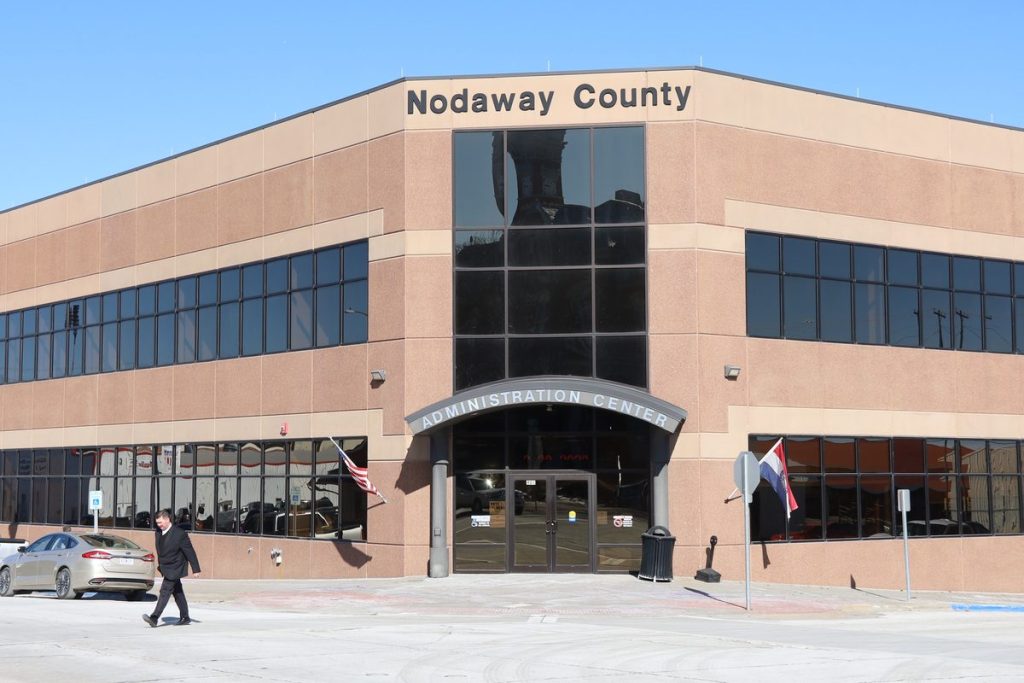
FORUM FILE PHOTO
Nodaway County Administration Center (copy)
MARYVILLE, Mo. — During a contentious meeting last month, IAMO Communications CEO John Shelton said that reimbursing Atchison Township for road repairs could result in having to do the same for other townships, potentially leading his company to slow fiber rollout in Nodaway County and raise rates on customers to absorb the cost.
At issue is just under $10,000 that township officials said the internet provider, which provides service to customers on both sides of the Iowa-Missouri border, should pay as part of its contract with the county to install new fiber lines last year. The Nodaway County Commission mediated a meeting about the dispute on Dec. 23.
The contract includes standard language that the company is responsible for restoring roads affected by the construction work to their previous condition or better. Township officials pointed out that other projects, for a pipeline and wind farms, have previously worked with county and township representatives to ensure the roads were in satisfactory condition, or had simply asked for a bill after the township had completed restoration work itself.
Township officials said that when work was completed around the beginning of November, the construction contractor, NewTech Construction, did not satisfactorily restore the roads to their previous condition. The county commissioners said that after a heavy rain, they received several complaints from residents, particularly farmers, who were unable to get in and out of their properties because of how muddy the roads had become, and drove the roads themselves.
“It was almost impassable even in our four-wheel drive,” said Presiding Commissioner Bill Walker.
Atchison Township Trustee Brandon Dougherty said he contacted Shelton, IAMO’s general manager and CEO, at that point to let him know the township planned to re-rock the roads as soon as possible to fix the issue and asked Shelton to come down and see them for himself. Doughtery said Shelton did not come down until after the muddy roads had dried, which Shelton stipulated to.
“They weren’t bad then, in my opinion,” he said.
Nate Larabee, a member of the IAMO board of directors, said that he had driven the roads just before the meeting in December after they had been re-rocked and said they looked good. He also questioned multiple times whether the added rock had been necessary and said there seemed to be too much rock on the roads he’d driven on.
The township’s reimbursement request did not include labor or other related costs, just the cost of the rock, totaling $9,982 for 434.14 tons across 6-8 miles of gravel roads.
Shelton told the group that IAMO’s board of directors didn’t “have an appetite for it.”
Potential precedent
Shelton said his company was reluctant to pay for the rock because it could cost the company more money if other townships run into similar issues and try to recoup their repair costs as well. If that happens, he said, IAMO may slow fiber rollout into rural parts of the county and raise rates on customers to pass on the expense.
“The sticking point for me is that in all the years we’ve been doing fiber, this is the first time anybody’s ever asked if I was gonna pay for rock. Ever,” he said. “… If we do, I’m setting a precedent in Nodaway County that makes that a reality every time we do construction in Nodaway County — specifically Atchison Township — this becomes the expectation. So then I have to figure into that, if I’m gonna plow fiber, this becomes an expense on that project and I will bring less fiber to Nodaway County.”
Getting fiber to rural residents is cost prohibitive, Larabee added.
“We might make a dollar on this project in about 12 years,” Shelton said.
The project was funded by federal grant money as part of a longtime push to get fiber internet into rural households. Adding the expense of reimbursing rock in the event of problems with road restoration would mean the company would look for a way to retain what little profit it might see from the expansion by having customers ultimately foot the bill, Shelton said.
“On a project this size, it’s not so bad,” he said. “But if somebody builds a house down the road from you, if I have to buy 100 ton of rock per mile or some damn thing to construct over to that person, I’m just gonna pass that on.”
Atchison Township Trustee Brandon Dougherty said that he couldn’t speak for why others had never pursued what he believed was clearly stated in the contract. During one of several heated exchanges, Dougherty threatened to encourage other townships to do just that.
“Well if that’s how you’re gonna pose it, then I don’t think we should buy any rock,” Shelton responded. “Because that’s the concern. If you wanna leverage that, then that is the concern.”
However, Eric Jones, the road maintainer for Atchison Township, said this situation probably wouldn’t recur because of unusual factors that resulted in the roads being in such bad relative condition after restoration.
Unusual factors
One of the major causes of the problem, all sides agreed, was that the county commission approved a different method than usual of installing the fiber line for this project. The commissioners said they offered the option to NewTech after the contractor brought it up as a possibility.
For this project, NewTech installed the new lines under the center of the roads, instead of to the side, as is the usual practice. Putting the lines under the center, the township officials said, resulted in soft spots along the tubes under the crowns of the roads, softening the base. The problem was exacerbated during the first major rain.
However, township officials and its road crews, which maintain the gravel roads, were not involved in the permitting, which is handled through the commission. Additionally, Shelton said that the company’s usual practice is to put the lines at the side of the road rather than the center, and had he been involved at the time, he would not have wanted to put the lines down the center either. The commissioners said they will not allow that method again in the future.
But it is a symptom of a larger communication issue that North District Commissioner Chris Burns said is inherent to the township style of government: The county approved the permits and signed the contract with the construction contractor, but it’s the township that handles the road maintenance itself.
That manifested in another problem.
Township officials said they were never contacted by the contractor about when work was to begin. Had they known, Dougherty said, the township would have held off on rocking the roads initially until after the work was completed so it would only need to be done once. But because they didn’t know beforehand, crews rocked the roads as usual and then the roads were torn up for construction.
A third major reason was many of the roads were in unusually good condition prior to the fiber installation due to work done for a wind farm project. In preparation for that project, that construction contractor used a chemical road hardener to stand up to the added weight that would be coming and going along the gravel roads. The hardener stabilizes the underlying soil and results in a material that can be nearly as sturdy as concrete. A little more than half of the roadways dug up for the fiber project had received such treatment, Jones said.
Because NewTech was laying the fiber under the center of the road instead of to the side, more of the road had to be dug up than usual. Normally, that would not have mattered too much. But because many of the roads had been hardened and the underlying soil bonded together, much more than just the center was torn up.
“It came up in sheets,” Jones said.
Those unusual factors are unlikely to repeat and set much of a precedent for future projects, Jones said.
The two IAMO officials said they would bring the matter to the next board of directors meeting on Jan. 12.
EDITOR’S NOTE: Eric Jones is a member of The Forum’s Editorial Board. Editorial Board members are not involved in news reporting decisions.