Sen. Black helping to target rural school funding
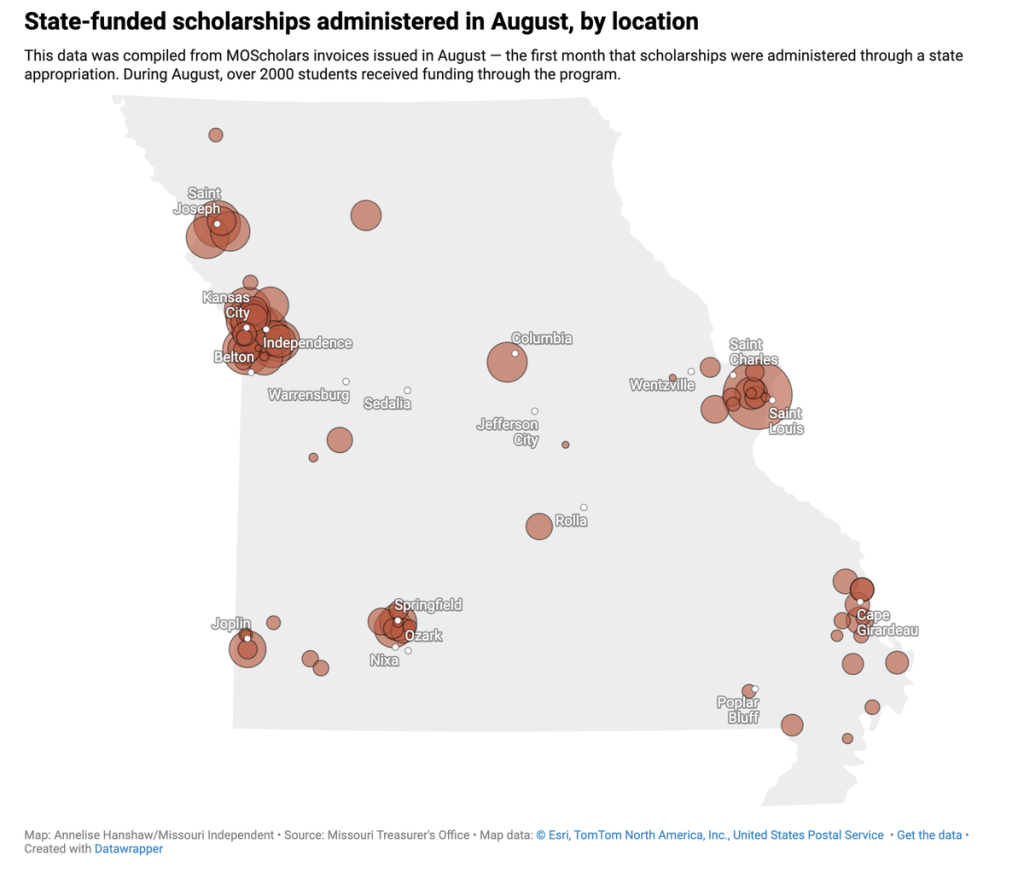
MAP: ANNELISE HANSHAW/MISSOURI INDEPENDENT SOURCE: MISSOURI TREASURER’S OFFICE MAP DATA: © ESRI, TOMTOM NORTH AMERICA, INC., UNITED STATES POSTAL SERVICE
Map used with permission. Originally used here.
MARYVILLE, Mo. — Multiple Nodaway County superintendents say local state Sen. Rusty Black, chair of a state education funding task force, works against the interests of rural students and has risen to prominence in the state party by serving deep-pocketed groups that aim to defund public schools and enrich private ones.
Gov. Mike Kehoe’s Missouri School Funding Modernization Task Force, three Nodaway County superintendents told The Forum, is part of a larger statewide effort to divert public education dollars to private entities, including through other initiatives like open enrollment, private school vouchers, and charter school and virtual education expansion. Black, who taught agriculture at Nodaway-Holt R-VII as part of a teaching career that spanned more than 30 years, has been a supporter of legislation that enabled all of the above.
Despite having a local legislator as the head of the task force, then, the superintendents said they are not surprised at the direction it’s taken — one they say will force haphazard consolidation of rural school districts without a plan for how to do it or resources to make it work.
“It’s all politics,” said West Nodaway R-I Superintendent Mitch Barnes. “They’re not fooling me. And Rusty Black, when he comes off in his folksy little ‘aw shucks’ way, don’t fool me either. He’s not a friend of public education.
“He does what the people that give him money want him to do.”
‘BEGINNING OF THE END’
Rural legislators, whether Democrat or Republican, have often stood against proposals like private school vouchers because of the importance local public schools have to rural communities. Twenty years ago, that made it a tough sell in the legislature. The way private school vouchers finally made their way into the state budget was a slow, methodical process over years that outlasted term limits and moved forward inch by inch.
A 2021 bill became the wedge that allowed school choice advocates to finally throw open the door. The legislation created the MOScholars program, which gave tax credits to organizations that paid for their selected students to attend private schools. Opponents of the bill, including state Rep. Allen Andrews, who represented Nodaway County then, said it was essentially taking public money that would have been paid into the state’s general revenue fund and giving it to private schools — an indirect voucher program. Every dollar gone from general revenue, he said at the time, was a dollar that didn’t go to a public school in his district.
This year, for the first time, the General Assembly included $51 million in general revenue funding for MOScholars, cutting out the middleman — public tax dollars now go to private schools that are overwhelmingly located in bigger cities.
“I’ve rarely seen a more obvious attempt to take money from the middle class and impoverished folks and move it into the hands of the wealthy,” said South Nodaway R-IV Superintendent Dustin Skoglund. A family of four making up to $178,433 is eligible this year, according to program guidelines. “And that’s what it’s doing. … This is going to folks who are already going to private schools, who can already afford to go to private schools — which, by the way, we have very limited access to here in rural areas.”
According to an analysis by Jon Turner at Missouri State University, about 80 percent of the money from MOScholars is spent in the St. Louis area. And according to the Missouri Independent, more than 98 percent of scholarships through the program were used for religious schools. Only six scholarships went to students north of St. Joseph: to students at St. Gregory Barbarigo Catholic School in Maryville.
State Treasurer Vivek Malek, whose office administers the state funding for MOScholars, has asked to double the amount of general revenue going to vouchers next year to $100 million, according to the St. Louis Post-Dispatch.
The three rural Nodaway County superintendents each brought up the MOScholars program as emblematic of how Kehoe and other Republicans at the state level see the future of Missouri education: more and more privatized.
Superintendent Barnes, of West Nodaway, described himself as “on the right” politically — “way over there.”
“But in the state of Missouri, we have a supermajority of Republicans that are in charge,” Barnes told The Forum. “I always think of two things when I think about that: I always think of the old saying, ‘Absolute power corrupts absolutely,’ and ‘Might makes right.’ In the state of Missouri, the people in control are not friends of public education. And I am a believer in public education.”
MOScholars is just one of multiple avenues opened up by state leaders intended to drain financial support away from public schools, the superintendents said.
That same 2021 omnibus education law also gave parents the ability to move their children into virtual education courses run by a private vendor. The student’s home public school district must foot the bill, sending its own tax dollars to pay the private school company that isn’t based in rural Missouri.
“If I have a kid that doesn’t want to take science because they don’t like my science teacher or they got a bad grade, we pay like $5-6,000 per kid for that (student) to take the same class we’re already offering,” Skoglund said. “And you wanna b***h to me about I’m not efficient? That’s not efficient. That’s not fiscally conservative. And that’s what we’re dealing with here.”
Recent pushes for open enrollment have also set local superintendents on edge, worried about having to compete with each other and leaving students behind who can’t afford to go to a different school or who might not be desirable enough for another school district to accept. The Missouri State Board of Education earlier this month approved legislative priorities that include voluntary public school open enrollment.
Taken together, the superintendents believe those measures are all part of a larger, coordinated attack on public education. And the next front will involve public education’s largest lifelines: property and income taxes.
“I think when you put all those things in a line, it sure seems like too much to be a coincidence, in my opinion,” Skoglund said. “And then when you couple it with the fact there’s been a huge push for school choice and some of these movements, it feels like the beginning of the end.”
LOCAL BURDEN
Already, Gov. Kehoe has made property tax overhauls a major priority in his administration, and the state House has assembled the Special Interim Committee on Property Tax Reform, which is gearing up to make property tax legislation a tentpole of the next legislative session.
In June, property taxes landed on the agenda Kehoe set for a special session of the General Assembly — along with disaster relief and incentives for sports stadiums — which resulted in a controversial law that caps property tax increases in some counties, including Nodaway. The law is being challenged in court, partly because of the seemingly arbitrary manner in which the law sets different caps for base property tax increases.
In July, Nodaway County officials criticized Sen. Black for unilaterally including the county among a group that can cap base property tax increases at 5 percent upon voter approval. Nodaway County Commissioner Scott Walk and Assessor Rex Wallace said Black should have consulted with county officials first about the potential effects. He did not.
State Rep. Jeff Farnan, a former school board president at Jefferson C-123 who represents Nodaway County, told The Forum that because the task force and property tax changes are so interconnected, continuing to pursue both simultaneously would be challenging.
“Here’s the problem that I see right now, is that the governor wants to do away with personal property tax,” Farnan said. “But he also wants to have the foundation formula rewritten. But they kinda go together. … So I see a problem there, and I don’t know what will happen, but I don’t think you can do one without having the other already done.”
All of those changes, superintendents have said, will result in less money for local school districts.
An even larger cut could come from what Kehoe has said will be his “top priority” for next year: eliminating the income tax.
According to the Missouri Budget Project, income tax revenue makes up about 60 percent of the general revenue fund, which is the fund used for state education aid. A 60-percent cut, especially coupled with curtailing property tax revenue, would devastate public schools, the superintendents warned.
In order to keep public schools open, funding would have to come from somewhere, like increased local property taxes — which could be constrained by property tax reform — or increased sales taxes. And still, public schools would have to share that money with private schools through the voucher program and other initiatives that are funded from the same pools.
“Good grief, folks around here already, relative to where they live, are paying a high tax levy for their school,” Skoglund said. “And then you’re basically gonna go to them and say, ‘We’re going to roll this up.’ Not to get a new gym or build some new wing for your science lab or whatever — just to keep your doors open. That’s pretty ridiculous in my opinion.
“And it’s a political maneuver to say, ‘Look, we’re the heroes down here that cut your property tax, and your local evil school board raised your levy.’”
In a separate interview, North Nodaway R-VI Superintendent Chris Turpin agreed.
“(Voters are) gonna have to speak up and tell these people who they vote for, ‘Leave our schools alone. Don’t screw with something that is working for us in our area,’” Turpin said. “Or, you can sit and do nothing, and then when it comes to your school in financial distress, then you’re going to have somebody like myself or the school board members come and say the only option we have is to raise taxes on you guys.
“So I think you have two options: You speak up with your voice, or you’re gonna have to say, ‘I want a school bad enough that we’re gonna have to pay for it locally.’”
That message isn’t one that the superintendents feel is being considered enough by the state education funding task force — or by their state senator.
“I think I wouldn’t be the only person that would say I don’t think he represents our constituents anymore,” Turpin said of Sen. Black. “I think he’s held to a higher power — that of deeper funds and deeper pockets.”
‘NOT ACCOUNTABLE’
In 2023, every rural school board in Nodaway County sent Black a letter urging him to oppose open enrollment legislation that they said would weaken small public school districts like theirs.
He voted for it.
Last year, the districts again asked Black to vote against an omnibus education package that further expanded MOScholars tax credits and access to charter schools, virtual schools and private schools.
Again, he voted for the measure.
During last year’s Legislative Coffee event, a town-hall-style event hosted by the Greater Maryville Chamber of Commerce each year at the end of the legislative session, Rep. Farnan said his office received “several hundred emails” from within his four-county district sent by school boards, administrators, and active and retired teachers. None of them were in support of the legislation.
Black ignored the same pleas to his own office, and at the same event, laughed off that throughout his Senate district, every single one of his counterparts in the House voted against the measure.
“I must’ve been wrong,” he joked at the May 2024 town hall. “Every state rep in my area voted no. Rusty Black voted yes.”
This year, the original date for the Legislative Coffee was scuttled by a special session, and a second special session further postponed any possible rescheduling. But in October, after the second special session was over, both declined to set a new date, chamber Executive Director Becky Albrecht told The Forum. It marks the first time in more than a decade that any local legislator has refused to attend, according to previous Forum reporting during that period.
It is the only public event in Nodaway County where Black typically faces constituents.
“Rusty is not accountable to us anymore,” Skoglund, the South Nodaway superintendent, told The Forum. “He is confident that he will be reelected regardless of (what) he does.”
In an interview for this story, Farnan told The Forum that he would never vote for legislation that used public money for private education, a stance he has consistently held since he took office in 2023.
“I think all public money should stay in our public schools,” he said.
Frequently, even prior to this story, superintendents have described Black as arrogant, aloof, uninterested in their opinions and increasingly hard to get a hold of — along with a few more colorful descriptors, too.
“I think Rusty Black is an egotistical ass,” Barnes, the West Nodaway superintendent, said. “If you ever get in a meeting with him, you get up there and he comes off with this ‘aw shucks’ countryfied attitude, and he either won’t answer your question, or he’ll tell you what you wanna hear and go do something else.”
During his time in the state Senate, and previously in the state House, Black has supported measures that local superintendents have said will hurt the small-town school districts that he represents across northwest Missouri.
But it has helped his political career.
RISING STAR
It was Black’s opposition to public education, the superintendents agreed, that ultimately made him the chairman of the Senate Appropriations Committee, which sets the state’s spending agenda.
Black was elevated to the post in September after Republican leadership ousted his predecessor, Springfield Republican Lincoln Hough. Although Hough was booted from his chairmanship shortly after opposing gerrymandered congressional maps and weakening the initiative petition process during a special session, he was also a thorn in Gov. Kehoe’s side on education funding.
In his January State of the State speech, Kehoe had said he did not intend to fully fund the state’s education formula because he did not think the system was working as it should. In April, when he was still Appropriations chair, Hough removed the $51 million slated for MOScholars — a key piece of Kehoe’s agenda — from the committee’s budget proposal, drawing the ire of the governor. Hough demanded that the foundation formula be fully funded before public money went to the private school voucher program, and also halted open enrollment legislation by attaching amendments tying open enrollment to a fully funded foundation formula.
Eventually, the MOScholars funding was restored as part of a compromise that also fully funded the foundation formula, which is why superintendents believe the Republican leadership was eager to replace Hough with someone more amenable — like Black.
Although Black and nearly all local superintendents have rarely seen eye to eye, most have previously been reluctant to publicly criticize the state senator too harshly, or at least tried to highlight legislation he has helped pass that supports rural public education.
And there have been some areas of agreement, like added funding for the Career Ladder program that provides extra duty pay for teachers, and legislation that allows retired teachers to come back to the classroom without losing their retirement benefits, both of which Black was instrumental in getting passed.
But mostly, Turpin said, the superintendents have been reluctant to say much to or about Black because they were afraid of retribution from their state senator who now heads both the powerful Appropriations Committee and an education funding task force. Someone vindictive in either of those chairmanships could bring disaster on school districts that the state, the superintendents believe, is looking to consolidate anyway.
“I think there’s multiple people sitting in this chair that (feel) that way, if you ask that question just like that — ‘Are you somewhat scared of your elected official, and what could happen if you spoke up too much?’” Turpin said.
Barnes agreed.
“Nobody wants to take the bull by the horns because they think that somebody will pay a price for it,” he said.
For more than a month, Black did not respond to multiple interview requests for this story. But he did provide a statement in which he said public school organizations have always supported legislation he has filed in both the House and Senate, and touted his work on increases to the state’s Small Schools Grant, Career Ladder and the changes that allow retired teachers to return to teaching without losing their retirement benefits.
“The 15 million dollar increase to the small schools grant and funding the increase was my individual effort,” he said in the email. That increase was part of the education bill last year that rural Nodaway County districts asked him not to support. “The changes to the Career Ladder Program Policy to benefit teachers and I believe school districts was due to a bill I filed and worked to pass. I was very instrumental in placing the State dollars in the state appropriation bill to fund the State portion of Career Ladder supplemental funding for teachers and schools. …
“The feelings around Rusty Black, I cannot address.”
RISING ALARM
Earlier this year, when Skoglund, the South Nodaway superintendent, started reaching out to his colleagues at other rural school districts about the governor’s education funding task force, not everyone felt the same urgency he did.
“We always feel like the sky is falling, right?” he told The Forum. “And it’s almost — you get a little calloused to it.”
This isn’t the first time local superintendents have warned that public education is under attack, or about the potentially disastrous effects of school vouchers or open enrollment for rural schools. And yet, the schools are still here. So he could hardly blame the public for feeling the same way.
“I think these people, they just get up, try to work hard every day, take care of their family,” Barnes, the West Nodaway superintendent, said. “They don’t pay attention to all that stuff. This is normal life for them. Does it cross their mind that their school might be in trouble and close? Probably not.
“But how do you raise the alarm level enough to make them pick up the phone and call somebody? Or do something?”
Though they are usually a low-key group in their public comments, the superintendents said the stakes were simply too high to not try to bring attention to what they believe will be disastrous for their communities. What happens after getting people’s attention, though, will require action by others, they said.
“I think when you sit in my chair, you go, OK, well I can inform my board, I can, you know, talk to the folks in the media about this, but — particularly in a rural area — who am I supposed to rally here?” Skoglund said. “What civic leaders do I have here in my school district that can go out and wield whatever influence they have in a way that produces a positive outcome for my kids?”
With the task force not slated to finalize its recommendations until December 2026, Rep. Farnan said it’s too early to do much of anything because the policies under consideration are still shifting.
But Skoglund said waiting would be “dangerous.” Instead, the superintendents said that if they waited to speak up until the task force had finished its work and the debate moved to the legislature, it would be too late for rural public schools to have much of a voice.
“Before we go down without a fight, I’m going to do everything in my power to not let that happen,” Turpin, the North Nodaway superintendent, said.
The superintendents suggested that residents who share their concerns should contact their state legislators and members of the task force to let them know how deep the connection runs between rural communities and their schools in ways that go beyond test scores.
“Let them know what this community means to you, the school means to you, why it’s important for it to stay here,” Turpin said. “And I’m not speaking just for North Nodaway. West Nodaway residents ought to be doing that for them. Northeast Nodaway residents oughta be doing it for them. Jefferson, where I live, has one of the highest tax levies. But why do people pay it?
“Because we believe in that school.”
The Missouri Right to Education Initiative has also filed a petition to amend the state constitution that would enshrine the “fundamental right” to education and charge the state to provide “adequate, thorough, and uniform high quality free public schools” in Missouri.
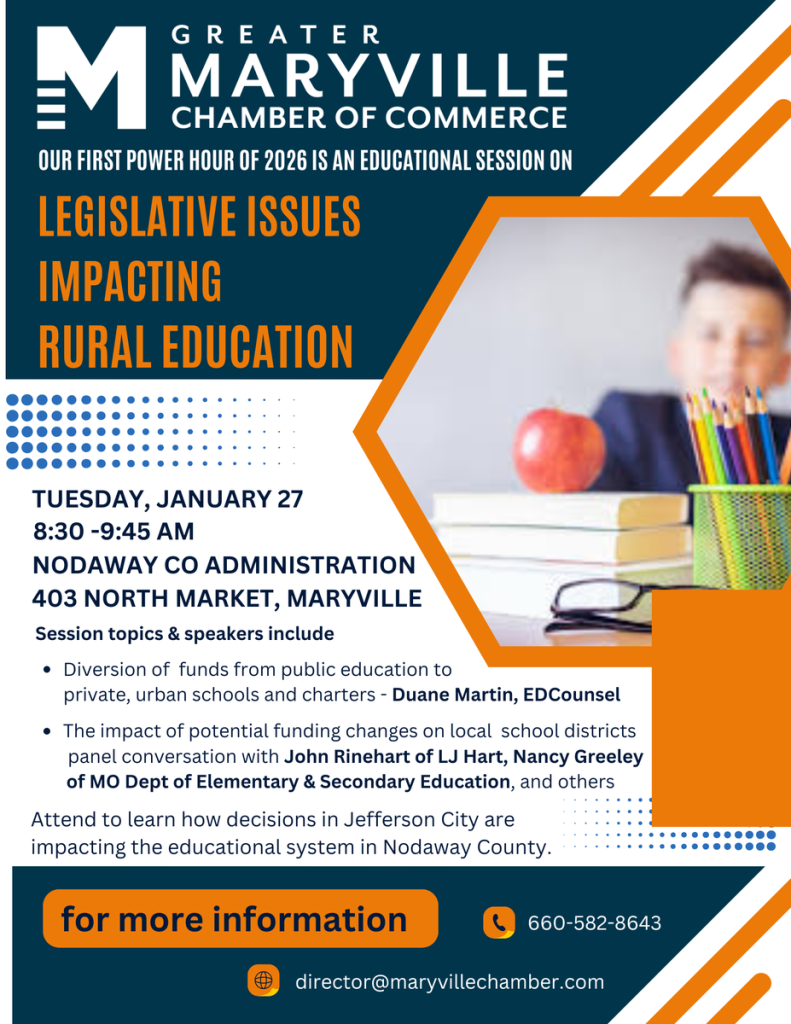
Locally, the Greater Maryville Chamber of Commerce will hold an informational session about rural public school funding from 8:30-9:45 a.m. on Jan. 27 in the main-floor conference room of the Nodaway County Administration Center. The featured presenter will be Duane Martin, an attorney specializing in school law from EdCounsel. The presentation will be followed by a panel discussion with local and state experts in the field.
With enough feedback from rural areas, the superintendents said, they hope the task force might consider funding models that ensure more equity for small schools and state leaders might be forced to change plans that would result in drastic cuts to public education.
It’s not so much that the sky never fell, the three superintendents said. It’s that the sky has been falling the whole time. Only now, it’s close to collapsing.
“If you wanna keep your local school open, you should care about it this time,” Barnes said. “If you don’t wanna keep it open, don’t care. And pretty soon your kids will be going to Maryville or traveling farther on a bus.
“It’s that simple.”
AT A GLANCE
EDITOR’S NOTE: This is the second part of a two-part Forum report on rural public education funding. The first part centered on the governor’s Missouri School Funding Modernization Task Force and published in the Dec. 18 edition of The Forum. The second part centers on the task force’s chair, local state senator Rusty Black, and other initiatives that, along with the task force, rural Nodaway County superintendents say is a coordinated effort to divert funds away from public schools and into private schools in bigger cities.
- Private school vouchers through MOScholars, open enrollment and other initiatives are designed to divert public money from public schools to private schools, superintendents say.
- Property tax changes and elimination of the income tax could cripple public school funding, they say.
- They say Sen. Rusty Black works against rural school interests and accuse him of being “held to a higher power — that of deeper funds and deeper pockets.”
- The superintendents encourage calling local legislators and attending an informational event on Jan. 27.
FORUM FILE PHOTO
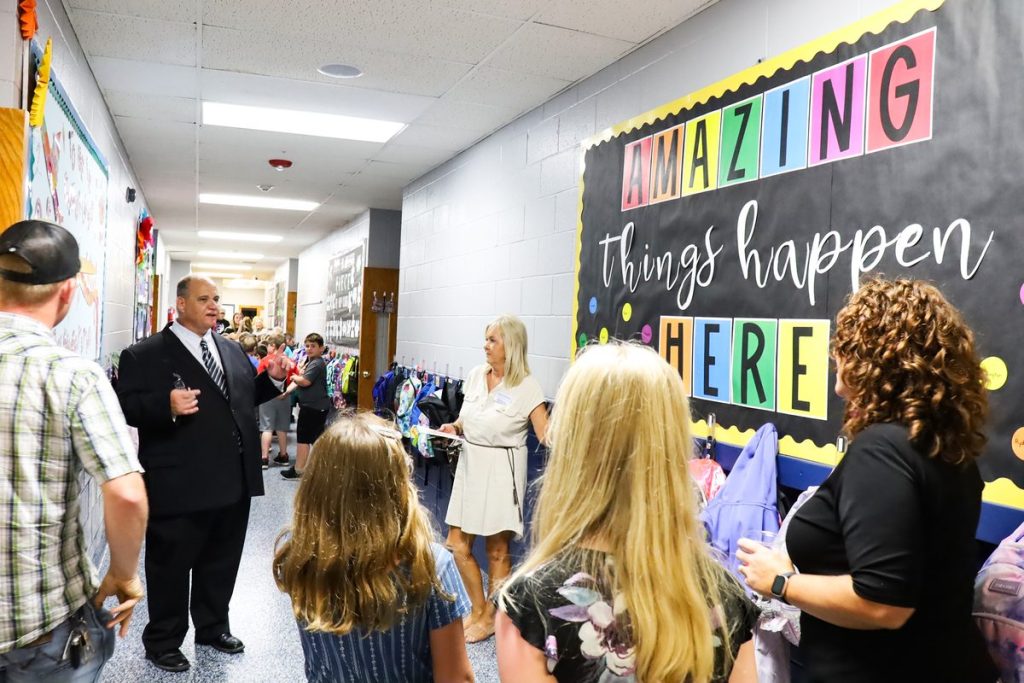
North Nodaway Superintendent Chris Turpin leads Nancy Greeley, current state supervisor of instruction with the Missouri Department of Elementary and Secondary Education, on a 2023 tour through the elementary school following the dedication of the Beccy Baldwin Center for Early Learning in Pickering.
Chamber informational event
FORUM FILE PHOTO
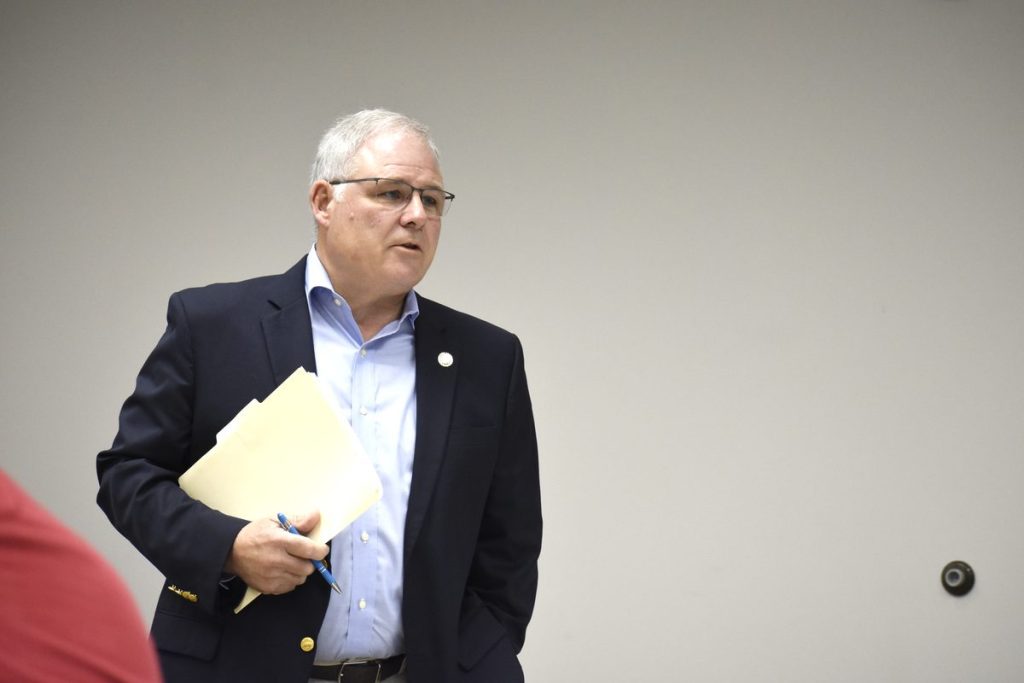
State Sen. Rusty Black, R-Chillicothe, is the chair of a state education funding task force that local superintendents say is part of a larger effort to defund public education. Black is seen speaking during a Legislative Coffee event hosted by the Greater Maryville Chamber of Commerce in 2023 during which he faced pointed questions about education funding.