SIDEBAR: Maryville, Worth County school leaders talk unique challenges

SKYE POURNAZARI/THE FORUM
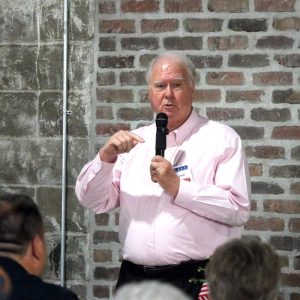
Philip Pohren Maryville R-II Superintendent
MARYVILLE, Mo. — While leaders of the six rural school districts in Nodaway County are deeply alarmed by the direction of the governor’s Missouri School Funding Modernization Task Force and other actions by state leaders that they say will devastate rural public education, the other two districts in Maryville and Grant City that The Forum and The Times-Tribune regularly cover face slightly different circumstances.
MARYVILLE R-II
The outlier of the group is Maryville R-II, the largest district in the region and the only one in Nodaway and Worth counties that isn’t a hold-harmless district. Instead, Maryville’s state aid calculation is subject to the current foundation formula.
While that calculation would change under a new formula, whatever the changes are, they wouldn’t result in the same kind of drastic cuts as at the Nodaway County hold-harmless districts — partly because Maryville gets comparatively little state funding already as a percentage of its total budget.
Superintendent Philip Pohren said that Maryville gets about 73 percent of its funding from local sources, mainly property taxes. Only 17 percent comes from the state. At North Nodaway R-VI, for example, it’s more than double: About 38 percent of its funding comes from the state. Making up the difference is much more difficult for smaller school districts, Pohren said, because they do not have as large a tax base.
But that does mean the other changes that Gov. Mike Kehoe is pushing for, like overhauling property taxes and eliminating the income tax, are likely to have a significant effect on Maryville.
“What’s so challenging is we have great teachers, great schools, great kids, great community support — whether it’s Maryville or one of these surrounding schools, right?” Pohren said. “But so many decisions are made based off of Kansas City, St. Louis, Columbia, Springfield, and that’s not necessarily the representation of all these small schools up here.”
WORTH COUNTY R-III
Worth County, the smallest county in the state by population, has already seen waves of consolidation result in only one district for the entire county. But even that isn’t guaranteed, worries Superintendent Chris Healy.
Losing hold harmless status wouldn’t hurt Worth County as much as other rural districts, partly because the county’s assessed valuation hasn’t gone up as much as other counties since 2005, which is what the current foundation formula is based on. The more local revenue a district has, the less state funding it receives through the formula. So with updated property values, Worth County’s amount of state aid would only go down slightly — a little less than $50,000 using the same calculation that other district superintendents provided to The Forum, which assumes a $10,000 State Adequacy Target, updated property values and elimination of hold harmless.
However, in an interview with The Forum, Healy said he is concerned that as part of the state’s push for consolidation, there could be a minimum threshold for how many students a district must have. The concept is not being discussed by the task force because a school enrollment minimum would not be a direct part of the funding formula that is within the its purview.
But if the legislature decides to implement a system to help even out whatever funding formula the task force recommends, it’s unlikely that Worth County’s 315 students would meet any such district population minimum.
“If we consolidate with another district, there’s gonna be kids driving 40, 45 miles to school,” Healy said.
Or, he said, students from different parts of the county may be absorbed into whichever other district is closest.
“So yeah, consolidation is a worry, and then funding, because there’s gonna be winners, gonna be losers,” Healy said.
Healy said he’s most concerned about the larger landscape and intentions of state leaders.
“In general, just the attack on public education as a whole is scary,” he said, singling out the MOScholars voucher program. An analysis of the program by Jon Turner of Missouri State University found that 80 percent of its spending was concentrated in St. Louis. “So we’re taking taxpayer money from Worth County and Nodaway County taxpayers, and … it’s going straight to St. Louis and not to our public schools. …
“Big schools might feel like they’re attacked, but definitely small schools right now are feeling like we’re attacked, or we’re not as important, maybe.”
Through her office, Mazzie Christensen, who represents Worth County in the state House, said that she preferred to wait to comment on rural education funding once the task force has made more progress on what changes to the formula it will recommend.
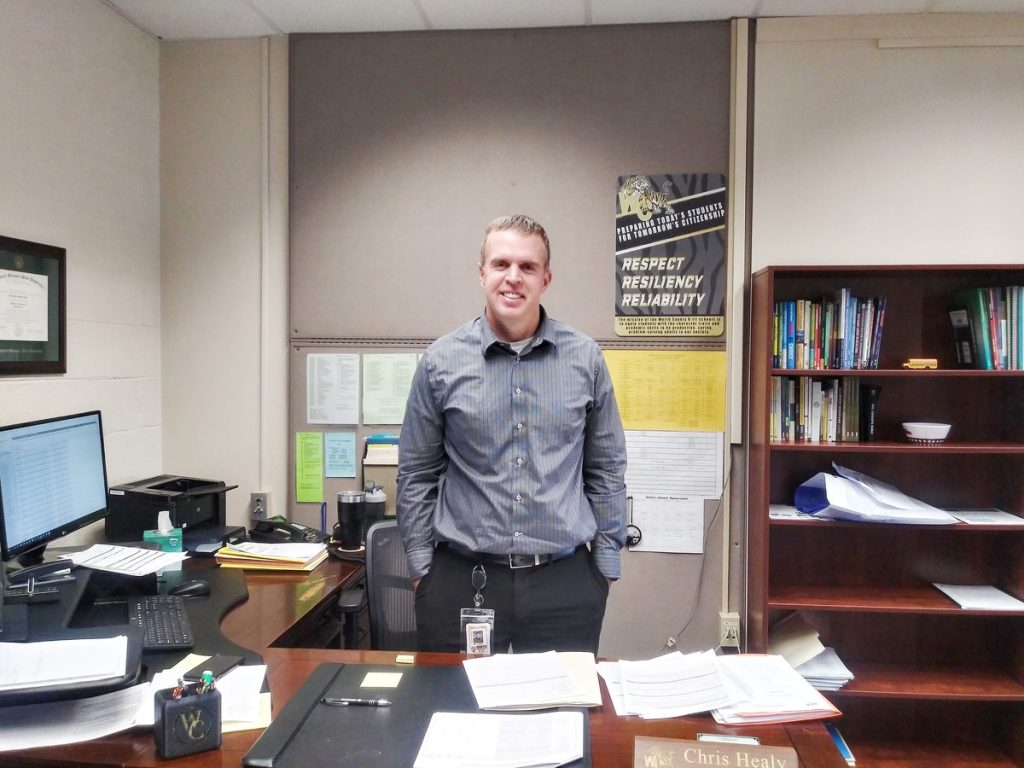
RILEY DRURY/TIMES-TRIBUNE
Chris Healy Worth County R-III Superintendent
Education funding sidebar cover