New water plant to be built on existing site, not Mozingo
FORUM FILE PHOTO
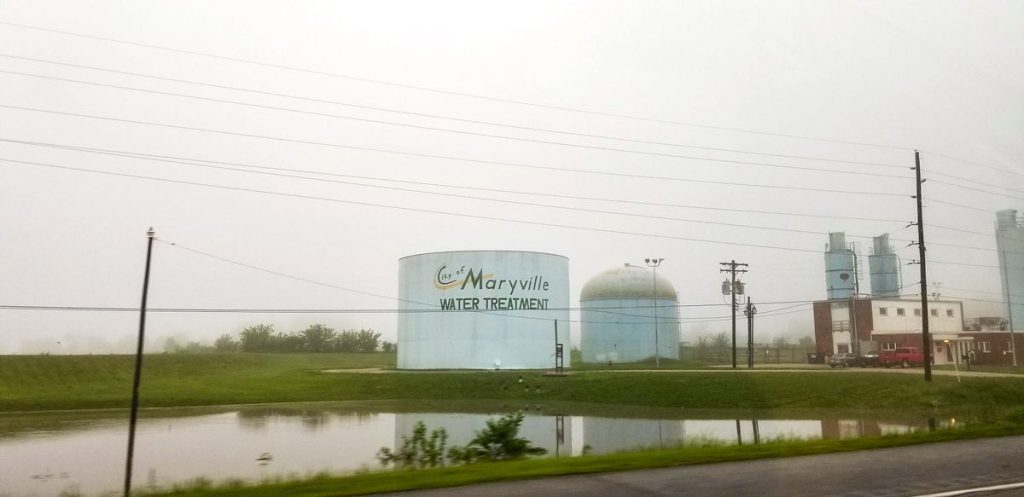
The city is planning to build a new water treatment facility to replace the existing plant that was built in 1958 with a new facility at the same location.
MARYVILLE, Mo. — The planned new water treatment plant will be built at the site of the existing facility instead of Mozingo Lake, project leaders said Monday, attributing the change to skyrocketing costs.
During Monday’s regular Maryville City Council meeting, project leaders from consulting firm HDR Engineering and construction firm Crossland Heavy Contractors said that as the design process continued, it became clear that building the new facility at Mozingo Lake as originally planned would far exceed the $50 million bond approved by voters in February. Officials from Crossland and HDR said that in particular, the prices for materials like stainless steel have been impacted by tariffs, while competition for both materials and workers has increased markedly across the region for large construction projects, ratcheting up costs further.
“With data centers popping up all over the Midwest, the lead times for some of these valves that you would think are pretty standard, pipe materials that you would think are pretty standard that we’ve been pricing for decades and decades and decades — they have a different price component to them now because they’re in demand,” said Jessica Adams-Weber, a vice president and regional business development director at HDR. “And so that demand has driven a price that’s sort of unseen (before).”
Adams-Weber pointed to the need for digging new lagoons for wastewater and running a redundant transmission line for electricity to the Mozingo site as the most significant costs that can be saved by staying at the existing site off U.S. Highway 136 along the One Hundred and Two River. That site already has wastewater lagoons in use by the current plant, and that location is very close to an electrical substation.
Additionally, Adams-Weber said the cost of a long-planned redundant water line to carry raw water from Mozingo Lake to the water treatment plant can be deferred, further reducing costs on the overall project to keep it within the $50 million approved by voters. As far back as 2022, the city and HDR planned on constructing the redundant line regardless of where the new plant was going to be located, but the city was unable to secure a state grant to build it. Adams-Weber said that HDR has worked with the city to apply for another Missouri Department of Natural Resources grant and loan program that would help pay for the redundant line as a separate project.
Timeline
A construction manager at-risk model brings in the construction contractor during the design phase and locks in the price once design is complete, rather than bidding out a full design to construction contractors. When allowed by law, the city uses this model often to get better cost certainty on large projects.
When Crossland was chosen as the CMAR in April, Adams-Weber said HDR would work with the company to have a guaranteed maximum price locked in and presented to the council by October. On Monday, Erick Lowe, division manager of the Kansas City region for Crossland, said the plan is now for the price of the new plant to be locked in around the end of this year. Adams-Weber said Missouri DNR is waiting on that guaranteed price to finalize the low-interest loan through the State Revolving Fund that the city will use to pay for the project.
All together, the challenges in finding available subcontractors and securing materials has delayed the ambitious timeline for the new facility. In June of last year, HDR and the city laid out their goal to have the new plant online by August 2027. When Crossland was brought on as construction manager at-risk in April, the anticipated completion date had already slipped to November 2027. The new estimated date of substantial completion of the new facility is now March 2028.
The process was kicked into high gear last year in an attempt to get the new plant online before the water filtration membranes at the existing facility age into obsolescence. The membranes were purchased and installed in 2020 and have a life expectancy of about seven years, after which their effectiveness drops significantly. The previous set of membranes that were replaced in 2020, for example, had been in place for nine years, but had trouble keeping up with demand toward the end. Replacing the membranes could cost around $10 million, HDR estimated last year.
During Monday’s meeting, the council approved replacing one train of membranes that have been underperforming and were not responding to normal cleaning processes. Keeping the membranes clean is especially important during winter months, when buildup on the membranes is more difficult to clear. In January, that led to a slowdown in water treatment which triggered voluntary water conservation measures in the city.
The council approved Monday a $685,680 agreement with Veolia North America to purchase 234 ZeeWeed 1000 modules, replacing the underperforming train of membranes.
Public Works Director Matt Smith said the other membranes are functioning normally.
Water rate study
Also during Monday’s meeting, the council approved a $25,000 agreement with NewGen Strategies & Solutions to update the city’s water and sewer rate model.
The water and sewer rates were last updated in 2023, prescribing increases of 3 percent in 2023, 2024 and 2025. However, the city opted not to increase rates for 2025.
The updated study will use the designs of the new water treatment plant, which are currently at 45 percent, to get a more accurate picture of how much rates will need to increase.
Council member Erin Allen voiced some concern over the timing since Crossland has not yet provided a guaranteed price maximum for the new facility, and the city has not outlined a future capital improvements plan for the water and sewer fund. Both of those would significantly affect how much rates would need to rise in the future.
City Manager Ryan Heiland said those numbers can be refined as the process moves along. But the city needs to move quickly on the rate study because the results will be used by Missouri DNR as part of the process of releasing the money from the State Revolving Fund for the new water treatment plant.
Other City Council notes
- The council approved two agreements with HDR Engineering totaling more than $3.36 million for engineering and design services related to the new water treatment plant.
- Council members approved another three-year agreement at $40,000 per year with Retail Strategies to consult on economic development opportunities targeting national retailers. It’s the third consecutive three-year agreement the city has signed with Retail Strategies, beginning in 2019. Heiland said the firm has helped bring Starbucks, Marshalls and the soon-to-be-in-operation Amazon last-mile delivery facility to Maryville during that time.
- The council approved a $60,000 agreement with Nodaway County Economic Development to assist with the city’s economic development efforts and to serve as a local business liaison for the city. In addition to that usual annual agreement, the council also approved a new $20,000 agreement with NCED for the organization to oversee several projects and the associated grant requirements, including:
- Munn Avenue Trail Extension
- South Main Trail Connection
- Grant reporting for the downtown pavilion and streetscape projects
- Reporting and administrative responsibilities for the city’s Façade Improvement Grant program
- Council members approved a $112,200 agreement with Nutrien Solutions for the purchase of 8,800 gallons of algicide for use on Mozingo Lake.
- The council approved a five-year, $162,335 contract with LensLock for the purchase of body cameras, in-car cameras and software for the Maryville Police Department. Police Chief Mike Stolte said the department’s current body cameras are aging, and using LensLock’s system will allow for full replacement along with consolidation of the multiple recording systems the department uses for in-car, body-worn and other cameras, saving officers time when compiling them and space when they are saved to DVDs.
- Additionally, Jeff Arp, a loss control specialist with the city’s municipal self-insurance group, the Missouri Intergovernmental Risk Management Association, presented a $2,982.11 grant award to the city to go toward the purchase of an in-car camera for the police department.
- Council members approved a $31,875 agreement with Capital Aggregates for the purchase of pea gravel for bunker renovations at the Sechrest 18 golf course.
- The council reappointed Travis Pierson to the Planning and Zoning Commission for an additional four-year term, and appointed Derek DeMott to an initial four-year term. Two vacancies remain on the board.
- Council members approved a request by the Maryville Pride Lions to hold the 30th annual Downtown Trick-or-Treat event from 3 to 7 p.m. on Oct. 30.
- The council approved a request by the Laura Street Baptist Church to hold its Fall Festival from 10 a.m. to 1 p.m. on Oct. 18, including the closure of South Laura Street between Thompson and First streets and Mattie Street between Thompson and First streets.
- Council members approved a request to hold the annual Speedy Spoofhound 5K Run on April 25 from 8 a.m. to around 10 a.m. The race will begin on the hospital trail, travel through Crestview to South Munn, cross West South Avenue and continue to Victory Lane where runners will turn around and follow the route back to the middle school.
WATER TIMELINE
Jan. 2020 – Public access to Mozingo Lake is shut down after Missouri DNR issued a warning about high concentrations of cyanobacteria, or blue-green algae, at the lake. City Manager Greg McDanel outlines a three-pronged approach to address the problem: new water treatment infrastructure, better techniques for treating the lake itself, and working with landowners to reduce nutrient runoff from the surrounding watershed area.
April 2020 – Cyanobacteria levels at the lake dip back under Missouri DNR’s threshold and public access to the lake is restored. Additionally, the U.S. Department of Agriculture’s National Resource Conservation Service opens a $200,000 fund to assist landowners in the Mozingo watershed to adjust crop applications to different techniques or products that may produce less nutrient-rich runoff into the lake.
June 2020 – The city begins working with HDR on comprehensive water solutions. Also this month, the U.S. Geological Survey works to map the bottom of Mozingo Lake to get a better idea of its sedimentary makeup. Later this year, officials from HDR, the city, Missouri DNR, the Missouri Department of Health and Senior Services, the NRCS and the Missouri Rural Water Association will form the Mozingo Lake Workgroup, building action plans and measuring progress to address the algae blooms at the lake.
Summer 2020 – New filtration membranes are installed at the Maryville Water Treatment Plant. They have an approximate lifespan of seven years, starting the clock on a countdown to when new membranes will need to be purchased or a new water treatment facility is ready to go.
Dec. 2020 – The naturally occurring compound geosmin is identified as the chief cause of an earthy taste and odor in the drinking water. The taste becomes detectable at around 20 nanograms per liter. Concentrations in Mozingo Lake were measured at 2,200 nanograms per liter.
Jan. 2021 – HDR outlines a comprehensive plan for short- and long-term solutions to water treatment, source water management and watershed management practices. The plan calls for regular algicide applications at Mozingo Lake, which have continued ever since, and in the short-term, the installation of a granular activated carbon adsorber to help more effectively filter the geosmin.
Aug. 2021 – Missouri DNR and the U.S. Geological Survey announce a partnership to install continuous water monitoring equipment in the creek that feeds Mozingo Lake to better measure nutrient runoff.
Nov. 2021 – NRCS kicks off a four-year, $1 million federal initiative to incentivize implementing conservation practices in the Mozingo watershed.
Dec. 2021 – The GAC adsorber goes online, significantly improving the quality of geosmin removal in the water treatment process. The $1.3 million cost of the adsorber, which was installed in a converted empty tank on the water treatment plan site, was split between the city and Public Water Supply District No. 1.
Sept. 2022 – A pilot water treatment plant using ozone and biofiltration methods is installed at the existing water treatment plant. The results will be used to plan a new water treatment facility and is a required step by Missouri DNR.
July 2023 – City, HDR and state officials tour Texas water treatment plants that utilize ozone and biofiltration methods.
Jan. 2024 – Backup filters at the water treatment plant went offline due to damage from extreme cold weather, necessitating voluntary water conservation measures. City officials point out that the problem was because of the dated technology in use at the plant and would not have occurred at a proposed new facility.
March 2024 – The Missouri Department of Conservation and the city announce a wildlife management plan for the Mozingo Lake watershed to restore natural habitats and improve the general health of the lake.
June 2024 – HDR and city officials announce that they will aim to construct a new ozone biofiltration plant, which would be the first in Missouri. They tentatively target August 2027.
Feb. 2025 – City voters pass a $50 million bond issue in a special election. The bond capacity is required to apply for a loan from Missouri DNR’s State Revolving Fund.
April 2025 – The state’s Clean Water Commission meets and approves the city as an SRF loan recipient. The city also hires Crossland Heavy Contractors as the construction manager at-risk for the project. Tentative completion date is pushed back to November 2027.
Oct. 2025 – Crossland and HDR report that locating the new plant at Mozingo Lake would cost too much money and shift plans to construct the new facility adjacent to the existing plant.
March 2026 – Construction could begin on the new water treatment facility.
March 2028 – Target date for substantial completion of the new water treatment plant.