Democracy in America Smithsonian Exhibit to open April 23
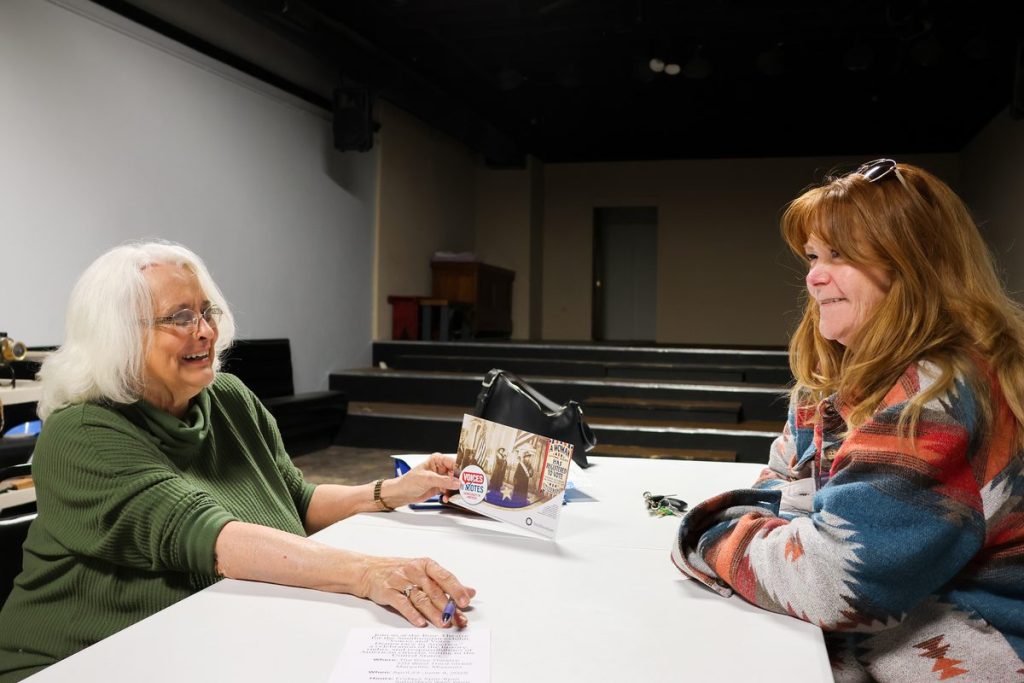
SKYE POURNAZARI/THE FORUM
Holly Kay Cronk and Nina Dewhirst prepare last week for the Voices and Votes – Democracy in America Smithsonian Exhibit at The Rose Theatre.
MARYVILLE, Mo. — Maryville is the first of six sites in Missouri to host the Smithsonian Institute’s traveling exhibit, Voices and Votes: Democracy in America, and it opens April 23 at The Rose Theatre.
Viewable for free through June 4, the exhibit, which will feature displays based on the Smithsonian’s National Museum of American History’s exhibition called American Democracy: A Great Leap of Faith, was brought to town by way of Missouri Humanities, the Nodaway Community Theater Co. at The Rose Theatre, Make it Maryville, the Maryville Public Library and the Nodaway County Historical Society.
IF YOU GO
Where: The Rose Theatre, 120 W. Third St., Maryville
When: April 23- June 4
Hours: Fridays 5 to 8 p.m. Saturdays 9 a.m. to 6 p.m. Sundays 10 a.m. to 6 p.m.
Tours for groups of 10 or more are available Monday through Thursday, but please email rosetheatre.maryville@ gmail.com to make an appointment.
The exhibit will explore the origins of American democracy, the struggles to obtain and keep the right to vote, how democracy works, the right to petition and protest, and the rights and responsibilities of citizens, noted a news release. The exhibit will feature historical and contemporary photos; educational and archival video; interactive multimedia games; and campaign souvenirs, voter memorabilia and protest materials.
Exhibit coordinators Nina Dewhirst, with the Nodaway Community Theater Co., and Holly Kay Cronk, with Make it Maryville, told The Forum late last week that they definitely identify on separate sides of the political spectrum — but in this effort have easily found their way to the middle, working for the good of their shared community and pushing for more people, especially kids, to understand their civic duty.
“This is not about your personal political beliefs,” Cronk said. “This isn’t about Republican and Democrat. This is about using your voice, using your vote. … It’s true, Nina and I have different political views, but it just goes to show you that you don’t have to agree with people to get along with them. … If everybody thought the same way or believed in the same things politically, we’d have no growth. You’d stagnate. So people need to understand that our differences are actually an asset that encourages growth, encourages change. They may not like it sometimes, but that’s life.”
Dewhirst agreed, noting that it’s the very reason our society is set up the way it is — to allow people to cast their vote.
“That’s why we make choices,” she said. “And if you wanna make those choices, if you wanna make a difference, you decide to make the choice, to do that at the ballot box — or wherever in your town, your community, your state.”
The two agreed and made a point to say that this exhibit is not a place for divisive political grandstanding. They’ve already received some phone calls from political parties and organizations saying they’ll come down to share their views during the event.
“This isn’t a Republican thing. This isn’t a Democrat thing. This is nonpartisan,” Cronk said.
But politics isn’t completely excluded from the exhibit, which arrived on site at the theater about a month earlier than expected. Sitting in 16 shipping crates, the exhibit was sent early by the Smithsonian and Missouri Humanities — a nonprofit organization affiliated with the federal National Endowment for the Humanities that supports research, education, preservation and other public programs in the humanities — in case the federal government shut down, the organizers said.
“They wanted just to make sure that it was in our possession,” Dewhirst said, to ensure the exhibit could make its way across Missouri even if the Smithsonian wasn’t able to ship it later.
The two said that they are a bit concerned with how people will take some of the information in the displays. Dewhirst said she’s concerned people might question information about equity and inclusion.
“You can’t rewrite history just to pacify people,” Cronk said.
Dewhirst was even considering asking the people at Missouri Humanities how to handle exhibit viewers who may cause a disruption because of it.
“This is historical,” she said. “This is what has happened with all the great things that have happened and with some of the things that have not been so very wonderful, but it’s part of the fabric of our democracy,” she said. “I’m just still a little concerned.”
Schools and students
The two exhibit coordinators hope that schools will be interested in bringing their students to tour the exhibit and aim to provide them with some of the basic information about voting and its history across the country. They’re so excited about it, they’re working to offer a small stipend to the local schools interested in sending their students.
“Thanks to the Nodaway County Commissioners and Tenaska that have helped with that, because part of (those donations) is going to be the stipend for schools,” Dewhirst said. “It certainly won’t pay for a bus and bus driver, but it will make it a little easier.”
She said they deliberately set the date of the exhibit because they wanted it to coincide with school schedules.
“I’ve been a schoolteacher, and I don’t know what their testing is going to look like this year, but April and early May are just really times when teachers, I think, would like to have something that would be useful for their education,” Dewhirst said.
While the exhibit is not tailored directly at children and has a more adult focus, the coordinators are working to create some hands-on activities and Cronk has created an activity book that has games, coloring pages and historical facts. It includes information about Alma Nash, a Maryville suffragist (1883-1965) who was recognized with the placement of a National Votes for Women Trail historical marker in 2023 for her efforts in the fight for women’s right to vote. That marker is located just half a block east of the theater where the exhibit will be displayed.
They’re also planning to have crayons and an instant camera that provides photo stickers visitors can take with the cardboard stand-ins for Frederick Douglass, Susan B. Anthony and Elizabeth Cady Stanton. Anthony and Stanton actually spoke in the Union Hall that was located on the second floor of the very theater in which the exhibit will reside for its first engagement.
“It’s part of the upstairs history,” Dewhirst said.
Dewhirst said they’re working to tie in the local history aspects with help from the Nodaway County Historical Society. The NCHS Museum plans to refresh its display surrounding women’s suffrage that explains some of those local ties to the fight for women’s right to vote, she said.
The public library is also planning to have a display for children and perhaps some additional programming during the exhibit’s stay here in Maryville.