Guest Expert Column: What weather changes mean for plant diseases
SUBMITTED BY OSCAR PERÉZ-HERNANDEZ
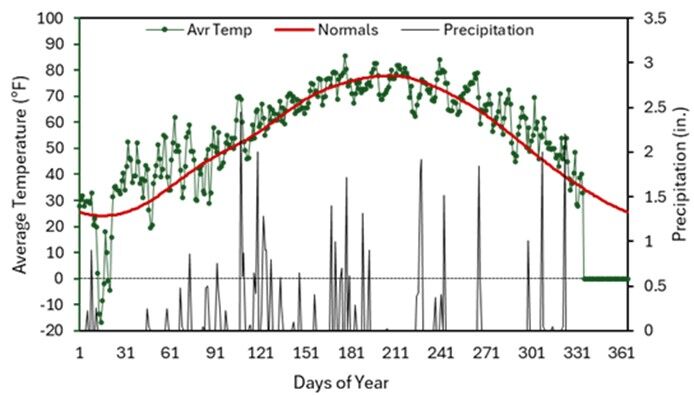
Pattern of daily average temperature and precipitation in Maryville in 2024 and for the 1991-2020 climate normals. Data source: Maryville 2E weather station – High Plains Regional Climate Center. Missing observations were estimated by spatial interpolation from nearby stations. Climate normals from the National Centers for Environmental Information.
Synoptic weather patterns like El Niño-Southern Oscillation (ENSO) and La Niña are recognized for their significant impact on weather in the United States and various parts of the globe. Furthermore, even with the recognized cyclical nature of these events, climate patterns still evolve on local and regional levels. As a result, weather patterns that were previously familiar to residents have been altered and turned unpredictable.
In a temperate climate like the one found in this area of Missouri, for instance, exceptionally high temperatures have been recorded in late autumn and early winter. Furthermore, unusual timing and distribution of precipitation, such as rainfall and snow, have been noted in this and other areas. No matter their origin, significant shifts in weather and climate influence not just human activities, but also the growth of crops and other occurrences, like the emergence of plant diseases and pests.
In general, this year, a variation from typical temperature norms was particularly noticeable in the area at the year’s start: Temperatures were higher than usual during the initial nine days, then dipped below average in the subsequent 13 consecutive days of January. During the subsequent 22 consecutive days, the daily average temperature exceeded the typical values, with some days in February reaching above 50 degrees and a maximum high of 62 degrees on March 5.
Precipitation also strayed from the two primary normal peaks that have usually taken place in May and June. Instead, this year’s rainfall peaks show plentiful precipitation at the end of April and more rain peaks throughout the year.
A significant disruption in normal temperature and precipitation patterns could have different effects on the emergence of plant diseases in this area. The results would rely on the prevalence and persistence of the weather conditions, which could positively or negatively impact diseases, just as it might affect crops too.
The impact of weather fluctuations caused by the El Niño-Southern oscillation is recorded for diseases like coffee rust, Stewart’s wilt, and various maladies affecting winter crops.
Temperature controls the life cycle of nearly all plant pathogens, many of which cease to develop at these latitudes in the U.S. because of the winter conditions. Certain pathogens survive the winter in soil, on crop remains or on different substrates in specialized structures that can endure specific low-temperature limits, but become active again when temperatures rise to certain levels.
For example, the germination of spores from certain fungal pathogens takes place exclusively when temperatures exceed 50 degrees. This indicates that sustained temperatures above this threshold during January and February can promote the earlier onset of some diseases compared to what is typically anticipated in the growing season for this region.
Conversely, cold temperatures in January and February may harm the survival of pathogens during winter, leading to an opposing effect. Elevated temperatures in late autumn can extend the activity of pathogens, leading them to reinfect healthy crop plants if they are present.
Precipitation in various forms, particularly as rain, influences the spread and development of pathogens. Rain droplet impact on crop residue containing pathogen inoculum significantly enhances dispersal, allowing it to be lifted by wind currents and spread over both short and long distances, where it is eventually deposited and leads to reinfections.
Frequent and heavy rainfall at the conclusion of the growing season can result in the emergence of field mold diseases triggered by fungi from the genus Fusarium, similar to what happened in the 2019 season in this region.
Among some of the diseases that are prevalent and problematic in U.S. southern regions and that could pose potential threats to soybean and corn production in northwest Missouri are corn southern rust, Asian soybean rust, and Cercospora leaf blight and seed purple stain.
Rusts are known as obligate parasites, that is, they need a living host to survive. Therefore, they are unable to survive in areas where a suitable living host plant is unavailable. Other diseases like frogeye leaf spot, tar spot, northern corn leaf blight, may just become more severe depending on the temperature and precipitation in a growing season.
In conclusion, the temperature and precipitation patterns in 2024 showed some divergence from the climate normals, particularly in January: initially, temperatures were elevated, then followed by a phase of lower temperatures. February concluded with a characteristic El Niño pattern for this region, featuring warmer conditions.
The yearly rainfall pattern also strayed from the averages, featuring intense rainfall occurrences in late April to early May and a higher frequency of rain peaks over the year. Southern rust appeared in cornfields in this region with greater intensity than in 2023, while other diseases such as frogeye leaf spot did not exhibit severe levels.
Oscar Pérez-Hernández is an associate professor in the School of Agricultural Sciences, Onema Adojoh is an associate professor in the Department of Natural Sciences and Joshua Hunolt is an undergraduate agronomy student, all at Northwest Missouri State University.

MF In the News