Maryville R-II school district bucks national teacher shortage trend
FORUM FILE PHOTO
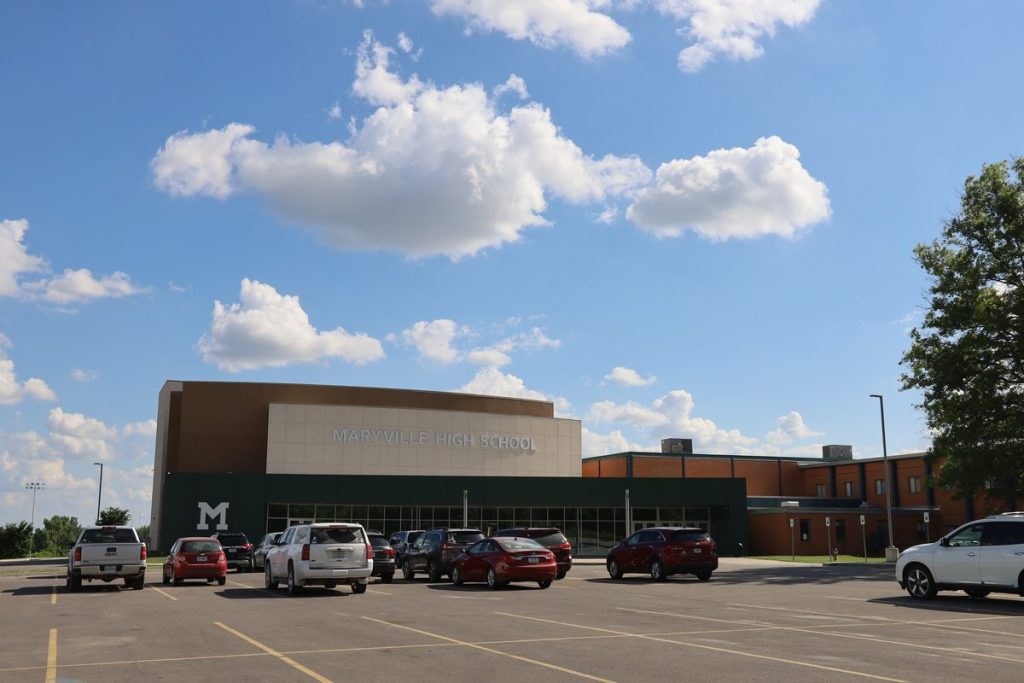
Maryville High School Building
MARYVILLE, Mo. — As states around the country are passing laws to address teacher shortages in rural areas, the Maryville R-II School District is fully staffed with teachers and prepared for the 2024-2025 school year.
Maryville Superintendent Logan Lightfoot told The Forum late last week that the district still has a couple coaching positions open, but it is fully staffed regarding certified teaching staff — which puts it ahead of many others across the state.
“I don’t want to be melodramatic, but it’s pretty bad, like statewide it is,” Lightfoot said.
The Missouri Department of Elementary and Secondary Education’s May 2024 Educator Vacancy Report notes there were 12,533 total vacancies reported during the 2023-2024 school year by the 556 district and charter schools that employ more than 80,000 educators and serve more than 897,000 Missouri students.
Of those vacancies, 9,692 (77.3 percent) were filled with appropriately certified educators; 1,932 (15.4 percent) were filled with inappropriately certified educators and 891 (7.1 percent) were left vacant.
The largest number of vacancies for 2023-2024 were in certified positions in elementary education, special education and physical education.
DESE lists the top five critical shortage areas by content area as:
- Elementary education 1-6
- Early childhood special education birth-3
- Early childhood education birth-3
- Severely developmentally disabled birth-12
- Mild/moderate cross-categorical K-12
What’s being done
Superintendent Lightfoot said that while the district is currently staffed, there are still concerns about the district’s future staffing issues. He said when Gov. Mike Parson signed legislation to allow teachers to come back out of retirement to teach for up to four years without losing retirement benefits, it was good for schools, but only pushes the problem down the road.
“That’s a nice Band-Aid, but it doesn’t fix the problem,” he said.
In May, Parson also signed into law bills SB 727 and HB 2287 which permanently increased minimum teacher pay to $40,000 per year. The law also increases salaries for teachers with master’s degrees and 10 or more years of experience to a minimum of $48,000 per year by 2027.
Lightfoot said this required pay increase is not necessarily a major boon for attracting teachers to the district. As of March 20, before the new statewide salary minimum, the Maryville school board had already approved a teacher salary schedule for the 2024-2025 school year that lists the initial pay of a first year starting teacher as $39,750.
Lightfoot said he didn’t believe there was a single teacher at the district below that $40,000 baseline limit.
“As a state we have got to do better supporting our teachers,” he said. “… It worries me. The trend is not going where we want it to go. Both teachers and leaders, that really concerns me.”
He drew comparisons between working in education in Nebraska, where he led Anselmo-Merna School District as superintendent from 2018 to 2021 prior to returning to Missouri. In Nebraska, Lightfoot said, teachers receive paid, full-family health care across the board, while in Missouri it is not typically paid.
“You could go to Nebraska and literally be married with a couple kids, you could have one spouse working as a teacher and support your family,” he said. “That would be very hard to pull off here.”
He said that when it comes down to it, districts need to find a way to bring more revenue in and that the solution is not overburdening local taxpayers.
A blue ribbon commission established to study teacher recruitment and retention across the state recommended reevaluating the statewide funding formula in order to ensure adequate funding is provided to schools across Missouri as a whole in a 2023 report.
“Missouri relies heavily on local funding for education; in fact, when compared nationally, Missouri ranks 50th in the percentage of education funding that is allocated from the state level,” noted the report. “A 2018 report from the state auditor also found that 68 percent of Missouri districts had seen an increase in the proportion of funding they were required to contribute over the past 10 years. This heavy reliance on local tax dollars to fund education creates inequities in the available resources and supports available to schools, teachers and students, as those who need the most receive the least. While this shows up in the disparities in teacher salaries offered between districts, it is a larger issue that deserves dedicated focus.”
Some districts throughout the state, including Nodaway-Holt and West Nodaway in Nodaway County, shifted their weekly schedules to four days in an attempt to entice teachers to apply.
Four-day weeks have been an option for Missouri schools since 2011, according to DESE, and while only one school district (Lathrop R-II) took part in the schedule that first year, the use of the abbreviated week has only increased. Now, around 115 (around 30 percent) of public school districts in the state offer the shortened schedule.
In January 2024, a DESE analysis found no statistically significant effect on academic achievement in Missouri from four-day school weeks.
The future of staffing
With regard to the future, Lightfoot said he still has concerns.
“We’re staffed up, which is a blessing,” Lightfoot said. But the lack of new teachers entering the teaching pipeline has consequences for those in leadership positions too, not just those in classrooms.
“I feel the same exact crunch with leadership,” Lightfoot said. “That scares me just as much as teachers, because you’ve got to have good principals.”
When working to fill last year’s elementary principal position, Lightfoot said, the district expected to receive a plethora of applicants, but only received about 10. He is concerned regarding potential future leadership openings and there being enough applicants to find the right person for the job.
That goes for anyone going into the education field, too, he said. While attending local career fairs and in other locations around the state, there are fewer and fewer people looking to go into education, Lightfoot said.
“We just didn’t see candidates,” he said. “That’s scary.”
Lightfoot said the district instituted an anonymous exit survey administered via a third party last year to learn more about why teachers left the district and found the top three reasons to be compensation, location and the lack of opportunities for professional growth.
“We’re really looking at this this year as a school district, Philip (Pohren, R-II assistant superintendent) and I are,” Lightfoot said. “… We’re looking at partnership with Northwest, how we can really provide them growth. I mean that’s a huge one.”
Lightfoot said when leading a school in Nebraska, he was able to start a program that connected rural teachers from one school district with rural teachers in other school districts and that this is something they may be considering at Maryville.
“It was just a way to grow professionally, like networking,” he said. “You would have specific focused topics of your craft, whether it be classroom management or whether it be teaching within the standard and those kinds of things. It was just a way to grow.”
Having recently dined with Lance Tatum, president of Northwest Missouri State University, Lightfoot said they talked at length about numerous topics including the teacher shortage and the large opportunity for teachers there is right here in Maryville.
He said they discussed what it might be like to have some of those learning at Northwest to be a part of the staff at the local district and what it might be like to have some of the Maryville staff go over to campus.
“Like do more of a partnership, with what’s the most effective practice with teaching?” Lightfoot said. “Horace Mann is a lab school and so that’s what you do with a lab school, you try new things. … It’s things we’re kinda kicking around that are a little outside of the box, but it’s stuff I think our teachers need.”