County gathers feedback on senior property tax freeze
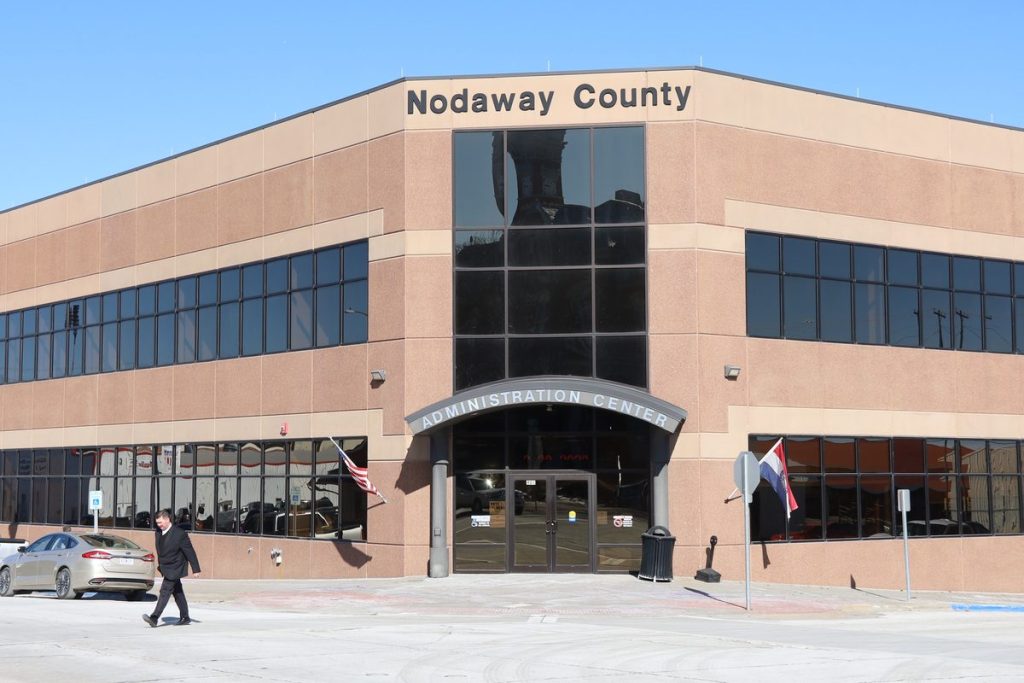
FORUM FILE PHOTO
Nodaway County Administration Center (copy)
MARYVILLE, Mo. — The Nodaway County Commission on Tuesday worked to assuage concerns and collect feedback from school district officials about a potential ordinance that would freeze property valuations for some senior citizens.
A law signed in 2023 by Gov. Mike Parson allowed counties across the state to “freeze” property valuations for senior citizens. But the law, which was nearly universally panned by officials across the state — including local officials on Tuesday — was poorly written and vague, leaving what exactly constituted a “senior citizen” up to counties and potentially leaving seniors who were not eligible for Social Security, like many teachers and firefighters, ineligible.
One of the few bills passed by the legislature this session fixed many of those outstanding issues, including setting an age of eligibility at 62. Parson signed the bill into law last week, prompting many counties, including Nodaway, to look at how to implement the program now that officials felt it was better defined.
The new state law allows counties to enact the tax freeze either through an ordinance or by a ballot initiative approved by county voters. The Nodaway County commissioners said Tuesday that they are planning to do so through an ordinance.
Tuesday’s meeting to discuss the basic contours of such an ordinance was of significant interest to area school superintendents, who are paying close attention to how a freeze on senior citizens’ property taxes may affect their districts’ future tax collections.
The commissioners said Tuesday that they haven’t begun to draft an ordinance of their own yet, but have assembled several ordinances passed by other counties to see what the prevailing best practices are and what elements might be best to take for Nodaway County.
But in broad strokes, once an ordinance is enacted in the county, seniors 62 and older will be eligible to apply for freezing the property valuation on their primary residence. Only their primary residence will be eligible and three acres of surrounding property, Collector-Treasurer Marilyn Jenkins said. Eligible seniors will need to reapply in person each year to keep the freeze in place, otherwise the valuation will reset to the current year.
For example, if the ordinance were enacted today, a senior who is 62 on Jan. 1, 2025, would be able to apply to freeze the valuation on their primary residence at the 2024 value. If the senior paid $2,000 in property taxes on their primary residence in 2024, they would continue to pay that amount even if the value of their home rose in subsequent years. Then when the property either changes hands or if there is an addition that causes the home to need to be revalued, the valuation would reset to what the present-day value would have been.
So the senior who paid $2,000 in property taxes for their primary residence in 2024 could continue to pay that amount even if their home rose in value to $2,100 in 2026. But if the senior built an addition to the home that would require the property to be assessed again, then the base value of the home would reset to the new assessment. Similarly, if the property changed hands in 2026, then the base value would reset to the $2,100 valuation, for example.
As for the effect on local school districts, which receive the majority of their funding through local property taxes, county officials don’t have the data to be able to make an educated guess about how many seniors in the county are likely to be eligible for the program, and the law hasn’t been in place long enough to get an idea from other counties what percentage of eligible seniors may participate.
According to 2020 U.S. Census data, though, people age 65 or older own 1,779 homes in Nodaway County, or about 35 percent of all homes in the county. Importantly, that figure does not include homeowners ages 62 to 64 and also does not delineate between properties owned by that age group and primary residences owned by that age group. However, those kinds of Census estimates have given officials a rough, ballpark idea of how many homeowners across the county may be eligible.
Curiosity about the program, which has not been well explained by state officials and was muddled because of confusion about the original 2023 law, led to significant interest from other officials throughout the county, with Maryville City Manager Greg McDanel and five Nodaway County school district superintendents — representing Jefferson, Maryville, Nodaway-Holt, North Nodaway and South Nodaway — in attendance at Tuesday’s meeting.
South Nodaway Superintendent Dustin Skoglund told the commission that school officials were primarily concerned about how much revenue they may lose out on in the future that otherwise would come in from rising property values.
“But it sounds like that’s gonna be relatively minimal,” he said.
Nodaway County Assessor Rex Wallace said the program is probably more complicated than it needs to be — “it could’ve been made a lot simpler, but they didn’t ask me” — but said it will provide relief to senior homeowners who could use it without making a major negative impact.
“I think it’s a workable program and I think it’s a home run for the citizens of Nodaway County and the state of Missouri, to be honest with you,” Wallace said.
The commission will now work to draft an ordinance and then seek a second round of feedback from countywide stakeholders before finalizing the language and voting on it, although all three commissioners indicated strong support for the measure in principle.