City plans new water treatment plant by 2027
FORUM FILE PHOTO
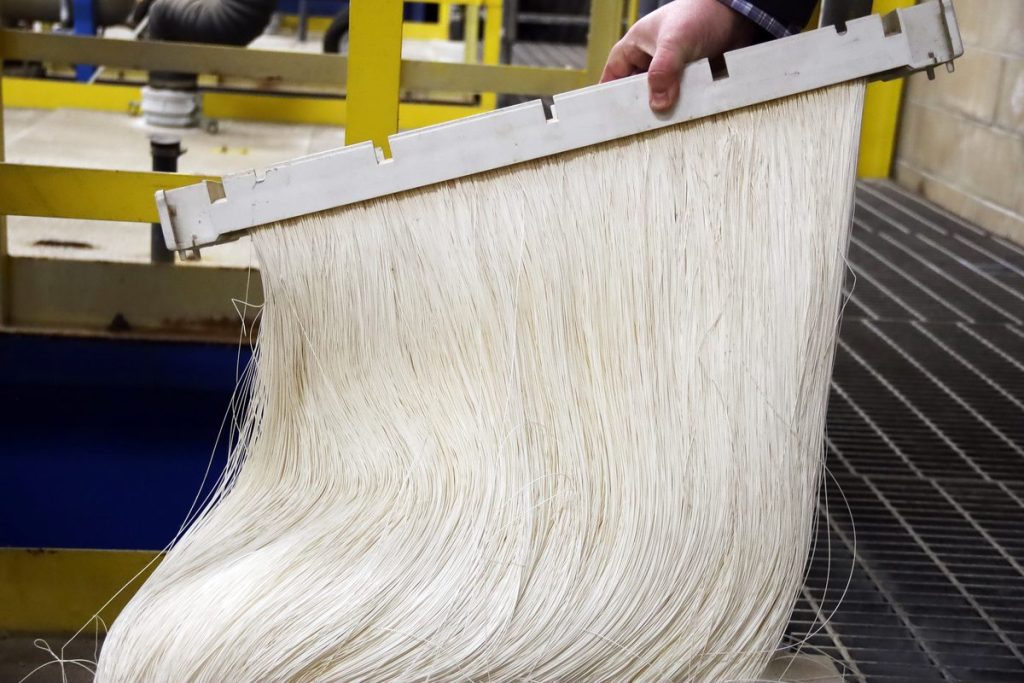
Water filtration membranes like this one, shown during a tour of the Maryville Water Treatment Plant in 2020, were installed that year and have an operating lifespan of about 7-12 years, according to HDR.
MARYVILLE, Mo. — The city of Maryville is targeting August 2027 to have a new, nearly $50 million water treatment plant up and running at Mozingo Lake.
The aggressive timeline was unveiled Monday during the regular meeting of the Maryville City Council by representatives from HDR, an engineering firm that has worked extensively and closely with city officials for years on the city’s water systems.
TIMELINE
Jan. 2020 – Public access to Mozingo Lake is shut down after Missouri DNR issued a warning about high concentrations of cyanobacteria, or blue-green algae, at the lake. City Manager Greg McDanel outlines a three-pronged approach to address the problem: new water treatment infrastructure, better techniques for treating the lake itself, and working with landowners to reduce nutrient runoff from the surrounding watershed area.
April 2020 – Cyanobacteria levels at the lake dip back under Missouri DNR’s threshold and public access to the lake is restored. Additionally, the U.S. Department of Agriculture’s National Resource Conservation Service opens a $200,000 fund to assist landowners in the Mozingo watershed to adjust crop applications to different techniques or products that may produce less nutrient-rich runoff into the lake.
June 2020 – The city begins working with HDR on comprehensive water solutions. Also this month, the U.S. Geological Survey works to map the bottom of Mozingo Lake to get a better idea of its sedimentary makeup. Later this year, officials from HDR, the city, Missouri DNR, the Missouri Department of Health and Senior Services, the NRCS and the Missouri Rural Water Association will form the Mozingo Lake Workgroup, building action plans and measuring progress to address the algae blooms at the lake.
Summer 2020 – New filtration membranes are installed at the Maryville Water Treatment Plant. They have an approximate lifespan of seven years, starting the clock on a countdown to when new membranes will need to be purchased or a new water treatment facility is ready to go.
Dec. 2020 – The naturally occurring compound geosmin is identified as the chief cause of an earthy taste and odor in the drinking water. The taste becomes detectable at around 20 nanograms per liter. Concentrations in Mozingo Lake were measured at 2,200 nanograms per liter.
Jan. 2021 – HDR outlines a comprehensive plan for short- and long-term solutions to water treatment, source water management and watershed management practices. The plan calls for regular algicide applications at Mozingo Lake, which have continued ever since, and in the short-term, the installation of a granular activated carbon adsorber to help more effectively filter the geosmin.
Aug. 2021 – Missouri DNR and the U.S. Geological Survey announce a partnership to install continuous water monitoring equipment in the creek that feeds Mozingo Lake to better measure nutrient runoff.
Nov. 2021 – NRCS kicks off a four-year, $1 million federal initiative to incentivize implementing conservation practices in the Mozingo watershed.
Dec. 2021 – The GAC adsorber goes online, significantly improving the quality of geosmin removal in the water treatment process. The $1.3 million cost of the adsorber, which was installed in a converted empty tank on the water treatment plan site, was split between the city and Public Water Supply District No. 1.
Sept. 2022 – A pilot water treatment plant using ozone and biofiltration methods is installed at the existing water treatment plant. The results will be used to plan a new water treatment facility and is a required step by Missouri DNR.
July 2023 – City, HDR and state officials tour Texas water treatment plants that utilize ozone and biofiltration methods.
Jan. 2024 – Backup filters at the water treatment plant went offline due to damage from extreme cold weather, necessitating voluntary water conservation methods. City officials point out that the problem was because of the dated technology in use at the plant and would not have occurred at a proposed new facility.
March 2024 – The Missouri Department of Conservation and the city announce a wildlife management plan for the Mozingo Lake watershed to restore natural habitats and improve the general health of the lake.
June 2024 – HDR and city officials announce that they are aiming to have a new water treatment plant at Mozingo Lake in operation by August 2027.
Fall 2024 – HDR and the city plan to begin designs on a proposed new water treatment plant.
Feb. 2025 – The city tentatively plans to hold a special bond election to allow for the nearly $50 million bonding capacity required to apply for a loan from Missouri DNR’s State Revolving Fund.
April 2025 – The state’s Clean Water Commission meets and will approve SRF loan recipients. The city also plans to begin working with a contractor on preconstruction work.
Nov. 2025 – Construction could begin on the new water treatment facility.
Aug. 2027 – The new water treatment plant at Mozingo Lake would begin operation.
The ambitious date — just three years and change from today — was selected because the most time-sensitive factor in upgrading the city’s water infrastructure is how long water filtration membranes at the current water treatment plant will last. The membranes were purchased and installed in 2020 and have a life expectancy of about seven years, after which their effectiveness drops. The membranes the city replaced in 2020 had been in place for nine years, for example, but had trouble keeping up with demand.
That led HDR to target August 2027 so that the city would not need to buy another round of membranes for a plant that would not be in use very long. Replacing the membranes would cost an additional $10 million or so, HDR estimated.
However, meeting that date will take overcoming some significant challenges in a short period of time.
Most significant of all, of course, will be funding.
Cost
During Monday’s meeting, HDR officials said that the new treatment plant project would likely cost around $50 million, including laying new water lines and the demolition of the existing plant. To finance the project, HDR recommended utilizing the Missouri Department of Natural Resources’ State Revolving Fund, a federal-state partnership which provides low-interest loans to Missouri communities for water infrastructure programs.
The SRF application will need to be submitted by Aug. 15. But in order to qualify for the SRF loan program, the city must be able to demonstrate that it has the bonding capacity to pay back what will likely be an approximately $50 million loan.
Although the city can — and will — look to reduce the local cost burden by pursuing state and federal funding opportunities, it must still demonstrate it can finance the full amount.
That will require a bond election, which according to HDR’s plan, the city intends to put on a special election ballot in February of next year. The bond issue can’t wait until the April municipal election because the state’s Clean Water Commission, which approves the list of SRF loan recipients, will meet in April — too late for Maryville to qualify if the election were held that same month. And any delay, HDR officials said, could throw off the taut timeline and result in the city having to pick up some costs along the way up front — like the more than $3 million price tag HDR estimates for the design phase of the project.
McDanel said the bond election looks to be the most challenging hurdle to clear, as putting measures before voters always comes with risk and the need for disseminating a lot of information in a concise way.
“So the education of that is going to be nuanced and very critical this fall,” he said.
Ultimately, local ratepayers will pay more on water and sewer rates to help pay off those bonds over the next several years, which city officials have communicated publicly for years in preparation for the new water treatment plant. But how much more will depend on how much external funding — like grants or congressional earmarks — the city is able to come up with. McDanel said finding other funding sources is an immediate top priority so that voters will be able to have as much information as possible about the financial impacts for a potential ballot question in February.
If voters approve the bond in February, that would clear the way for the Clean Water Commission to authorize a planning loan, used for design of the project, and then a construction loan at its meeting in October of next year to pay for the actual construction.
Even if all those approvals go through without any problems, ensuring the new treatment plant is up and running by August 2027 will require coordination among multiple agencies and contractors to make sure everyone is on the same page and schedule, said Jessica Adams-Weber, water client development lead at HDR.
“Really what this boils down to is this requires a lot of collaboration,” she said. “Collaboration with the city, collaboration with DNR, who’s been amazingly involved.”
History of partnership
The groundwork for that collaboration has already been well laid, as HDR and the city have worked closely with officials from Missouri DNR and from other state and federal agencies since 2020, when algae blooms at Mozingo Lake turned into a potential health hazard and forced clean drinking water to the top of the community’s priority list.
Algae blooms like the ones at Mozingo are typically caused by high amounts of nutrients like nitrogen and phosphorous that usually make their way into water sources from agricultural, wastewater or stormwater runoff.
The nutrients cause algae growth to explode, which can, on its own, occasionally result in toxic blooms. That wasn’t a worry at Mozingo. Instead, it was a compound that came from the algae dying off in cold weather.
When the algae blooms die, they release a compound called geosmin, a difficult-to-filter substance that was identified in 2020 as the chief culprit behind the taste and odor issues in Maryville’s drinking water.
The proliferation of algae blooms in drinking water sources, though, is not unique to Maryville. A 2017 EPA study found that 45 percent of the country’s freshwater lakes had excess nutrient levels. In 2020, Assistant City Manager Ryan Heiland said that 78 percent of all lakes monitored in the EPA’s Midwest region — Iowa, Kansas, Missouri and Nebraska — have dealt with algae blooms similar to the ones in Maryville. And algae blooms, along with their associated drinking water issues, will only continue to get worse as climate change grows more extreme, the agency has predicted.
But in Maryville, the resulting amount of geosmin was eye-popping.
Most people can detect the earthy taste and odor of geosmin in their drinking water with only about 20 nanograms per liter of the compound present. Particularly large concentrations of geosmin are usually measured in the hundreds of nanograms.
At Mozingo Lake in 2020, geosmin was measured at 2,200 nanograms per liter.
“When we go to conferences and say that, rooms full of engineers gasp,” McDanel said. “So this was a significant algal bloom issue. And we’re the first, but we’re not the last. This is a trend that a lot of surface water lake sources are facing, and so I think DNR knows that they’ve got to get ahead of this.
“And we were able to find a partner in HDR that’s got great relationships with regulatory agencies, has experience in other states and other projects that have done what we need to do. So we just think it’s been a great fit and their expertise is paramount to this.”
HDR has used that expertise and connections to bring significant attention to Maryville from state and federal agencies as the company has worked with the city to implement short-term and long-term solutions to address the health of the lake, water treatment capabilities and efforts to cut down on nutrient runoff from the surrounding watershed area.
That’s part of why HDR officials believe they will be able to meet the ambitious August 2027 in-service date for a new water treatment facility, which promises to be the first of its kind in Missouri.
Ozone biofiltration
Before a community can build a new water treatment facility, Missouri DNR must approve the plans. Even before that, DNR requires a pilot plant to demonstrate that the method proposed for a full facility will function optimally.
That process is already in the rearview mirror for Maryville as HDR and the city oversaw the operation of a pilot plant for more than a year beginning in 2022. Then, they submitted a facility plan to DNR.
Last year, officials from PeopleService, the company that operates the city’s water treatment plant, in addition to representatives from the city, HDR and Missouri DNR toured water treatment facilities in the Dallas, Texas, area that have already put the method to use.
Adams-Weber said that was a major vote of confidence from DNR.
“They actually sent folks down to Texas with us,” she said. “I heard from them at that visit that they’d never done that before. So they’re very invested in making sure that this project is a success.”
HDR expects that the facility plan will be approved by DNR next month, which will allow the SRF loan process to continue.
When Maryville’s water treatment plant was first constructed in 1959, it was used to take in water from the One Hundred and Two River. That has caused some issues over the years when the city’s water source changed to Mozingo Lake after the lake was formed in 1994.
The new water treatment facility will be built at the lake itself, cutting out the need to pipe the water from the lake all the way to the facility on the other end of town and then out to customers.
But most importantly, the modernized facility would be the first in Missouri to use ozone and biofilters to process drinking water.
Ozone is a fairly common method of treating drinking water, but using biofilters — which use organic material to remove compounds from water — in combination would be a first. The yearlong results from the pilot plant showed that the combination was the most effective way to remove the contaminants that come from the water at Mozingo, much more effective than the current plant and the temporary granular activated carbon adsorber the city installed in 2021 as a stopgap measure.
Adams-Weber said that HDR has already laid the groundwork to make sure that contractors are aware of the August 2027 timeline, and anticipates no shortage of interest in the project when the time comes.
“I would not be concerned at all about getting a good competition for a project of this size, especially when it’s the first ozone biofiltration in Missouri — contractors really want to show that they were the ones who put that in,” she said. “Because based on the interest from DNR, I don’t think it’s gonna be long before you’re gonna see more ozone biofiltration facilities in the state.”
FORUM FILE PHOTO
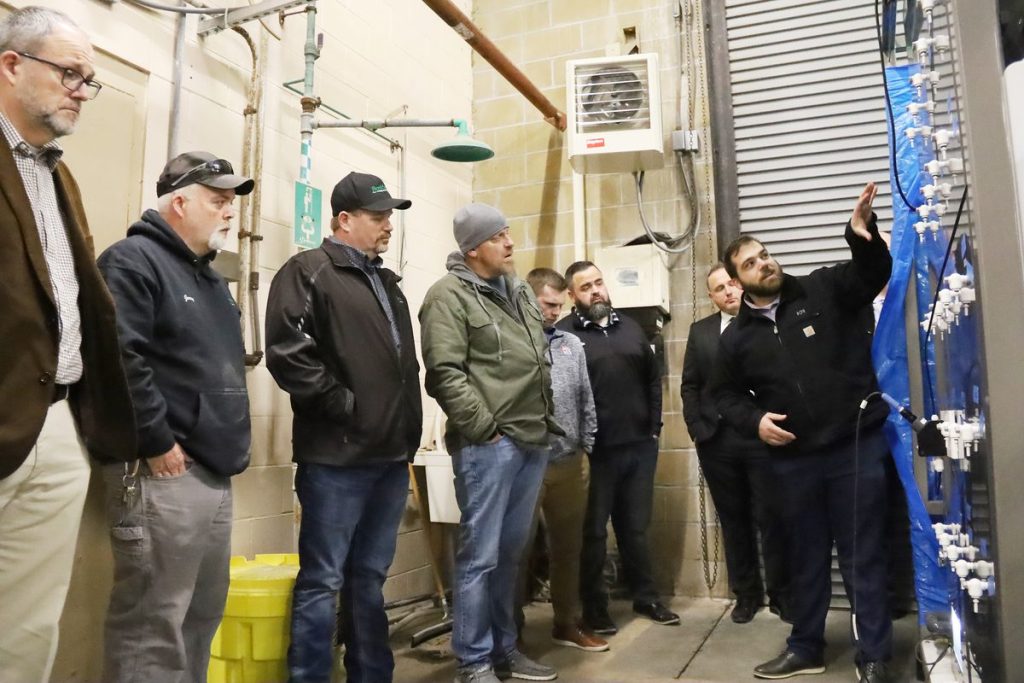
Water treatment pilot plant operator Vito Palmietto, right, explains to Maryville City Council members in December 2022 how pilot plant operates. Palmietto and staff from HDR, the city and PeopleService, the company that operates the water treatment plant, monitored the pilot plant’s efficacy over the next year to determine what would be most effective for a new, full-sized water treatment plant.
HDR
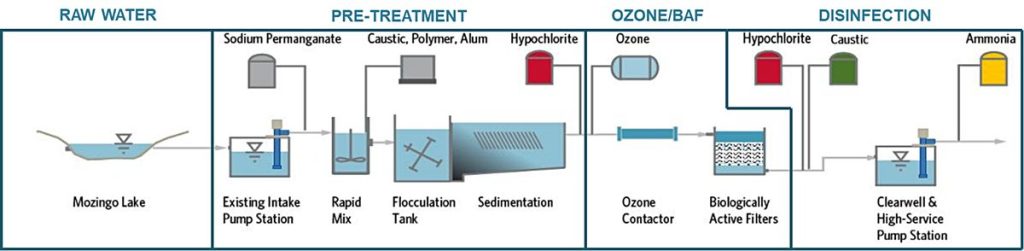
The proposed treatment process at a potential new water treatment facility to be built at Mozingo Lake. It would be the first in Missouri to use a combination of ozone and biofiltration to treat drinking water.
FORUM FILE PHOTO
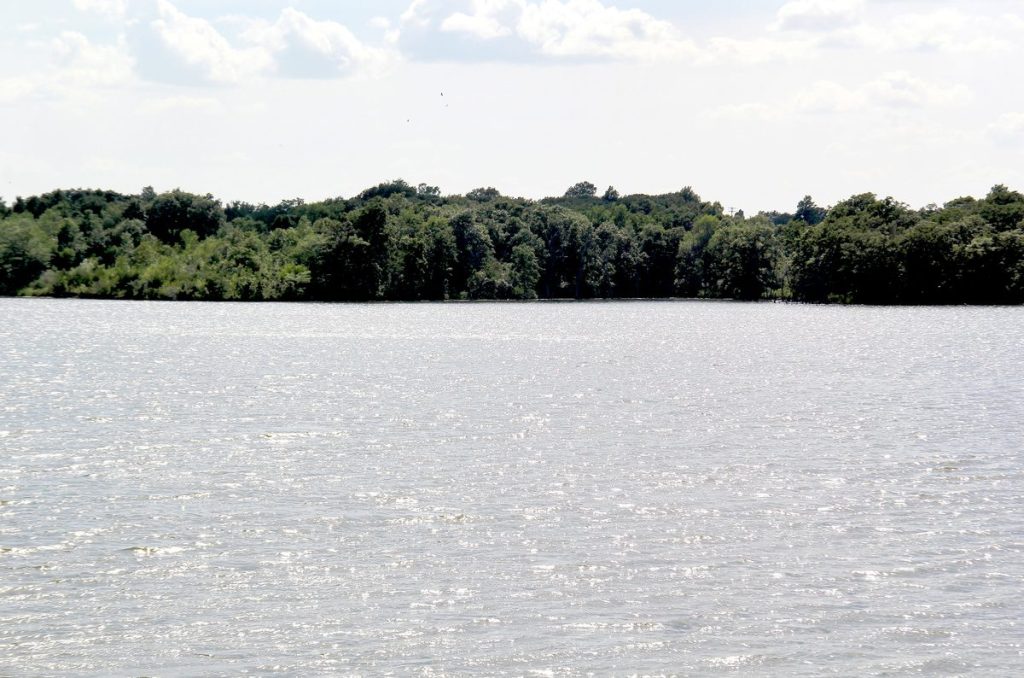
Mozingo Lake (copy)