SIDEBAR: Farnan, Black tout accomplishments during session
GEOFFREY WOEHLK/THE FORUM
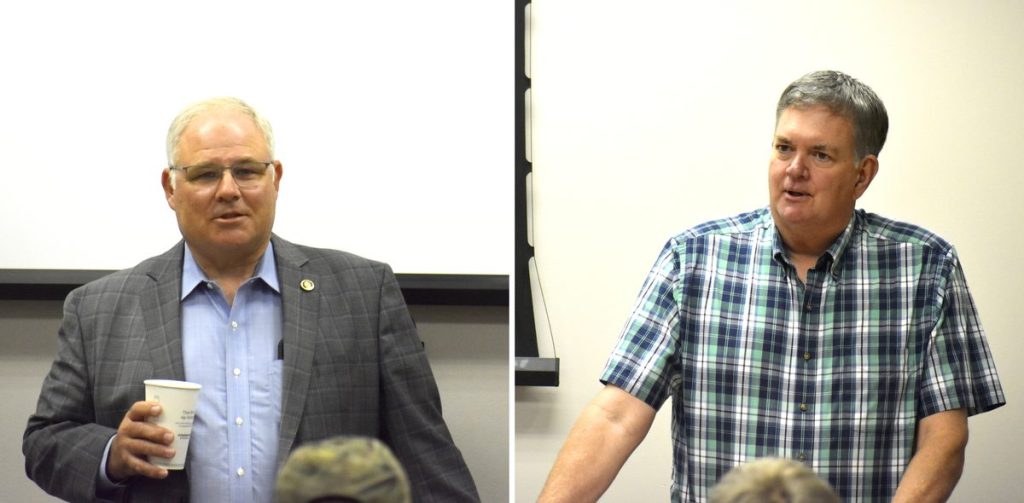
Sen. Rusty Black, left, and Rep. Jeff Farnan, right, spoke at the Greater Maryville Chamber of Commerce’s annual Legislative Coffee event at the Nodaway County Administration Center on Tuesday.
MARYVILLE, Mo. — During Tuesday’s Legislative Coffee event hosted by the Greater Maryville Chamber of Commerce at the Nodaway County Administration Center, Rep. Jeff Farnan and Sen. Rusty Black highlighted some of the legislation they sponsored during the session that ended on May 17.
Farnan
Topping Farnan’s list this year was $228,000 that made it into the state budget that, if signed by the governor, would go to North Star Advocacy Center in Maryville for capital improvements. Farnan thanked Black for helping to keep it in the budget on the Senate side.
As for non-budget bills, Farnan primarily cited three issues that he sponsored bills to address: expanding pathways to become funeral directors and embalmers, allowing the use of biometric identification to verify age for alcohol purchases and allowing A+ scholarship program participants some leeway when convicted of certain crimes. The bills about funeral directors and embalmers and biometric IDs passed the House but died in the gridlocked Senate, while the bill about the A+ program didn’t make it to a full vote of the House.
HB 2322 – Funeral directors and embalmers
HB 2322, passed by the House in March, would have reformed the licensing process for individuals pursuing careers in funeral-related services. The bill would have:
- Required embalming student license applicants to be at least 18 years old, possess a high school diploma or equivalent, and be enrolled in or have completed a funeral service education program.
- Allowed student licensees to assist in embalming under supervision, with a mandate to complete an apprenticeship, embalm 25 bodies and pass exams within a five-year period.
- Stipulated that funeral director license applicants be 18 years old, hold a high school diploma or equivalent, and work as an apprentice under a licensed director. They must obtain a provisional license and fulfill requirements within 36 months, or obtain a full license through accredited programs or apprenticeships.
- Introduced limited licensure for funeral directors, allowing them to work in cremation-only establishments.
HB 2499 – A+ scholarship changes
This bill would have prevented eligible students from being disqualified from receiving a grant under the A+ program solely because of a guilty plea or conviction for minor charges of possession of a controlled substance or possession of drug paraphernalia.
“If for some reason they do something stupid — an MIP or something like that … this will allow them to have one infraction like that and still receive their A+ scholarship,” Farnan said.
Farnan said the bill had bipartisan support, but it didn’t make it to the Senate before the end of the session.
HB 2599 – Biometric ID
This bill would have allowed the use of biometric methods of identification to verify customers are of legal age when selling alcohol. Examples of biometric IDs include palm or retina scanning.
The bill was backed by Amazon, Microsoft and other companies that serve as vendors for such services and have been pushing similar legislation in states across the country. Black and Farnan were both open about the fact that companies and lobbyists for a number of interests wrote the legislation they sponsored, including this one.
“I call it ‘the Amazon bill’ (because) it was brought to me by Amazon,” Farnan said.
Methods like palm scanning are already in use in some locations nationwide, including at sports venues like Allegiant Stadium in Las Vegas, Nevada, and Coors Field in Denver, Colorado.
Vendors typically require an age verification up front, and then palm scans afterward. For example, Amazon requires a physical ID to be scanned into their system first, and then a customer’s identity can be verified via a matching palm scan at all participating locations.
The bill would have allowed vendors to store and sell customers’ biometric data, like retinal scans and palm prints, to third parties, but would have required companies to allow customers to opt out and delete their data. Opting in, though, is a requirement to participate in Amazon’s system, for example.
The timing of this legislation was intended for the upcoming World Cup, Farnan said.
“So the main reason they wanted this with the World Cup coming in 2026, this will speed up the concession lines,” Farnan said.
It passed the House 86-53 and had a hearing in the Senate, but didn’t make it to a full vote before the end of the session.
Black
Because of the gridlock in the Senate this session, Black said he “wasn’t as productive” as Farnan, highlighting only two measures he sponsored.
Topping his list of accomplishments this session is restoring funding to a state retirement fund for sheriffs and prosecutors, Black said. He sponsored Senate Joint Resolution 71 that will ask voters to enshrine it in the state’s constitution.
The other was a bill that would allow specialized care workers at child care facilities instead of only in children’s homes. Black said that he would like to find more ways to reduce existing barriers for child care providers in the future.
But Black said he’s most interested in the appropriations process. There, he said he’s pleased with the way the state has grown its $7 billion surplus and the work he and Farnan have done to direct $100 million of it to low-volume road maintenance. Most of those roads are in northern Missouri, he said.
“By the time we’re dead, our blacktop roads might be better,” he joked during Tuesday’s event. “But remember, for 35 years there’s been absolutely nothing done to them. So it’s gonna take time to do that.”
SJR 71 – Sheriffs’ retirement fund
Prior to 2021, the Missouri Sheriffs’ Retirement System was funded by a $3 surcharge as part of municipal and circuit court costs. In 2021, the Missouri Supreme Court ruled that was unconstitutional, violating a clause in the state constitution ensuring that “justice shall be administered without sale, denial or delay.” The fee, the court said, constituted a “sale.”
In the meantime, the state approved general revenue funds, but it was a one-time infusion of cash to keep the retirement system afloat. As a long-term solution, Black shepherded through this bill that will ask voters to amend the state constitution to clarify that the administration of justice includes levying costs and fees to support salaries and benefits for sheriffs, former sheriffs, prosecuting attorneys, circuit attorneys and former circuit attorneys.
The amendment will require a simple majority of Missourians to approve it.
SB 1111 – Day care licenses for complex care
This bipartisan-backed bill would create a new licensing process that would allow child care centers to care for children with medically complex needs. Currently, these children can only receive that kind of care through private nurses at home.
But Black said that the state Department of Health and Senior Services approached him with this legislation that would allow child care facilities licensed by DHSS to hire a nurse to provide that care for multiple children at the facility. That, supporters say, would help relieve some of the burden on parents, allow children to engage in socialization with other kids, and help to make up for the lack of qualified nurses available to provide that care individually by allowing them to care for multiple children in one location.
The bill is awaiting Gov. Mike Parson’s signature.