Local law enforcement officers tackle ongoing tough issue
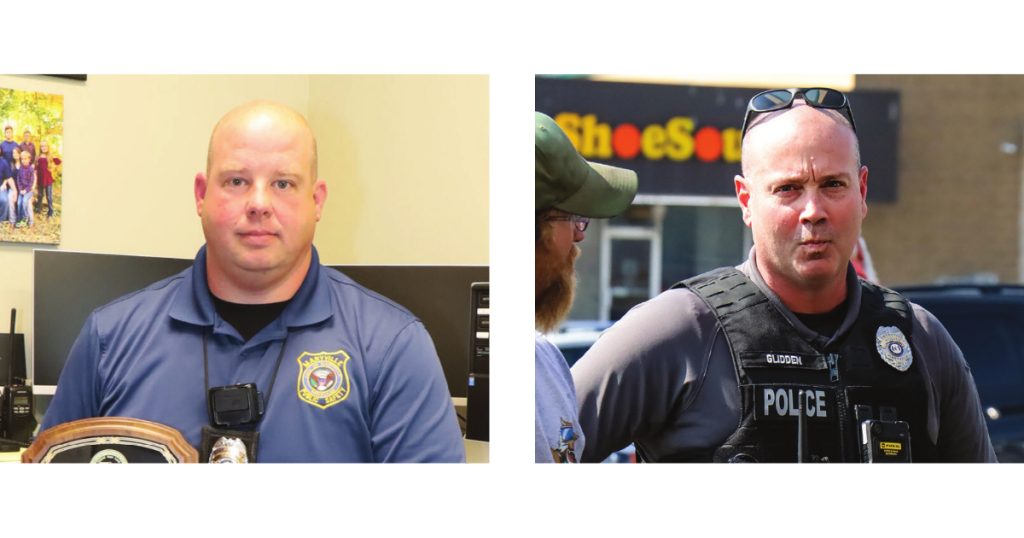
Maryville Police Detectives Sgt. Adam James, left, and Sgt. Ryan Glidden, right.
MARYVILLE, Mo. — Scam experts in northwest Missouri are few and far between, but right here in Maryville, a pair of detectives are becoming well-known as the right guys to talk to when scam victims find themselves in need of help.
Maryville Detectives Sgt. Adam James and Sgt. Ryan Glidden have spent the last five years working an increasing number of cases involving scams.
James, who has been with the department for 16 years, told The Forum that over the past several years, those calls have “really ramped up.”
“We know there are countless cases here that go unreported,” he said, noting that many people are too embarrassed to make a report, or only want to discuss what happened over the phone and not identify themselves.
SCAM SERIES
The Maryville Forum is kicking off a yearlong series about scams. With the ever-evolving nature of scams, new AI technology and faster communication, people of Nodaway County and northwest Missouri are falling victim, losing more than a million dollars to scams over the past five years.
The Forum is diving into the specifics of some of the most prevalent scam types being used in Nodaway County today, red flags to look out for and what local businesses and financial institutions are doing to stop the scams before they happen.
We’ll also talk to people who have been scammed to hear, from their perspective, just how easy it is to fall victim to the practiced, nuanced and sophisticated scammer, whether on the phone, on social media or in your own email.
Part 2 on the dangers of sexploitation is available here.
He said the department has always taken scam calls, but “we have been absolutely slammed (with scam calls) the last month, almost two months.”
Of those reports the department has handled in the last five years, James said victims have lost a total of $1,221,940.54. This does not account for reports made to the Nodaway County Sheriff’s Office or the Northwest Missouri State University Police Department.
“That money is coming out of our community and actually it’s so much more because people don’t report it,” James said. “Or when they do come in, ‘how long is this going on?’ ‘I don’t want to talk about it.’ ‘How much have you lost?’ ‘I don’t want to talk about it.’ So then you don’t really know.”
Whether it’s elderly romance scams, lottery scams, manipulation scams, exploitation scams or others, he said, “really the only way we can do it is just to get people to quit falling for it on the local level,” Glidden said.
They’re also helping people from surrounding communities because they often show up in Maryville to send the cash.
“We intercepted a package the other day, an older couple, a farm couple, and found out that they were out (around) a million dollars,” Glidden told The Forum in October. “This is happening to people’s friends, loved ones every day here in our community and a lot of time we don’t know about it until it’s too late. We’ve recovered a lot of money over the years, but it was too late for these folks. The only thing we were able to get back for them was the cash ($5,500) that they were trying to FedEx out.”
James told The Forum in early December that the family is now selling scrap metal off the farm to help pay monthly bills.
“After talking with them for over two hours trying to educate, I would learn they had lost in the span of three years, just shy of $1,000,000.00,” James wrote in a December email to The Forum. “They are at retirement age and have nothing left.”
Scams from Bitcoin to romance continue to bombard the area and law enforcement officers and at least one bank manager concur that it’s really about informing people that, “If it’s too good to be true, it probably is,” said Mandy Felton, bank manager with Southern Bank in Maryville.
In mid-December, Felton was working 12 separate fraud cases from the bank’s side of things. She said they receive tips on four to five different possible fraudulent charges per week. While talking with The Forum, Felton received yet another report on a possible fraud.
“It’s so smart and it’s getting smarter every day,” she said. Now with artificial intelligence entering the ring and becoming more available, she said scammers are able to copy voices which can imitate a family member and pair that with a “spoofed” caller ID, making it incredibly difficult to catch a scammer.
“I’ve had so many tears in this office,” Felton said, explaining that more often than not it’s the shame of realizing what they’ve fallen for that hurts the most for people she’s had to tell they’ve been scammed.
She said there’s almost a need for a support group for those who’ve been scammed.
“These are majority, fixed-income, elder targets, and in speaking with other branch managers at U.S. Bank, Bank Midwest, and Nodaway Valley, somewhere, somehow along the way, Nodaway County and this area has gotten hit hard,” Felton said. “I think it’s just they’ve figured out we have an elderly demographic. We have a lot of fixed income.”
James told The Forum that educating people, “talking to our grandparents,” is the best option for stopping the billion-dollar scam industry locally.
“In Maryville, we can fight to get people’s money back, we can stop it, but we can’t jump in a car and follow packages,” he said. “How are we going to get to New York in time? … We are down to education and the more people you (can) get to.”
James said that of the 176 scam calls in the last five years, 76 of which had reports officially filed, 18 of them were stops by Rapid Elite involving $104,900. In 24 instances, funds were returned to victims and totaled $248,900.
That doesn’t always happen, though. James said more often than not, the money is already gone.
“Usually we don’t find out until days or weeks later,” he said.
If someone suspects a family member or friend has been scammed, the earlier they reach out to law enforcement the better.
Call the Maryville Police Department non-emergency line at 660-562-3209 to report a possible scam.
EDITOR’S NOTE: In upcoming parts of the series, The Forum plans to offer a deeper look into specific aspects of several of the more common scams, the use of AI in scamming, how local businesses are trying to help stop scams, how banks are catching fraud every day and how local people who have been scammed are dealing with the aftermath. Part II will publish in February.