Florea to retire from Nodaway County Ambulance District
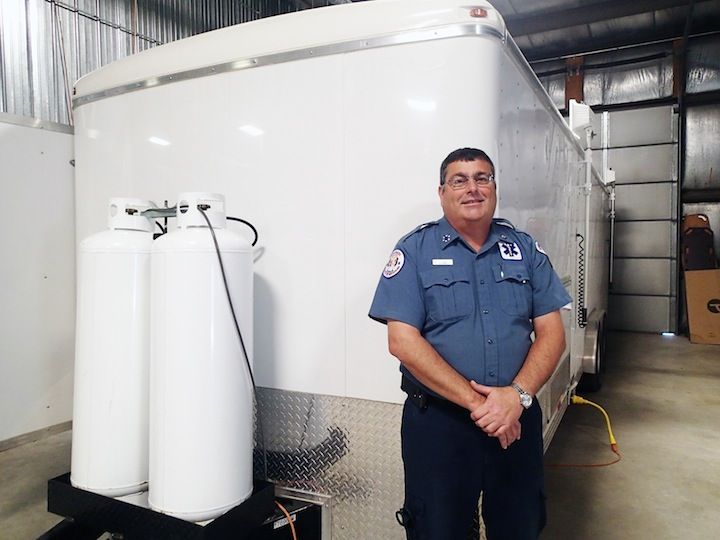
FORUM FILE PHOTO
Bill Florea, operations director for the Nodaway County Ambulance District, stands beside the district’s mass casualty response trailer in 2015. Florea plans to retire on Friday after 42 years with the ambulance district.
MARYVILLE, Mo. — Before he began a 42-year career at the Nodaway County Ambulance District, Bill Florea wanted to build things.
Fresh out of high school, Florea had planned a life in construction, and liked the idea of having winters off and not working in the rain.
But then his older sister suggested he take an EMT course.
Four decades later, Florea, the longtime director of operations at the ambulance district, has decided to retire.
“It’s time,” Florea said: time to spend with his wife, Kim, time to spend with their kids and grandkids, and, at long last, time for that long-awaited winter off.
Not one for bluster or to bring attention to himself, Florea has spent the better part of his career serving as the sturdy foundation of the ambulance district.
He had already been with the district for 13 years when LaRee Lager joined the staff in 1994. Lager, who eventually became the business manager for the district, beat him to retirement by a year.
Florea was the assistant director when Lager started and the two were partners for a period of time, she said. As a slew of colleagues across his four decades could attest, what stuck out to Lager was Florea’s dry, wry sense of humor that she admitted took a little bit of time for her to catch on to and really appreciate.
“I was petrified in the first year or two,” she said. “But, he was my work husband there for the last however many years.”
Describing their back-and-forth joking, Lager said they used to trade positions between driving and helping patients in the back, which was good, because she didn’t particularly care for the driving part.
“I had a wonderful teacher because he was helping me as I was doing my EMT,” Lager said.
Some days would be spent out on calls, but others, Lager said, Florea just couldn’t help but fall back on old habits.
“He would paint,” she said, “but he hated wallpaper. We did a lot of that work and some of the other stuff — you know, back when money was tight.”
Just last week, Florea was still at it, working to pour, smooth and level a concrete table near the wash area of the ambulance bay.
“He would be out on his tractor spraying leaves and the next day working on the budget,” Lager said.
The leaves and the calls, that wasn’t the hardest part, Florea said. The budgeting and paperwork? That always seemed to bring more stress. While the work in the field is “all in here,” Florea said, pointing to his head, the administrative work wasn’t something that came naturally. He credits “some of the strong board members over the years who have given me guidance” with helping him along.
Nodaway County Commissioner Scott Walk served around 17 years on the NCAD Board of Trustees before taking his current position. Serving as chairman and treasurer for a time, Walk said Florea has been a frugal and incredibly dedicated leader for the barn.
“Bill was a dedicated servant to this community for many, many years,” he said. “And as manager of the ambulance barn was outstanding.”
It was the work out on calls, though, that brought Florea to the job, saving lives and providing some light during people’s darkest hours.
“I’ve worked with some paramedics who have probably influenced me more than I realized,” he said of his colleagues.
When Lager’s father-in-law had a heart attack, it was Florea and John Maxwell who received the call.
“Thank God I had those two, because (they’re) the two that I trusted the most at the time,” she said, noting Florea “could hit an IV blind, I swear.”
She said Florea has been called to most of the more difficult calls throughout the county in the past four decades. She couldn’t recall his partner, but said Florea was called to the shooting at Conception Abbey in 2002, and he was on the call to Skidmore for Bobbi Jo Stinnett’s murder in 2004.
“He was on some of the worst calls that I can ever remember,” Lager said. “It’s the bad calls that you tend to think of and then we got the good calls, you know, where you save them, and I think those far outweighed (the bad). They had to.”
Florea recalled numerous difficult calls, and noted that there are many that still come to mind on occasion. To work through some of the more difficult things they see, crews bond through conversation.
“You need to be able to talk to your coworkers about it,” he said, noting that coping with the sights they have to see can often be difficult.
Lager said even before her time, crew members would work out together, climbing towers and pulling pranks to blow off steam. And the prankster-in-chief? The understated Florea.
“Oh, he was a prankster all the time,” Lager said she was told upon starting with the district. While that side of Florea seems to have been put away upon taking the director position in 1998-1999, his wit and humor are still apparent in conversation between staff.
Current district business manager Julie Schmitz said she’s learned a lot working with Florea for the past seven years.
“It feels like you’ve been here a lot longer,” Florea broke in and joked.
Taking over for Lager, Schmitz said from learning new computer and equipment systems to budgeting and spreadsheet software, Florea has helped teach her how to do the best work she can for the district, and in turn, the community it serves.
“I’ve thoroughly enjoyed working here and working with him,” Schmitz said.
Florea said it has been time now for a little while for him to leave the field, as he’s finding himself getting more cynical about the job and to some degree burnt out.
One of the toughest challenges of the job has been low staffing. Since Florea began in 1981, call volume has more than doubled, he said, running about seven-and-a-half calls per day on average. Meanwhile, the two crews on staff, he said, must now do more in the back of the ambulance on the way to a medical facility than ever before.
And while the workload has gotten heavier, that’s not the only thing: Florea said the very real increase in average patient weight over the past 40 years makes calls even more difficult. Florea estimated that when he started, the average patient weighed around 155 pounds. Now, they’re more like 220.
When tasked with that kind of heavy lifting, he can’t blame people who leave to work at hospitals that can afford to pay them more.
“I think sometimes we lose track of why we’re doing what we’re doing,” Florea said.
That became especially hard to see sometimes when getting lost in the administrative duties that he never saw himself doing. Due to an aging population, Florea said that about 30 percent of all calls are “transfers,” when a patient is taken from one facility to another. Often, they’re Medicare patients, he said, which only reimburse at 50 percent.
Those kinds of costs have been forced to the top of Florea’s mind as long as he’s been operations director, having to be conscious of everything down to the $150 needles now carried on ambulances.
“I know everything (has gone up) — gas, maintenance, that equipment maintenance, software maintenance, you have liability insurance, malpractice insurance, your wages,” he said. “We basically had to increase our wages just to match the increase for all the minimum wage increases.”
After spending 42 years as the district’s foundation, Florea said all of those factors contributed to the realization that it was time to let someone else do the heavy lifting and tackle the newest set of challenges that await over the next four decades.
“I think everybody’s gonna miss him,” Lager said. “It’s gonna be rough on everybody’s who’s still there.”
The NCAD Board of Directors hasn’t officially approved the next director, but board members were scheduled to meet Wednesday and a closed personnel portion of the meeting is on the agenda.
Florea said he is 98 percent sure the board will select current assistant director Jared McQueen to the position.
Florea said there’s a small chance he’ll stay on with the district in some capacity to help out, but that after speaking with other retirees, “life is different outside of this,” is the overwhelming response, and he wants to experience it. After Friday, Florea intends to spend more time with his wife, children and four grandkids spread out here and in Tennessee.
“I’ll just be glad when it’s not my responsibility, one week from today,” he said with a smile last Friday. “But who’s counting?”
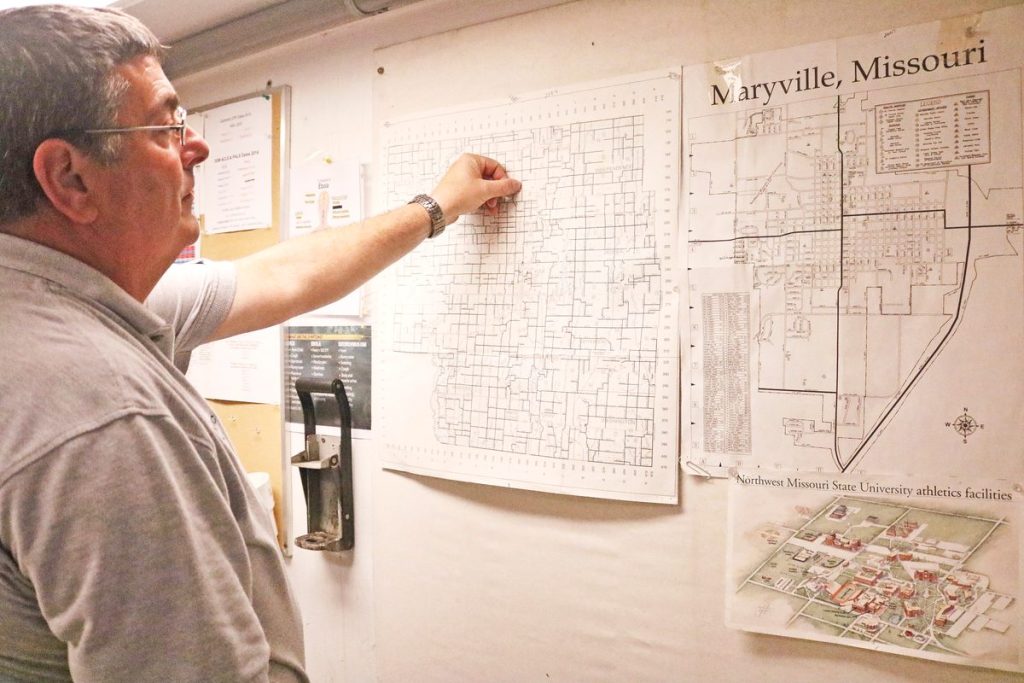
FORUM FILE PHOTO
Bill Florea points to an old map of Nodaway County that the ambulance district used to use to direct ambulances on calls in 2016. That year, the district upgraded to iPads.
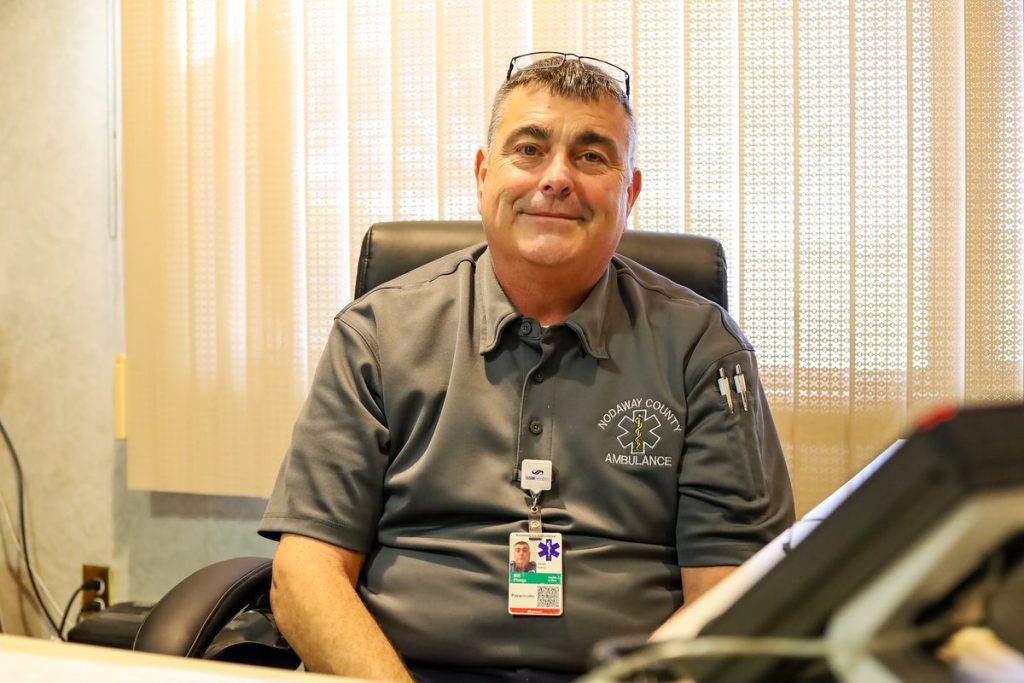
SKYE POURNAZARI/THE FORUM
Bill Florea, Nodaway County Ambulance District director of operations, plans to retire on Friday after serving the community for 42 years.