Council, school board candidates talk priorities at forum
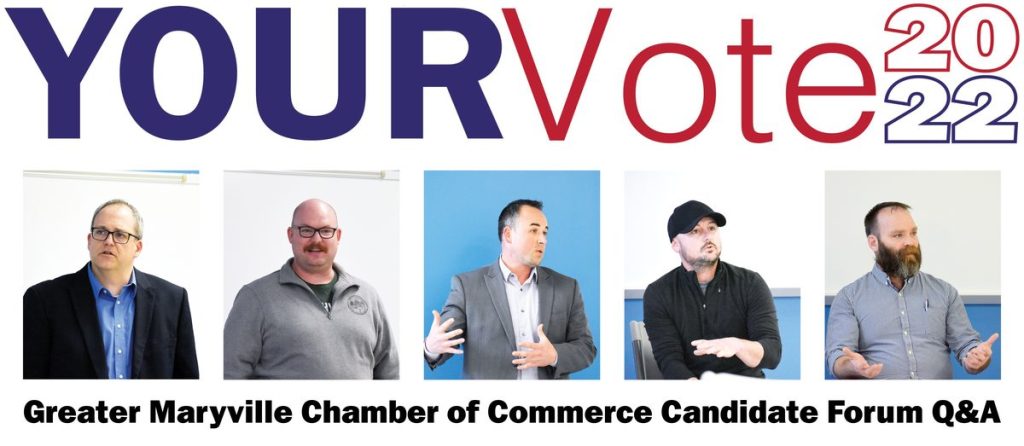
Candidates for Maryville City Council and Maryville R-II Board of Education spoke at the Greater Maryville Chamber of Commerce’s candidate forum on Tuesday ahead of next week’s election on April 5. Shown from left are council candidates from left are Tye Parsons and Bryan Williams and school board candidates Mitch Coffelt, Isaiah Korthanke and Josh McKim.
MARYVILLE, Mo. — Candidates for Maryville R-II Board of Education and City Council made their cases directly to voters on Tuesday during the Greater Maryville Chamber of Commerce’s candidate forum.
Three candidates are vying for two open seats on the Maryville school board during Tuesday’s election: Mitch Coffelt, Isaiah Korthanke and incumbent Josh McKim.
Two candidates are running for one City Council seat: Bryan Williams and incumbent Tye Parsons.
City Council
In the council race, although Williams and Parsons expressed a good deal of common ground on responsible spending and improving streets, their differences shone through starkly in their approaches to how to grow Maryville and ensure a thriving community into the future.
Williams said one of his biggest concerns going forward is the rising cost of living, and said that in order to try and keep those costs as low as possible, he would not support any new tax.
The candidate forum was held in the Maryville Community Center, which is in need of major maintenance work and would be one of the primary beneficiaries of a proposed 1/4-cent sales tax for Maryville Parks and Recreation that is also on the ballot Tuesday.
“I don’t wanna see any more burdens put on our community, so one way I would handle that is I wouldn’t support any new taxes,” he said. “I understand that’s how we function as a city, we bring in taxes. Unless it’s something that could justify it, something that’s a critical need, I don’t know if I could support that. I don’t wanna put any more undue burden on our families in this area.”
Parsons said his biggest concern was the continued outmigration of population from the area. In 2020, the city of Maryville saw the largest percentage of population loss in one U.S. Census period in the city’s history, dropping 11.2 percent of its population between 2010 and 2020.
Parsons linked that underlying issue to other pressing needs, like being able to draw qualified professionals such as teachers, doctors, social workers and mental health professionals.
“How do we compete against Omaha, and St. Louis, and Kansas City and those places? That’s a tough nut to crack,” he said. “The way that we do that is making sure that our quality of life here in Maryville competes with some of those other places. What we have that they don’t is a small-town, safe type of community where you know your neighbor, it’s safe for your kids to go out and play — that’s what Maryville has going for it.”
Critical to that community vibrancy, Parsons said, is attracting younger generations of workers.
“We’ve got such a resource out here at the university,” he said. “The best and the brightest, they come here from all around, they get educated, and they leave. Let’s keep them here. So one of the ways that we do that’s making sure that our town is vibrant, it’s growing, it’s conducive to economic development and it’s a safe place to be.”
School board
In the school board race, major topics revolved around competing to attract and retain teachers and ensuring students are prepared for whatever future awaits them.
Coffelt said that the teacher shortage starts with a lack of students going into that field to begin with.
“… start there,” he said. “Try to make that a more attractive position.”
Coffelt said that would mean not just offering more money, but more effectively selling the rewards of being a teacher in general to encourage more people to get into the profession.
But it was Korthanke and McKim who staked out the strongest views on how they would make an impact on the board.
Korthanke was critical of what he said has been a tendency of school board members to not have the courage of their convictions if school administrators at first indicate that a given idea might not be possible. And he came armed with examples. During one school board meeting, Korthanke said, McKim had suggested giving teachers back sick time lost if they were forced to use it while quarantined as a close contact to someone with COVID-19, but never tested positive themselves.
“But instantly the administration says, ‘oh, we already did our finals for the year, I just don’t think we’re gonna be able to do that. Maybe we can do it next year,’” Korthanke recounted. “… And Josh pushed a little, but he didn’t have any help, you know? He didn’t have anybody to say, hey, hold on, I think Josh had a good idea there. I want you to go back this next month and you work through and I want you to tell me how we get this done. Because the teachers need it and the community wants it.
“And so we’re not gonna take ‘no’ the first time. If you come back and you say no, and this is why, this is why, we might take it. But we’re not gonna take ‘no’ the first time you say it, because we think that when a school board member has a good idea that they get from the community, they should be willing to fight for it.”
For his part, McKim, executive director of Nodaway County Economic Development, focused on wanting to better prepare Maryville students for the workforce.
“I think that’s one area that really — I shouldn’t say ‘dropped the ball,’ because the tech school does a great job,” he said. “But that’s only a fraction of the students. There’s a whole set of students who never go to the tech school, who never get that real-world experience. And I want them to have that as they come out, as they make decisions on whether they go four-year, they go to a tech school or they go right into the workforce — they need to be equipped to make that happen. And I’m not sure that we’ve done that effectively.”
McKim said he was particularly excited for incoming Superintendent Logan Lightfoot because of his experience with programs that partner with businesses and other organizations to expose high school students to professional environments and incorporate those partnerships into the learning experience.
Below are the questions and answers presented as verbatim as possible from Tuesday’s candidate forum. The format was similar to past years’, with four local media representatives — one each from KXCV-KRNW radio, KVVL radio, the Nodaway News Leader newspaper and The Forum — posing one question apiece for each race. Each candidate then had two minutes to answer. Questions and answers are presented in the order they were asked.
Maryville R-II Board of Education
Q: What piece of the whole student experience is Maryville district lacking to produce a good, productive citizen when graduation time comes?
Josh McKim
You know, I think we do a pretty good job. And I want us to be — I think our school district needs to be the very best in northwest Missouri if not the best in northern Missouri, there’s no reason we shouldn’t be. With that, I think there’s always room for improvement. One of the areas that I really think we can improve and need to improve on is getting the students prepared for the workforce. I think that’s going to continue to be a challenge. There is a tech school and they do a great job. But not all the students go to the tech school. And so that’s one reason I was excited about Logan Lightfoot, is that he has some experience in bringing, in getting students a real-world experience while they’re in school, trying to get them educated not just on the books side, but actually applying what they’re learning in school into the real world and getting them, maybe, work experience. I think that’s one area that we can improve on and need to improve on, because, frankly, that’s what we’re about: we’re about educating kids and preparing them for the future — whether that’s going on to college or it’s going into the workforce, they need to be ready. And I think that’s one area that we can improve.
Mitch Coffelt
Yeah I would have to agree, I feel like the school has done a great job. There’s always room for improvement, and that improvement would also be getting those students prepared for the four-year school. If I’m not mistaken, I believe the school has created a position as a counselor that is specific for that. So they’re growing those things and making that an emphasis, which is, you know, getting that student ready to be a contributing adult. And I think that’s the main aspect, the main objective.
Isaiah Korthanke
Something that sticks out to me is mental health of the children. Especially over the last couple years, whether it be isolation from being close-contact quarantined, or not being able to see faces with face masks — whatever you believe was best for the district, you still can see that that was really hard on the kids. And whether it be bullying in class or stuff like that, it’s just, what we really need to focus more on, I think, is the mental health of the kids. And realizing what we kind of put them through over the last two years and get the services we need to make sure that going forward, they’re gonna be on their best foot. I’ve heard stories and stuff about middle school bullying and stuff like that that really needs to be addressed. And I know the board has addressed them — I mean, I know they’re looking for a social worker to help at the school and it’s just, it’s tough. But it is something I think that is lacking in the district and would help kids be ready to take on anything in the world knowing that their mental health issues have been taken care of.
Q: How can the district attract and retain top-flight teachers and staff in an age when fewer people are entering the education profession as a whole?
Mitch Coffelt
So, I feel like there’s fewer people entering that field — I think that’s where, start there. Try to make that a more attractive position. Make it a more attractive position by making that a more positive job — by social media, all media, all forms of media — and also making it a more, you know, people will want to go into that field with a higher, you know, salary. Just make that a more competitive — for all jobs, not just teachers — and just try to find a way to make that work and work with the state and things of that nature whether, you can come to something that can get more qualified applicants. And more applicants, you get the best of the best and things of that nature.
Isaiah Korthanke
I think we really have to start thinking outside the box. For so long, especially with government, we just get kind of in a rut of this is how we do things and this is how we’re gonna do them. When you see smaller communities looking at four-day work weeks and stuff like that — I’m not saying that’s what we need in our district, I am saying that that’s an example of how other districts have said, hey, we’ve gotta start doing something to attract these teachers because if not, if it’s just dollar signs, we can’t compete with Overland Park, we can’t compete with Omaha. So, we do have a wonderful community here. If you want a small-town feel, it’s a great community for that, but I do think we have to start thinking outside the box. One of the things that I’ve brought up before is an on-campus day care for K-3 for teachers — 14 to 20 percent of teachers leave the workforce to take care of family, to take care of their kids. And if we were able to provide that for teachers, young teachers, even if they weren’t using it, just to have that option when they walk through the door on that first day to say hey, I can have kids here, still work on school and you know, during lunch I can go see my kid in day care.
Why are teachers leaving?
Korthanke’s statistic about teachers leaving the workforce to take care of children tracks with available data, though it could vary by region. But generally, studies have shown child care as a top reason for teachers leaving their jobs at a higher rate the younger the teacher is, especially female teachers.
For example, in a recent nationwide study conducted by the RAND Corporation, 13 percent of teachers who left their job teaching at a public school after March 2020 due to concerns related to COVID-19 said child care responsibilities was the most important factor. That number went up to 24 percent for teachers under 40.
But that’s just one thing. We really — I think the main thing is, we have to keep on reaching out to the community to find ideas that they want and that would help teachers. Ask the teachers what they want. One thing I saw in a meeting, the school board meeting, is that we were talking about health insurance. And one of the school board members asked, “well, do teachers like their health insurance?” And the administration said, “well, I think they do, but I don’t really think that it’s necessary to ask as long as we’re paying their full premium.” And I just don’t think that’s right. I think we should make sure that we’re asking teachers what they want and not just assume.
Josh McKim
I think, honestly as we look at it, it’s a challenge that all school districts are facing. As you can see, a lot of the school districts are looking at some new ways of trying to address that. I worry about the long-term impacts of some of those things that they are doing. I think that’s something that has some at least preliminary worries for me. So I’m open to those discussions, but I think we’ve got to look at it not just from how convenient it may be, but what does it actually do to the trajectory of growth for those students over time? There’s some concerns. But if we’re answering the question about what do we do for teachers, you know, I did kind of wonder — and we do exit interviews trying to understand why people have left the school district and try to answer, “what are we failing at here and what are we doing well?” Very few of them are leaving because they have other opportunities that are better for them. There’s a few, but most of them are (moving up in their career) cycle, or they’re moving because they’ve got family, friends or other social opportunities they wanna pursue. Not a lot of them are leaving for, you know, it’s better pay in Savannah or St. Joe or somewhere else. What we have to ongoing do an ongoing evaluation of the benefits and the salaries that we’re doing. We’ve upped the benefits — excuse me, the salary — $2,000 for base pay over the past two years. That gets us to ($37,500). St. Joseph just upped theirs to ($37,700).
Base teacher salary
| Maryville R-II | St. Joseph | |
| 2020-21 | $34,500 | $36,700 |
| 2021-22 | $35,500 | $37,200 |
| 2022-23 | $37,500 | $37,700 |
| Source: Missouri State Teachers Association and the school districts | ||
OK so we at least now are competitive with St. Joe. We hadn’t been. So we’re starting to get that. We’ve gotta continue to do that. We’ve gotta do unique things, and I think that we have to continue to connect with Northwest Missouri State University, attract those teachers, get them in our schools ahead, before they graduate, get them there so they experience our culture. And then we need to make sure we have a culture that is supportive of our teachers, of our staff and our administrators. As a school district — board, a school board — we need to set that. We need to say, you know what, we’ve got your back, we want you guys to be successful, what do you need from us to make that happen? So we’ve gotta create a culture, we’ve gotta make sure our salaries are on point, and then we’ve gotta hit those kids when they’re coming out (of college).
Q: In the future, if the need to evaluate potential for mask mandates or other protective measures regarding COVID arises, keeping in mind that revelations late are that masks aren’t as effective as we thought and children are not as affected as first thought, how will you guide your decisions if that need arises?
Are masks not effective?
The question posed does not cite any sources and it’s unclear what it’s referring to, but its conclusion is not supported by available data.
Masks have proven to be a highly effective method of limiting the spread of COVID-19, according to the CDC. Still, misinformation persists, as it has throughout the pandemic. Studies cited by the CDC from around the world in various settings generally indicate that masks were effective in individual situations, but cut the chances of testing positive for COVID-19 tremendously in universal masking scenarios even when in close proximity with someone who has COVID-19.
Are children ‘not as affected as first thought?’
Once again, it’s unclear what the question is referring to, but according to data cited by the CDC, this is actually the reverse of what studies have shown — early in the pandemic, some studies suggested children may have been less likely to contract COVID-19 than adults. But this has not held true as more studies have been performed and children have had more opportunities to interact with others in social settings.
The CDC reports that in the U.S. through March 2021, children ages 5-17 had comparable rates of symptomatic infection to adults 18-49 and higher than adults 50 and older. In children ages 0-4, the rate was roughly half of the 5-17 rate, and comparable to adults age 65 or older.
However, studies indicate that children and adolescents infected with COVID-19 are more commonly asymptomatic or have only mild symptoms compared to adults, which may have been part of the question’s intent.
Isaiah Korthanke
How I would evaluate, I would look at the science behind it to see that masks aren’t that effective, especially in small children. But then, also, I would allow the parents to make their decisions. I mean, I would try to influence parents if I thought this was the best way, but I’m totally against mask mandates. I’m totally against stepping in on parents and saying hey, this is what you’re gonna do because we say you’re gonna do it. If a child wants to wear a mask or a parent wants their child to wear a mask, I’m all for it and if they want the teachers to check — “Hey, can you have Johnny keep his mask on?” — I’m all for that too. But I don’t think that — I don’t believe in a mandate. I don’t believe in mandating kids. I think they do more harm than good.
Mitch Coffelt
I feel like hindsight’s 20-20. I think we’ve learned that, like you alluded to, the infection rate of the young kids isn’t as high as (the adult rate) so, it’s not as necessary for masks for them. And I don’t know that there’s any reason for a mandate to come from the school board. Now if that was from a higher level and brought down, then you just deal with that at that time. But I don’t feel like that would be a mandate that would be needed to come from the school board. Now, support it from a parent’s individual — or a kid’s individual — right to put a mask on or to not put a mask on.
Josh McKim
So I think that’s an interesting question because I don’t believe we had any mask mandates that were mandated by the school board. Generally we were dealing with some other kind of mandate that was coming from another entity that really had oversight or — had control over and above the school district.
Has Maryville R-II imposed any mask mandates?
Technically the school district had a mask mandate in place for 9 days last year without any authority higher than the school board compelling it to, and the vote to end it was 3-2.
The school district first began requiring masks when students came back to school in person in August 2020, adhering to the city of Maryville’s ordinance that required masks for anyone age 10 and older. For students in fourth grade or lower, they were only required to wear masks on school buses because of a federal rule.
The city rescinded its order on March 23, 2021. In a 3-2 vote and over the recommendation of Superintendent Becky Albrecht, the school board removed the mask requirement from its policy effective April 1, 2021.
I know there’s some legal arguments both ways on that, there’s all kinds of lawsuits, but I’ll just be frank with you: my priority’s to get students in school. I want them having face-to-face — or as much as they can face-to-face — education because remote learning is not near as effective. And that is absolutely true. If we’re about educating kids, we’re gonna get them into school, we’re gonna get them before teachers, and we’re gonna do what we have to do to make that an ongoing priority. If that means they’re gonna wear masks, as much as I hate it, I want them to wear masks so they’re in front of teachers, so that we don’t have to have them be quarantined and going home somewhere else and not learning as much as they should. And that’s the problem we really face, guys, the real problem we faced was we have mandates that we cannot control. We have a public health that has at least some authority over that, and they are quarantining kids — and if we can avoid it by having a mask on, let’s do that. Because we’ve gotta get kids in school, we’ve gotta get them — some of them lost a year and a half because of this. We’ve got kids that are gonna be impacted by this for a long time, so we gotta get them face-to-face, we gotta get them in school. If that means we have to do a mask mandate? Yeah, I don’t think you’ll ever see the school district go for one of those. But if somebody else says you have to do it, we’re gonna comply. Because you’ve got to.
Q: What do you think is the biggest problem facing the school district that the school board hasn’t been addressing?
Josh McKim
The biggest problem we haven’t been addressing. I think you’d get a lot of different answers on that one. But I think the one that, again, that concerns me the most — and I am, again, most excited with what I think we are trying to do to address it — is going to be getting real-world experience for those kids. And it’s ingrained in the new superintendent, he has a background in a CAPS program trying to incorporate real-world experience with education. I think it provides great opportunities for our kids. I think that’s one area that really — I shouldn’t say dropped the ball because the tech school does a great job. But that’s only a fraction of the students. There’s a whole set of students who never go to the tech school, who never get that real-world experience. And I want them to have that as they come out, as they make decisions on whether they go four-year, they go to a tech school or they go right into the workforce — they need to be equipped to make that happen. And I’m not sure that we’ve done that effectively. And this is one way to do that. You know, I’m like a broken record, I came back with the same answer, but that’s something I’m passionate about.
Mitch Coffelt
I’ll kind of relate it to earlier, relate it back to earlier. I think the social aspect, the mental health aspect, maybe that hasn’t been dealt with. But the school board has created a position, they just haven’t been able to get an applicant. If they’d had an applicant, they would have somebody there. They just, the counselors don’t have the time to give the students that level of attention that kids need. That can be looked into more, maybe, to you know, network with people that the community knows, the school knows, and just try to recruit more, whether that’s reaching out to a recruiter — just thinking outside the box and just doing something to get that social worker to come in or even just, you know, looking to the private sector, even, to get that social worker to come in and help the kids that need that mental health help.
Isaiah Korthanke
I would say my immediate answer is, there’s not a lot that the school board doesn’t address that the district needs. The big gap that I see is the school board taking no the first time they hear it — when they have a good idea — from the administration. For example, Josh, at one of the meetings, he brought up how teachers are losing money because they’re out of sick leave because they were quarantined. And now when they can’t show up because they’re sick, they get docked their pay. And Josh’s idea was to give them back their sick leave. If we made them quarantine when they weren’t sick but they tested positive — for 10 days they were in quarantine — we should give them back those days so that they’re not losing money. But instantly the administration says, “oh, we already did our finals for the year, I just don’t think we’re gonna be able to do that. Maybe we can do it next year.” Which would be next school year. Well, COVID’s gonna hopefully be gone by then. And Josh pushed a little, but he didn’t have any help, you know? He didn’t have anybody to say hey, hold on, I think Josh had a good idea there. I want you to go back this next month and you work through and I want you to tell me how we get this done. Because the teachers need it and the community wants it. And so we’re not gonna take no the first time. If you come back and you say no, and this is why, this is why, we might take it. But we’re not gonna take no the first time you say it, because we think that when a school board member has a good idea that they get from the community, they should be willing to fight for it.
Maryville City Council
Q: Besides South Main and the water issues that you’ve all publicly talked about ad nauseum for several years now, what are your top priorities and how can they be achieved?
Bryan Williams
So, I put on Facebook a few times, my top priorities are critical infrastructure — which is our streets, your sanitary sewer, water distribution system, and I also wanna include public safety in that as well. So our sewer system is roughly 8 miles long, a little bit longer than that. Water system is about the same. Both are getting very old, and both need to start to look at ways to replace or upgrade. Something that we’ve done in the past is sewer lining, which is basically a sock gets pulled through your sewer, lines it, and seals the cracks and prevents leaking. Because whenever it rains, you have water getting into your sewers, which causes damage to your streets, which causes water to go back into your homes, causes your southwest lift station by the middle school to overflow into the creek — it’s not a good thing. So, I would like to refocus some of our budgeting, refocusing more of that on our critical infrastructure, put more of an effort into replacing the sewers, upgrading the water lines. Also our storm sewers, because again, whenever those things leak, they damage the streets and makes it harder for us to get around, go to school, get jobs — it’s really important for us to focus on getting those improved. On public safety, we’ve done awesome with trying to make us more desirable as an employer for officers. I would like for us to see possibly ways to keep them once we got them. What can we do to retirement or other benefits to maybe keep them here longer still instead of other communities. A big part of that’s gonna be refocusing our budget back to those goals and priorities.
Tye Parsons
So (Forum owner and publisher) Ken (Garner), you said I couldn’t talk about water and I couldn’t talk about South Main? Well, that’s what I wanted to talk (about)! No, I don’t wanna rehash what Bryan said because he’s exactly right: water, sewer, streets. Right? Those three things, that’s what a city council’s supposed to do, you gotta have those things. The trick with being on the city council is prioritizing your projects, right? Because there’s not enough money to do everything. Too bad there’s not, but there’s not. And so you have to prioritize, you have to pick your projects, you have to work through the annual budgeting process to figure out which project is most needed at that time. And so the annual budgeting process with infrastructure is how we tackle those things, and what Bryan said was exactly right. I wanna talk a little bit about our economic development environment, about downtown Maryville. I think that’s a tremendous opportunity and something that has been improving so much over the past several years — certainly over the three years that I’ve been on the city council. I sit on Josh (McKim)’s board — I sit on the Nodaway County Economic Development board. The thing that the city council has done, our first Chapter 353 tax abatement, which helped bring Black Pony to downtown — what a fantastic resource that is and a new business, something that we hope to expand and continue to do, bringing those small business downtown. Things like downtown design guidelines, sounds boring, right? But downtown design guidelines, making sure our downtown functions the way we want it to function and it looks the way we want it to look so that we can elevate the entire community. So definitely downtown improvements and growth are things that we want to continue to work on.
Q: What do you see as the biggest problem facing our area, and once you identify it, how would you help correct it?
Tye Parsons
Well that’s a big question. The biggest problem facing our area. So let’s go regional, let’s go northwest Missouri: outmigration — population loss, brain drain, losing the people that we need to be here, losing our kids, why we can’t find teachers, why we can’t find doctors, why we can’t find social workers and mental health professionals. How do we compete against Omaha, and St. Louis and Kansas City and those places? That’s a tough nut to crack. The way that we do that is making sure that our quality of life here in Maryville competes with some of those other places. What we have that they don’t is a small-town, safe type of community where you know your neighbor, it’s safe for your kids to go out and play — that’s what Maryville has going for it. So how do we take that message, how do we take that information and marry it with the quality-of-life issues that we have to have, with South Main, with good water, with public safety that works? All of those things are critically important to keeping our people here, right? We’ve got such a resource out here at the university. The best and the brightest, they come here from all around, they get educated, and they leave. Let’s keep them here. So one of the ways that we do that’s making sure that our town is vibrant, it’s growing, it’s conducive to economic development and it’s a safe place to be.
Bryan Williams
I think one of the biggest things affecting our area is it’s getting expensive to live. Prices of almost everything’s going up, and it’s just how things go sometimes. I don’t wanna see any more burdens put on our community, so one way I would handle that is I wouldn’t support any new taxes. I understand that’s how we function as a city, we bring in taxes. Unless it’s something that could justify it, something that’s a critical need, I don’t know I could support that. I don’t wanna put any more undue burden on our families in this area. I mentioned it in one of the articles — that was (Forum News Editor) Geoffrey (Woehlk)’s — the way I prioritize things, as a first responder: that’s life, property, environment. So, when it comes to a budget — because like you said, Tye said, you only have so many dollars in the piggy bank to use in a year — I’m only gonna focus on things (like), OK, what are priorities (for) life? What are things that we can do to help protect our property? So, I’m gonna have a hard time spending money on beautification when we need to focus on spending on water purification or delivering quality service to our community. So, refocusing the budget to where we’re focusing on those things, and if we can avoid new taxes, I think that’s gonna be huge for not just Maryville, but everyone who lives outside of Maryville that comes here to shop and do the day-to-day business.
Q: So last year there was a lot of discussion about the city’s Tourism Committee and expanding it to open up seats for people in the county. And eventually it was passed. Is that something you are open to with other committees that the city has?
Bryan Williams
So, I am not fully educated on all the committees that the city has.
How many city boards are there?
There are nine city advisory boards created by city ordinance:
- Airport Board
- Board of Code Appeals
- City Tree Board
- Housing Advisory Board
- Mozingo Lake Recreation Park Advisory Board
- Park and Recreation Board
- Public Art Advisory Board
- Tax Increment Financing Commission
- Tourism Committee
I know the tourism committee was something that we formed, it wasn’t actually mandated by the state, there’s not really a specific charter that dictates how we staff that committee. As long as there’s not a stipulation that prevents us from doing that, I don’t have a problem with people being on the Tourism Committee that’s outside of city limits. For example, that specific committee — tourism isn’t just tied to Maryville, that’s the entire Nodaway County also. If they want Maryville to be successful, then people on the committee (would) also (be) invested in their own areas of the county. So, I’m trying to think of another committee. Now, I would say that the public safety committee, if we had a public safety committee — well, we do not — I wouldn’t be for that. They’d need to live in the city limits for that committee. But for tourism, I’m OK with living outside city limits for that.
Tye Parsons
I was pretty vocal on that issue — no, I don’t support having people that live outside the city limits serve on city committees and here’s the reason why, let’s talk about the Tourism Committee in particular. That is a committee that is funded by a city tax that is paid by people that live and work here.
How is the Tourism Committee funded?
The Tourism Committee is funded by a five percent transient guest tax added to hotel and motel bills within city limits, so in that sense, it is not likely paid by people who live and work in Maryville.
However, Parsons has said in the past that tax revenue paid to the city of Maryville belongs to the people of Maryville, and so its uses should be decided by the people of Maryville. It’s likely that’s what he was getting at in his answer.
You don’t give away local control of local dollars. Period. That’s bad government. And so no, I don’t support that at all. City committees are by people that live in the city. Period. Easy answer.
Q: Infrastructure needs seem to be an extremely important topic for the city of Maryville. Right now, the Maryville budget for ’21-’22 is seeing 34 percent of their expenses being infrastructure. But of course, a big part of that is the South Main project. What level would you think should be used for a more normal year that doesn’t have a $12 million project?
How much of the city budget is spent on infrastructure?
It’s unclear how the percentage in the question was figured, but the true percentage depends on what’s defined as infrastructure and even what’s included as part of the city’s expenditures.
In total, the city of Maryville figures to spend just under $45 million in fiscal year 2022, which began in October.
That number can be a little misleading, however, both in its total — it includes federal funding sources being spent by the city like American Rescue Plan funds and BUILD grant money for the South Main Corridor Improvement Project — and in trying to evaluate what percentage of it is spent on “infrastructure.”
Much of the money allocated in the budget could not be spent on infrastructure under any circumstances because it must stay within a designated fund that is only allowed to be used on certain areas, like the Mozingo Recreation fund or the transient guest tax fund. Similarly, much of the budget cannot be spent on anything other than infrastructure.
Also adding to the difficulty is the definition of “infrastructure,” which has an extremely broad range of interpretations.
To get a very rough starting point, the capital improvements fund this year is budgeted for about $15.1 million in expenditures, which includes $10.49 million in federal BUILD grant dollars and hundreds of thousands in other grant funds as well.
The city’s water and sewer fund is budgeted for about $9.7 million in expenses this year.
Broadly, most expenses associated with most people’s definition of infrastructure is likely to come from one of those two funds, with some supplementary funding possible from general revenue and from others for special projects.
Tye Parsons
Yeah, virtually impossible to put a percentage on that type of question because it all depends on what the current environment is, it depends on the needs. One of the things that we hear about a lot, just in the grocery store or on the street, is boy the streets are bad. Boy we need to put more money on the streets. Hear it all the time. The reality of that issue is that we could spend every dollar of our discretionary funding in the city on streets, and we still wouldn’t have beautiful streets all the way through town. There just isn’t enough money to go around, and so you have to prioritize those dollars. And so, you know, what the percentage is? I don’t know what the percentage is. But what I can tell you, is that I think we need to use the dollars that we have and use them wisely and leverage other sources with our local sources. And what I mean by that — so, I’m a grant writer, right? That’s what I do for a living. Take local money and leverage that against state and federal money, that’s what I do every day, that’s what I’m a proponent for at the city level. So our South Main project, the city put in $2 million, we turned it into $10.4 million. Our new fire truck, the city put in $640,000, the federal government put in $660,000. And so you take what resources you do have and you leverage that against other resources to make the pot bigger and to do more.
Bryan Williams
I don’t know if there’s ever such a thing as a regular or normal year. It always seems to be some major project that’s a goal (that) the city is working towards. Not too long ago, we were upgrading our sewer treatment facility, now the South Main project, upcoming looking at replacing our water treatment facility. I don’t know if there is ever a normal year or regular year to solve the problem, to mirror what Tye said there. I know one thing we really need to do though is to look at our budget, and kinda what you do for a fiscally sound household is, what things can you eliminate, what things do you need to keep to better allocate those funds? I think it’s hard to ever eliminate a city service, so I would prefer not to do that, but I would like to see that maintained if not increased on a regular year. I would like to see us continue to grow and improve our infrastructure and keep that a priority in our spending.