Nodaway-Holt eliminates quarantines for at-school contacts
DEPARTMENT OF ELEMENTARY AND SECONDARY EDUCATION
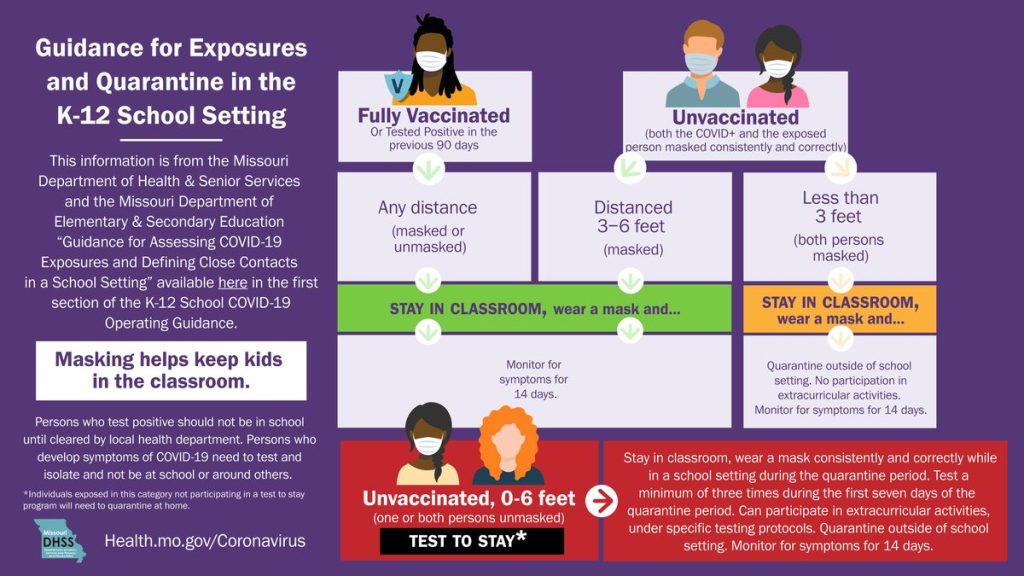
A flowchart shows current quarantine guidelines issued by the Missouri Department of Elementary and Secondary Education. The Nodaway-Holt school board voted Wednesday to deviate from the guidelines.
GRAHAM, Mo. — In a break with federal, state and local guidelines, the Nodaway-Holt R-VII Board of Education on Wednesday voted unanimously to allow students who were exposed to COVID-19 at school to continue attending class in person rather than quarantine at home.
“If you listen to (state health and education officials), and listen to everybody, they want to keep the kids in school,” said Superintendent Jeff Blackford. “Well, this is one way to do it.”
Over the past few months, guidance from the Missouri Department of Elementary and Secondary Education has narrowed the list of circumstances in which a student who has been deemed a close contact should quarantine. Currently, DESE only recommends quarantines for students who are unvaccinated and for at least 15 minutes were within six feet of someone who tested positive for COVID-19 where one of the two parties was not wearing a mask.
Last month, DESE also introduced a test-to-stay option, which allows students who would otherwise be advised to quarantine to keep attending school as long as they test negative on three rapid COVID-19 tests performed within seven days after exposure. Such students would also be eligible to participate in extracurricular activities through the Missouri State High School Activities Association as long as they test negative prior to a game or contest on the same day.
The plan unanimously approved by the Nodaway-Holt school board Wednesday, which the district is calling a “quarantine at school” option, will allow parents to decide whether their child should continue attending class in person if they have been notified their child was a close contact of someone at school who tested positive for COVID-19 — effectively eliminating quarantines for at-school close contacts.
“I don’t think it makes sense to make healthy kids stay home,” said board President Jane Hanson. “I just don’t.”
The new guidelines do not apply to exposures that happen outside of school, like in-home exposures.
If a parent decides their student will continue attending class, the student will be required to social distance at all times, or when not possible to social distance, will be required to wear a mask. In a classroom setting, that would mean moving a student’s desk six feet away from all other desks in a classroom, Blackford indicated. Those students would also undergo daily checks with the school nurse to monitor symptoms.
New Nodaway-Holt quarantine option
If student is a close contact due to exposure made at school, is unvaccinated and one party was not wearing a mask during exposure, parents may choose to have their child:
Quarantine at school
May stay in school during quarantine period. Must wear a mask when unable to social distance, and will be monitored for symptoms. Nurse check daily.
Extracurriculars: Per DESE guidelines, may stay in school during quarantine period, but must wear a mask at all times. Must also test negative three times during the first seven days of quarantine to participate in games and contests, and must be tested on the same day as a game/contest prior to the event in order to participate.Quarantine at home
Follow existing state and local health guidelines, including for extracurriculars.
“It’s much more effective than having a virtual education,” Blackford said. “And it is a choice.”
Parents will also have the option to allow their child to quarantine at home as per local health protocols.
School districts across the county — and beyond — have consistently chafed at quarantine guidance, and several local school boards have discussed the possibility of breaking with local health guidelines. During the recent spike in COVID-19 cases across the county — the worst outbreak since the throes of the pandemic around this time last year — school districts have seen significant numbers of students sent into quarantine from being close contacts, leading to a fresh round of frustration.
However, in every other district that has discussed it, school administrators have been reluctant to recommend doing so because of potential liability issues. If a child suffered negative health consequences from exposure to someone who was attending school in breach of federal, state and local quarantine guidelines, a school district that endorsed such behavior could potentially be held liable by the child’s parents, multiple superintendents have said at prior school board meetings.
Blackford told The Forum he did not consult with an attorney about potential consequences of the move, but indicated that any potential lawsuit would likely have trouble meeting the standard to show that the school district’s policy definitively caused an exposure.
In an email to The Forum Thursday, Tom Patterson, Nodaway County Health Department administrator, said he understood the frustration felt by many schools.
“State departments and officials tell the public these decisions are up to locals while at the same time floating out rigid guidance that districts and agencies are compelled to comply with by funding, good standing, regulation, statute, etc.,” Patterson said. “The state needs to either adjust quarantine guidance further so asymptomatic kids can stay in school, or actually turn it over to locals.
“…We will continue to support and work with our schools through this difficult time in every way we can, and I will keep advocating for more flexibility locally.”
Additionally, according to MSHSAA guidelines, any student who does not follow local public health agency guidance is not eligible to participate in MSHSAA-sanctioned games or contests. That means even if a school district loosens its quarantine guidelines, like Nodaway-Holt, it must be backed by the local health department for students to follow the looser rules and retain eligibility.
In order to compete in games or contests, the new guidelines from Nodaway-Holt note, students can essentially utilize the test-to-stay option offered by DESE — but will have to make their own arrangements to do so.
Under test-to-stay protocols, students can continue attending school while wearing a mask, and must be tested at least three times within the first seven days after exposure. If any of those tests come back positive, the student would need to quarantine at home. Students are allowed to participate in extracurricular games and contests if they also test negative prior to the event on the same day.
However, school board members in general expressed some misgivings about applying the test-to-stay protocols more broadly, citing concerns about the quality of the tests and the rationale behind the program.
School districts that opt into test-for-stay can receive free test kits through the Missouri Department of Health and Senior Services, along with supplemental funding of up to $200 per student and staff member in the district. The test kits allow participating schools to perform the rapid tests, which take about 15 minutes to return a result, on-site and ensure compliance with the protocols.
So far, only one district in the county, West Nodaway, is participating in the program.
Ultimately, the Nodaway-Holt board decided not to pursue that option, meaning students who intend to “quarantine at school” will have to make their own testing arrangements if they intend to participate in extracurricular games and contests.
The new policy took effect immediately.
GEOFFREY WOEHLK/THE FORUM
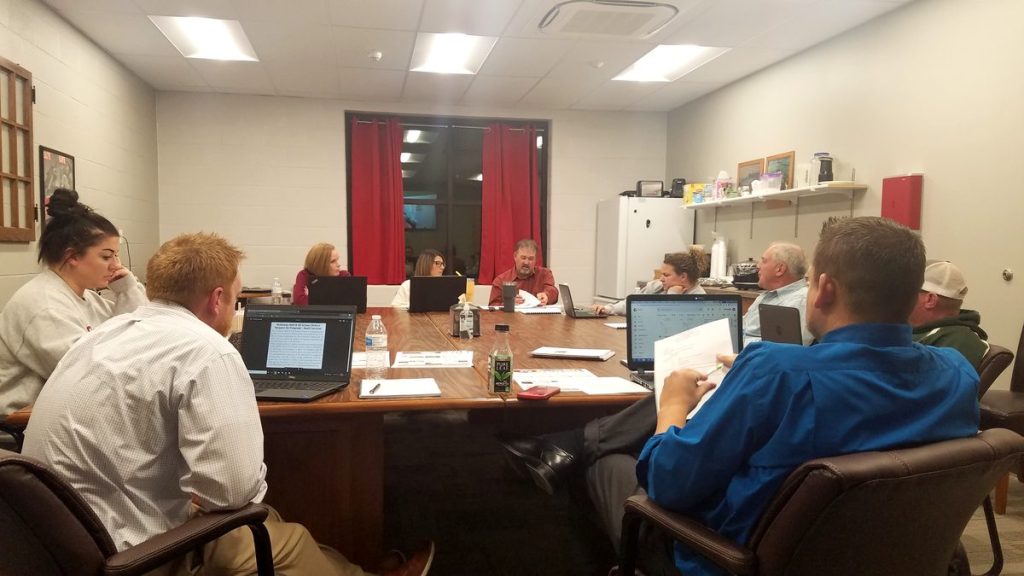
After a unanimous vote by the Nodaway-Holt R-VII Board of Education on Wednesday, parents can choose whether students exposed to COVID-19 at school should quarantine at home as advised by health officials, or return to class in person.