City plans for pilot water treatment plant next year
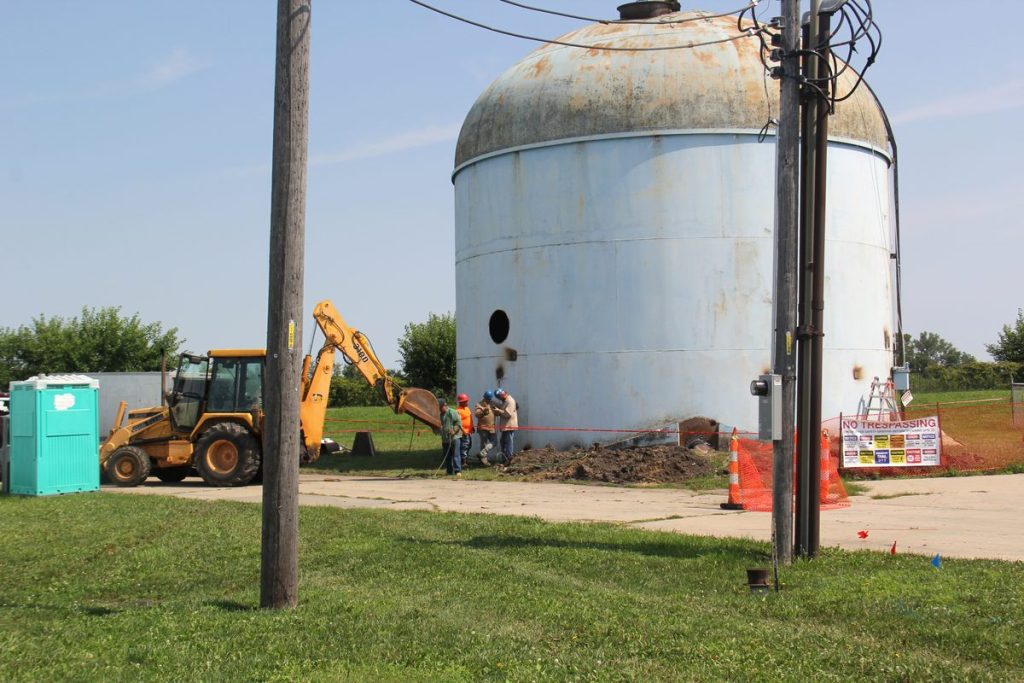
GEOFFREY WOEHLK/THE FORUM
Crews work on retrofitting an unused clearwell tank at the Maryville Water Treatment Plant in July to accommodate a granular activated carbon adsorber. The city has announced inclusion of funds in next year’s budget for a pilot water treatment plant.
MARYVILLE, Mo. — A pilot water treatment plant, which would gather necessary data to be used in the construction of a full, new treatment facility, is included in the city’s plans for next year’s budget at a cost of up to $1 million.
It would be yet another step toward building a new water treatment plant to replace the existing facility — originally built in 1959 — that has increasingly run up against its limits in recent years, unable to combat a cyanobacteria problem on Mozingo Lake that has grown more intense over the past decade.
Water treatment is one of the three prongs in the city’s comprehensive approach to combating the effects of the cyanobacteria — or blue-green algae — blooms on the lake that have caused taste and odor issues in the drinking water.
In the short-term, the city followed a recommendation from consulting firm HDR Engineering, which recommended the installation of a granular activated carbon adsorber at the existing treatment plant while the city lays the groundwork for a long-term solution.
So far, that solution has looked more and more likely to be a new water treatment plant built from the ground up for the city’s needs at Mozingo Lake. The current facility was originally constructed to handle water drawn from the One Hundred and Two River, which has led to some issues over the years.
One of the steps required by the Missouri Department of Natural Resources before constructing a new water treatment plant is first building a pilot plant, City Manager Greg McDanel said last week. The pilot plant would be used to test out different treatment methods — like using ozone, GAC and others — and fine tune them to determine the most effective strategies for use in a new, full facility.
In a City Council budget work session on Sept. 20, McDanel said the pilot plant will likely cost between $750,000-$1 million.
The draft budget expected to be approved Thursday includes $500,000 for the pilot plant, and another $500,000 will likely be set aside from the city’s $2.3 million American Rescue Plan allocation. McDanel also said the city plans to continue to partner where possible with Public Water Supply District No. 1, the city’s largest water customer, on several upcoming water-related issues, including proposed water rate increases and the pilot plant.
Both McDanel and multiple City Council members have made a point over the past few months to stress their appreciation for PWSD No. 1’s willingness to partner on projects like the GAC adsorber in use now to mitigate the more severe taste and odor issues, especially those caused by the compound geosmin. The water supply district agreed to put up $600,000 — about half the cost — for that project.
McDanel said the pilot plant would gather that data for about nine months. After that period, the city could move forward with a better idea of what a new water treatment facility would need to include.
Lake monitoring
Addressing the other two prongs of the city’s trident-like approach to its water issues, lake and watershed management, representatives from HDR briefed city officials on Monday about a proposed monitoring program at Mozingo Lake, part of a concerted effort among every level of government to come up with solutions.
The Mozingo Lake Workgroup, made up of officials from the city of Maryville, Missouri DNR, the Missouri Department of Health and Senior Services, the U.S. Department of Agriculture’s National Resources Conservation Service and the Missouri Rural Water Association, has been meeting about every six weeks for at least a year now, building action plans from multiple angles to combat the blue-green algae blooms that have affected recreation on the lake and the drinking water that comes from it.
In August, Missouri DNR announced a partnership with the U.S. Geological Survey to install a monitoring gauge in Mozingo Creek, the largest tributary to Mozingo Lake. Over the next few years, the gauge will gather data on nutrient runoff to determine how much of the increased nutrients present in the lake that cause the algae blooms may be coming from the surrounding watershed area.
At Monday’s meeting, David Carani, water quality lead at HDR, said the company is looking at a comprehensive monitoring program for the lake itself as well.
“I do think it’s important to start collecting some data soon, because I think with this whole situation, we’ve been sort of operating in an information-deficient space right now,” Carani said. “I think the more we learn about the lake, I think that’ll just make us smarter going forward.”
Data gathering has so far been the name of the game, aiming to better understand the processes in the lake that are leading to the blooms. The monitoring program proposed Monday would put several new gauges of different types at points throughout the lake and the surrounding watershed area.
The ideal monitoring program presented by Carani would cost somewhere around $72,000-$105,000 between new monitoring equipment and laboratory costs. Carani said HDR is working with Missouri DNR to identify grant funding opportunities to defray at least some of the costs, and until that picture is clearer, the city won’t be asked to take further action. But Carani said the best time to start the monitoring program would be in the spring.