Health department hears proposal for loosened K-12 quarantines
DESE
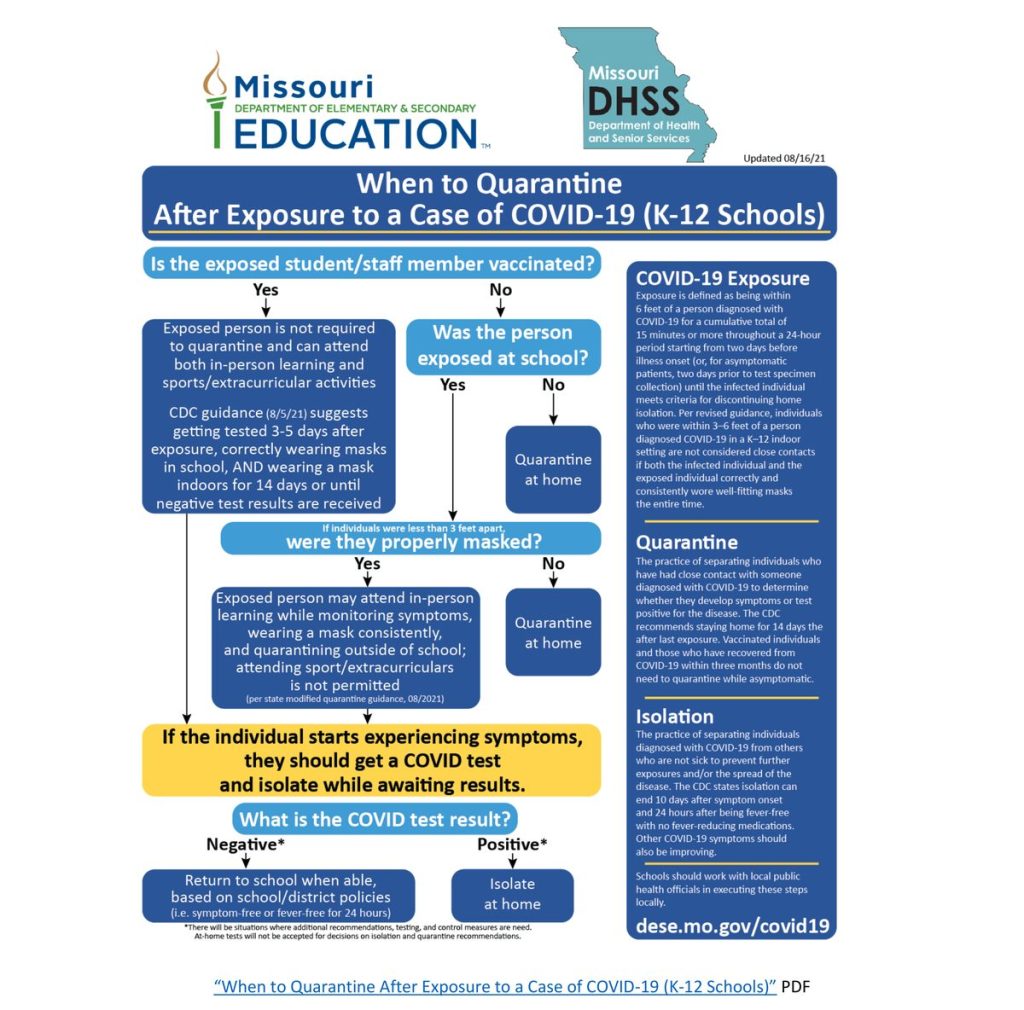
The Missouri Department of Elementary and Secondary Education has provided a one-sheet flow chart for school district guidance on quarantine protocols.
MARYVILLE, Mo. — A push to eliminate COVID-19 quarantines for K-12 students who are exposed during school appears unlikely to gain much traction with the Nodaway County Health Department board, but Administrator Tom Patterson said statewide changes in guidance could be coming soon.
At a meeting of the health department’s board of trustees on Wednesday, Nodaway County resident Isaiah Korthanke asked the board to consider adopting measures similar to guidelines in effect in Jefferson and Newton counties in Missouri, which allow school districts to exempt students from having to quarantine if exposed to someone during school who tests positive for COVID-19. In order to continue going to school despite being a close contact in those counties, students must quarantine outside of school hours, wear a mask at all times at school and not show any symptoms of COVID-19.
Over the past two weeks, Korthanke has collected more than 700 digital signatures on a petition on Change.org supporting the change, though signatures are not verifiable or required to come from Nodaway County residents.
The initiative has received plenty of support and notice from some local officials, including Nodaway County North District Commissioner Chris Burns, who appeared in front of the health department board in support of such a change.
“Basically, I hope we can keep healthy kids in school, I guess is what all of our objectives are,” Burns told the board. “Keeping everyone healthy, but keeping our kids in school is part of the reason I’m here.”
The proposed policy change would only apply to students who are exposed in school to someone who has tested positive for COVID-19 when one of the parties is not wearing a mask. The change would not apply to students who are exposed outside of school, including during extracurricular activities on school grounds, and students affected by the new policy would likely not be allowed to participate in extracurricular activities — as is the case in Newton and Jefferson counties.
Currently, all K-12 public school districts in Nodaway County follow state guidance for student quarantines. Under those policies, students deemed close contacts must quarantine at home for 10 days after exposure and may return if they do not show symptoms during that time. The Nodaway County Health Department opted to shorten the quarantine time, an option under the guidelines from the Centers for Disease Control and Prevention, to 10 days from 14 this school year.
However, if both the person who tested positive for COVID-19 and the close contact were wearing masks during the exposure that happened in school, the close contact does not need to quarantine. Further, regardless of mask status, if the close contact is vaccinated, then that student may return to school without going into quarantine — unless they show symptoms — even from a contact made outside of school.
Patterson, in a detailed explanation of the public health apparatus and the local health department’s responsibility within it, said he could not recommend his board approve a policy change that is significantly out of step with accepted state and federal standards because it would isolate the department from resources and support from the rest of the state and national public health system, and open up the county, and potentially schools, to liability issues.
Further, he said, the quarantines from in-school exposures from student-to-student have been rare in the county so far — which is the only situation the change would address — and school districts already have tools at their disposal to virtually eliminate the chance of in-school close contacts under the guidelines as they exist now.
“It starts at the CDC, it goes to the state health departments, and it goes to locals,” Patterson said of the public health system. “And we do that with food, and we do that with all of our areas where we’re working to prevent disease. We get guidance from federal authorities, where the experts are in disease and whatnot for our country — whether it’s, for food, FDA; if it’s communicable diseases like TB, and flu and COVID, it comes from the CDC — they put it out and states adopt this guidance, because that’s where all the research is, the ones who have to do all the background stuff.
“The states adopt that — some flavor of it, usually pretty similar — and then they float it out to us. And then we’re compelled by regulation to work with it.”
Patterson said Newton and Jefferson counties — the only two of Missouri’s 114 counties to break with state and federal policies, he stressed — and school districts within them, may run afoul of longstanding regulations about schools preventing people with known transmittable diseases from attending school, as well.
“So, there’s a lot of implications when you go outside of the guidance, because what you’re doing is you’re getting away from the standard of care,” he said.
That also includes opening up the county to liability issues. In fact, Korthanke had previously gone to the county commission to see if the commissioners could amend their classification last year of school staff as essential employees — who do not need to quarantine unless they show symptoms — only to be told that the commission could not help: That particular change, the commission said their attorney advised, has to match federal guidance on who is an essential employee. And any other, broader changes, like to student quarantine protocols, could open the county up to liability issues.
School boards
School boards themselves could also make the change without the backing of the health department if they wanted to. However, superintendents have been similarly hesitant to step out of line with the accepted standards.
Tim Jermain, superintendent of the Jefferson C-123 school district, told his school board Wednesday evening that the district adheres to the standards set out by the health department so that everyone on up the chain has backing for the policies they’ve put in place.
“The guidance we’ve been given, as long as we’re not reckless, we’re immune from someone saying they caught COVID at the district and suing,” Jermain said.
An example given by multiple superintendents to The Forum was the federal mask mandate that applies on all school buses. Although no school district in the county has an indefinite mask mandate in place during school, all follow the federal mandate for buses.
“(If) we said we weren’t gonna do that, then someone could come back and say, hey, my student caught COVID on the bus and something bad happened,” Jermain said. “You weren’t following the federal mandate, you were being reckless. Then, we would be open to liability.”
School districts in Nodaway County and the health department have worked extremely closely since the pandemic began, talking frequently and regularly both individually and as a group to navigate the existing guidance that can change by the day.
“I said in my report and I told our principals this: sometimes I feel like a used car salesman because I’ve told the parents something one day, and the next day we’re told something different by the department of health,” Jermain said. “It’s frustrating, that part of it’s frustrating. But, no one knows what the right thing to do is; we’re all getting through it the best we can. I will say, our county health — Tom Patterson, he’s very good to work with. They’re in a very difficult position.”
Although Jermain said Wednesday that the existing quarantine protocols for students can be frustrating, he also acknowledged that he probably would not do anything differently if he were in charge of the health department — a sentiment echoed by North Nodaway R-VI Superintendent Chris Turpin.
Over the phone last week, Turpin praised Patterson and the health department, and said that the agency’s primary goal — to keep people healthy — sometimes gets lost in the discourse.
“I think that they’re following protocols to look out for the betterment of the county as far as liability from the county, and their workers and the commissioners — all of those people — but also, ultimately, they’re following these standards hoping that it makes a difference on mitigating and stopping people from being sick,” Turpin said. “And I think that we lose sight of that, that people aren’t doing these to make one side or the other — as far as a political thing goes — upset. People do these with the intention of trying to keep people from getting sick.”
In-school transmission
And by that measure, existing protocols seem to be working fairly well, Patterson said, which is another reason making a change may not make sense. For example, as of Wednesday, no school district in the county had a single student quarantined who would have been allowed to return to school under the proposed policy changes.
In-school transmission from student-to-student, Patterson said, has been rare so far. Instead, most exposures involving students have happened at extracurricular activities or not related to school at all — and if students are exposed under those conditions, even under the policies in place in Newton and Jefferson counties, students would still have to adhere to the regular quarantine protocols.
Missouri’s guidance, Patterson said, also already carves out multiple ways to reduce in-school exposure to practically zero. Monday, for example, Patterson said a group of students at Horace Mann Elementary were exposed to a case — but because the school requires all students and staff to wear masks, under Missouri guidance, none of the students were forced to quarantine.
More masking could be one option that would significantly reduce actual transmission and close contacts, Patterson suggested, though he acknowledged that across-the-board mandates are likely too unpopular for school boards to consider putting in place at this point. Instead, he suggested more targeted approaches would work too, with masking only required in certain areas where it’s more difficult to social distance.
“If they could … incorporate things like that, it’d solve a lot of problems, even overnight,” Patterson said, remarking that he doesn’t like wearing masks either. “But what we’re running into is this situation where it’s like, well, we don’t want to wear masks and we also don’t want to quarantine.
“Well at this current state where we’re at right now, that’s just not where we’re at yet. Will we get there? Yeah, we’ll definitely get there. But we have a little while longer where we need to keep the precautions up.”
Other than South Nodaway R-IV for a short period in effect after the school closed its doors earlier this month due to too many students in quarantine, no K-12 public school district in the county has opted to put mask mandates in place this year. Most of the quarantined students at South Nodaway were exposed during an extracurricular activity, not in school, district officials said.
“Really, they could do that this afternoon and tomorrow their issue would be solved — they would have very few (quarantines), they would have very few exposures, there would be more kids playing sports because there would be less transmission in school — more of everything, more kids in the classrooms, which is what we’re talking about, you know, keeping more kids in school,” Patterson said. “And it’s right there in front of them.”
In addition, Missouri’s guidelines allow for vaccinated students to return to school and participate in extracurricular activities without going into quarantine as long as they do not show symptoms and wear a mask. Vaccinations are available for children 12 and older.
Changes coming
However, Patterson said he’s happy to pass on all feedback to the state level, and is in favor of changes to loosen the quarantine protocols for students.
“Nothing sits on my desk; I send it right up, because they need to know what’s going on out here,” Patterson said Wednesday. “Because we are the eyes and ears. Because like I said, we are a part of the whole system of public health.”
One of the changes Patterson is in favor of, and has lobbied for with state officials, is a change to the policy that requires both a close contact and someone who tested positive for COVID-19 to be wearing masks in school in order for the close contact to be exempt from quarantine.
“I’m advocating for a single-mask option because it would help kids that want to participate avoid quarantine,” Patterson said. “Because right now, you go right into a school situation and get quarantined even though you’re trying to wear a mask and protect yourself.”
But he doesn’t recommend his county health board make that change unilaterally without the state’s protocols changing.
And Patterson said state officials have indicated changes to Missouri’s guidelines are coming this month. In a conference call with local public health agencies last week, Patterson said, state officials said to expect significant changes within the next couple of weeks.
On Wednesday, the health department board took no action on the proposed policy.
By GEOFFREY WOEHLK The Forum
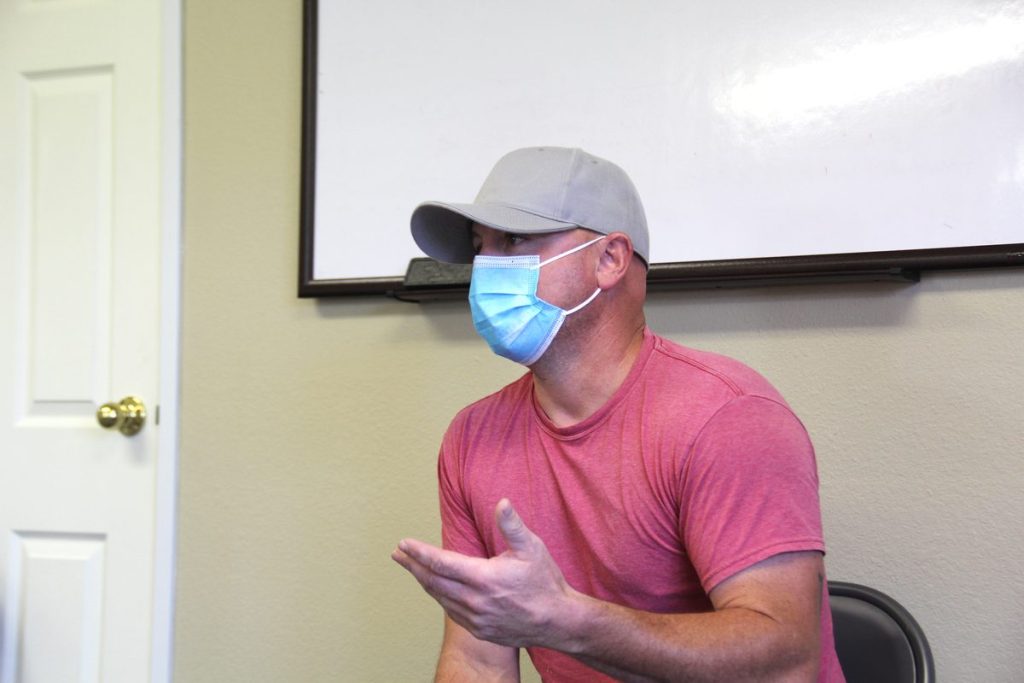
Isaiah Korthanke presents his case to the Nodaway County Health Department board Wednesday, asking board members to consider allowing K-12 students to return to school if they are deemed a close contact of someone who tested positive for COVID-19 as long as the close contact shows no symptoms and wears a mask.
By GEOFFREY WOEHLK The Forum
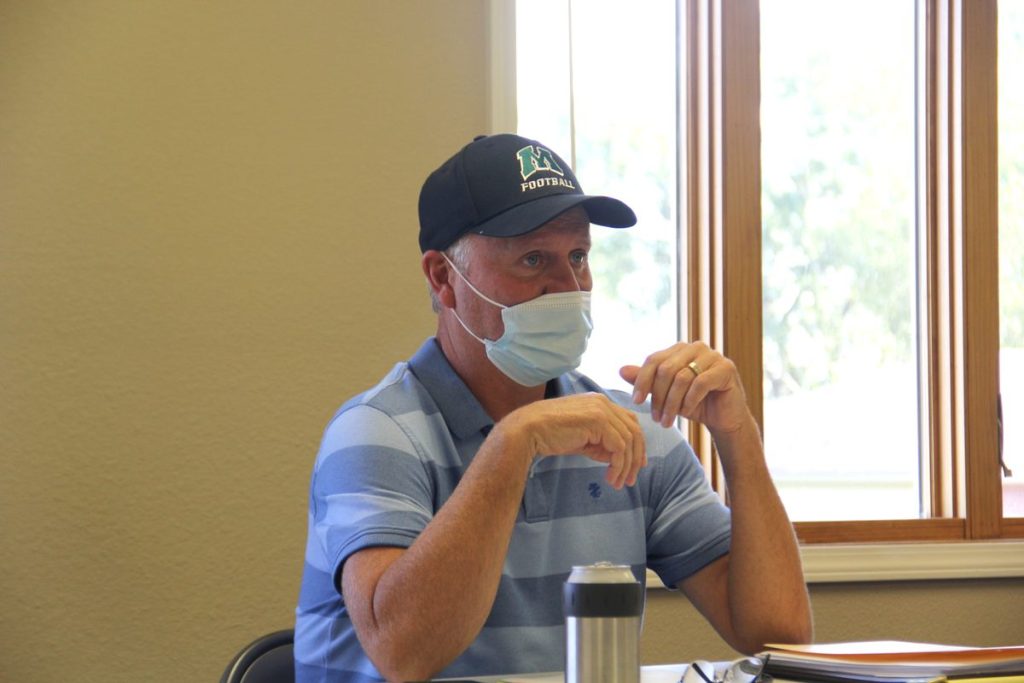
Chris Burns, Nodaway County North District Commissioner, attended Wednesday’s health department board meeting in support of the looser protocols.