Vaccinations trending up, health officials prep for booster shots
CENTERS FOR DISEASE CONTROL AND PREVENTION
Coronavirus Cancellations
MARYVILLE, Mo. — Vaccinations are up slightly in Nodaway County, crossing the 300 mark over a 7-day period for the first time in several weeks.
As of Aug. 17, the number of Nodaway County residents who have completed a vaccination regimen rose to 8,316, according to the state’s online vaccination dashboard. More than 9,200 residents have at least initiated a vaccine regimen, and over the past seven days, 334 doses have been administered in the county. Overall, about 39.2 percent of county residents have been fully vaccinated, and 43.7 percent have initiated a vaccine regimen.
At Wednesday’s Nodaway County Health Center Board of Trustees meeting, health department Administrator Tom Patterson said he’s seen demand for vaccines tick back up recently, and advocated for working to encourage people on an individual level to get vaccinated.
“My thought on that is, there’s a whole lot of people out there in the middle,” Patterson said. “There’s people on the other side of that that won’t get a vaccine no matter what. Honestly, I don’t know how much energy you should spend on that. But there’s a lot of people in between that just, for various reasons, haven’t decided. So that’s what I mean, we’re getting them one at a time, and they’re talking to each other and they’re getting (vaccinated).”
Although cases have been on the rise over the past month, Patterson said they haven’t risen as high as he’d feared they might, though the return of college students and in-person K-12 classes could exacerbate transmission of the more contagious delta variant.
“We have yet to see the major spike that we anticipated,” Patterson said. “I don’t know how major it’s going to be. I don’t think it’s going to be as major as last year, hopefully, but we’ll see. I think we’re in a little better shape going into this situation.”
Last year at this time, the county was entering a period of the highest case levels recorded to that point. Active cases started to rise sharply in the middle of the month, hitting 62 on Aug. 18, 2020, on a march toward a seasonal peak of 275 on Sept. 2, 2020.
This year, active cases have hovered between 50 and 70 for about a month now. The most recent data released by the health department, as of Aug. 16, showed 66 active cases in the county, and two hospitalizations. The 31 deaths reported, for the first time in several weeks, remains unchanged.
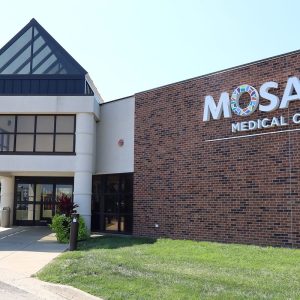
Barbara Mullock, infection prevention specialist at Mosaic Medical Center – Maryville, said that as of the early morning of Aug. 18, one patient was hospitalized for COVID-19 in Maryville and 43 across the Mosaic system.
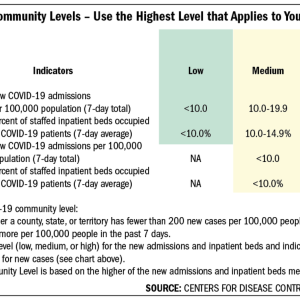
According to data compiled by the Missouri Department of Health and Senior Services, the transmission rate in Nodaway County remains high: the 7-day positivity rate as of Aug. 17 was 13.9 percent, and the 7-day rate of new cases per 100,000 people was at 194.6. The CDC defines an area with high transmission to have a positivity rate of more than 10 percent and a new case rate per 100,000 of more than 100. Only two counties in state fall short of those criteria: Schuyler and Scotland counties in northeast Missouri, both of which meet the standard for moderate transmission.
In areas of moderate or high transmission, the CDC recommends that all people regardless of vaccination status wear face coverings indoors to help mitigate the spread of the virus.
Booster shots
Health officials and the U.S. Department of Health and Human Services announced Wednesday that pending an independent evaluation by the FDA, vaccine booster shots may begin to be offered beginning the week of Sept. 20. Acting on data gathered from areas of the U.S. and other parts of the world, the move to give booster shots to those who have already been vaccinated is intended to head off a possibility that the existing vaccines’ efficacy could begin to wane soon.
According to the joint statement by HHS public health officials and medical experts, the data gathered “make very clear that protection against SARS-CoV-2 infection begins to decrease over time following the initial doses of vaccination, and in association with the Delta variant, we are starting to see evidence of reduced protection against mild and moderate disease.”
The fear, they said, is that especially for high risk patients, the effectiveness of the vaccines’ protection against severe disease, hospitalization and death could diminish further in the months ahead.
“For that reason, we conclude that a booster shot will be needed to maximize vaccine-induced protection and prolong its durability,” the statement said.
Booster shots are anticipated for all vaccine recipients: Pfizer, Moderna and Johnson and Johnson, but booster shots for Johnson and Johnson recipients will not be available until more data can be gathered. Health officials expect that to take at least a few more weeks.
For Pfizer and Moderna vaccine recipients, a booster shot won’t be recommended until eight months after an individual’s second dose. If booster shots do indeed begin on Sept. 20, only people vaccinated prior to mid-January would be immediately eligible. The first vaccine was administered in Nodaway County on Dec. 22, 2020.
In the statement, health officials indicated a booster rollout is likely to follow a similar pattern as the initial vaccination rollout last year: becoming available first to the most vulnerable.
Administrator Patterson said his local office started receiving information about booster shots yesterday, and is still “digesting” the guidance, even as it changes by the hour.
Quarantine policy
The Nodaway County Health Department last week announced a shift in its policy for COVID-19 quarantine.
The department has reduced the recommended quarantine time for close contacts from 14 days to 10 days. The CDC still recommends a 14-day quarantine for any close contact who has not been vaccinated, but allows for local authorities to shorten quarantine times to 10 days at their discretion.
Vaccinated individuals do not need to quarantine if they don’t show symptoms, but should be tested 3-5 days after exposure and wear a mask indoors for 14 days even in low transmission areas, or until their test result is negative.
The shorter quarantine standard, Administrator Patterson said, brings the county in line with all surrounding counties. The different lengths, he said, had led to confusion and anger in some cases, especially at schools in the county that used longer quarantine times than their counterparts in other areas of the state.
The potential for developing COVID-19 also falls off significantly around day 9 or 10 after exposure, Patterson added.
Vaccination data note
Starting this week, The Forum has begun using new, more accurate 2020 U.S. Census data in vaccination population calculations. Because the new figures showed a significant decrease in the population of Nodaway County, the vaccination percentages reported by The Forum may be higher than other sources that continue to use the 2019 U.S. Census estimates, including the state data posted to the DHSS online vaccination dashboard.